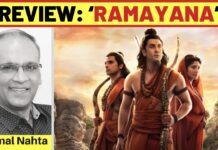


















Double Negative, Monster Mind Creations and Prime Focus Studios’ Ramayana is based on Indian epic Ramayan. To be made in two parts, this one starts from the childhood of Lord Rama and ends with the kidnap of Sita by Ravana. The second part (to be released two years later) is expected to begin where the first one ended — with the killing of Jatayu at the hands of Ravana and its immediate aftermath.
The story of Ramayan is, of course, too well-known and supremely interesting and engaging. It has been adapted by Shridhar Raghavan and Nitesh Tiwari, both of who have also jointly written the screenplay. The screenplay is interesting, of course, but it seems a bit scattered at times. That’s because several scenes have been merely touched upon instead of being elaborated. For those who know the Ramayana, this may not pose a serious problem, but it does disturb the viewer when he sees things being rushed up. On the other hand, there are portions when the drama takes a dip and loses its grip on the audience. There are several scenes in which the emotions touch the heart and will make the viewers cry, but there are some scenes in which the emotions could’ve been more underlined and pronounced. One such fulfilling emotional scene is the interaction between Rama and Kaikeyi when the former is leaving, with Sita and Laxman, for the jungle. The entire sequence of Rama, Sita and Laxman leaving Ayodhya tugs at the heart strings and will evoke tears from the eyes of the weak-hearted. However, the build-up to that sequence looks hurried. The emotional quotient is low in scenes showing the three living in the jungle for 14 years. That’s because there are more visuals in the jungle scenes and less dialogue drama between the threesome. There are a couple of other scenes which bring a lump in the throat of the viewers. The best part of the screenplay is that the audience enjoy the experience of moral values of the highest order when they see characters like Rama and Sita interacting with the other characters of the drama. Also, since there’s so much faith and divinity attached to the epic Ramayana, the viewers watch the drama unfold with a lens that’s quite different from that used for other films.
The first half will appeal more to the ladies audience while the menfolk will like the post-interval portion better. Of course, the opening of the drama (about 20 minutes at the start) is mind-numbing. The audience get a feel of the never-before-experienced mounting of the film and the superb computer graphics and visual effects. The climax, in which Jatayu fights with Ravana in a bid to save Sita from his clutches, is extraordinary. Also superb is the outburst of a distraught Rama when he challenges his destiny.
All in all, although there are many plus points in the screenplay, it is also true that Shridhar Raghavan and Nitesh Tiwari should have written a tighter and more heart-touching drama which would have evoked the feelings of divinity among the viewers. It does appear to the viewer that grandeur and visual appeal are far more overpowering than the drama.
Dialogues, penned by Nitesh Tiwari and Shreyas Jain, are excellent at places, but not consistently so. Also, liberties have been taken at several places, in the language used.
Ranbir Kapoor plays Rama wonderfully. In spite of not having the scope to indulge in theatrics for almost the entire film, he acts with so much dignity and class that he brings alive the character. He uses his facial expressions and body language very effectively. In short, he looks and plays Rama wonderfully. Sai Pallavi is natural in the role of Sita. She may not look extraordinarily beautiful (which is what the audience would expect Sita to be) but her sober acting will win her fans. Yash is extraordinary as Ravana. His physique is to die for, and his acting is simply terrific. He literally owns the screen when he comes on it. Ravie Dubey is endearing in the role of Laxman. His acting is mature. Arun Govil lends remarkable support as Dashrath. Anupam Kher’s voice acting for bird Jatayu is pretty impactful. Rakul Preet Singh looks bewitching and acts ably as Surpanakha. Vivek Oberoi has his moments as Surpanakha’s husband, Vidyutjeev. Lara Dutta is realistic as Kaikeyi. Sheeba Chaddha delivers a noteworthy performance as Manthara. Kajal Agarwal gets limited scope as Mandodari but she stands her own. Shobana also hardly gets scope to perform in the role of Kaikesi but she is good. Indira Krishnan (as Kaushalya) and Sonal Jha (as Sumitra) are adequate. Kunal Kapoor (as Indra), Adinath Kothare (as Bharat), Ajinkya Deo (as Vishwamitra), Saurabh Sachdeva (as Mareech), Shishir Sharma (as Vashisht), Mukesh Tiwari (as Agastya) and Faisal Malik (as Kumbhakarna) make their presence amply felt with able performances. Raghav Juyal (as Meghnad), Harish Uthaman (as Vibhishan), Ayrton Malhotra (as young Dashanan), Nitish Sharma (as Shatrughan), Kanchan Chetal (as Tadaka), Sonia Balani (as Urmila), Geeta Aggarwal (as Anusuya), Danishk Dadiach (as young Rama), Rhyah Narsimhan (as young Sita), Samar Birje (as young Laxman), Vidhaan (as young Bharat), Hridansh (as young Shatrughan), Dishita Sehgal (as young Surpanakha), Hridyansh Gokani (as young Kumbhakarna), and the rest do as desired.
Nitesh Tiwari’s direction is good but it could’ve been better. He has probably got bogged down by the need to capture the grandeur. A.R. Rahman’s music is good but it is disappointing for a film of this scale. It should have comprised super-hit songs but they are missing in the film. Jai jai Ram song is a hit but that’s not part of the film except in the end rolling titles. Dr. Kumar Vishwas’ lyrics are of a fine order. Shiamak Davar’s choreography is fantastic. Background music, composed by Hans Zimmer and A.R. Rahman, is outstanding. Pankaj Kumar and Mahesh Limaye have done an outstanding job of the cinematography. Computer graphics and visual effects are of the kind never before seen in Hindi films. They match the high Hollywood standards. Action and stunt scenes (choreographed by Guy Norris and Terry Notary) are phenomenal. Production designing (by Ravi Bansal, Ramsey Avery, Amit Ray, Subrata Chakraborty and Sayali Naikwadi) is fantastic. Huzefa Lokhandwala’s editing is sharp.
On the whole, Ramayana is just too grand and it has extraordinary computer graphics and VFX of the kind never before seen on the Hindi screen. Because of the faith factor attached to epic Ramayana, people of all age groups will make a beeline for the cinemas to watch the film. In fact, that’s the reason for the extraordinary start in spite of the film having been released in the terribly dull pre-Diwali days. It also has repeat value. Many will watch the film due to the FOMO (Fear Of Missing Out) factor. The FOMO factor will add crores of rupees to the revenues of the extravaganza. Whatever the reason, the film will do extraordinary business and will recover its cost of Rs. 1,100 crore (Rs. 1,500 crore including publicity abroad). Business in Overseas will also be huge because it has been released abroad like any big-budget Hollywood film, a first for an Indian film.
Released on 5-11-’26 at Inox (daily 21 shows) and other cinemas of Bombay thru Dharma Productions. Publicity: outstanding. Opening: terrific (despite the release during the very dull pre-Diwali days). …….Also released all over. Opening was extraordinary at many places.