




























LAJJA
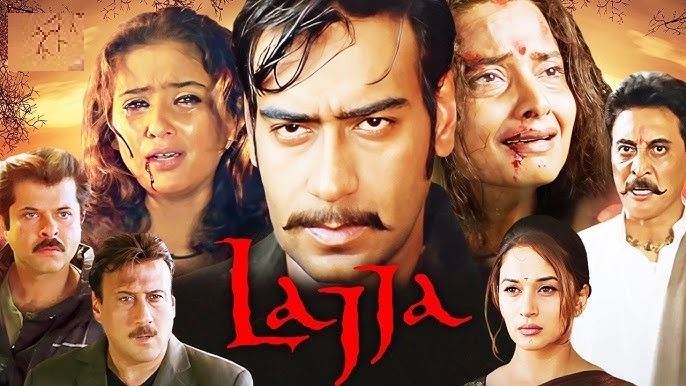
Santoshi Productions’ Lajja is a film of four episodes, all of which highlight the plight of women in the male-dominated Indian society. The story is sought to be conveyed through the journey of an Indian woman (Manisha Koirala) who flees New York from her flirtatious Indian husband in order to save her life and, more importantly, the life of the child in her womb. She comes to India and her journey takes her to three completely different women — each of them troubled and exploited due to the orthodox beliefs and the norms of society.
The first woman she meets is a victim of the dowry system. This woman (Mahima Chaudhry) revolts rather than succumbing to the system and asks her groom and to-be in-laws to get out of the wedding venue.
The second lady who Manisha encounters is a bold and brash nautanki actress in a village. She is carrying the child of her beloved. The guy has promised to get married to her. He, however, deserts her. In a fit of frustration, she questions the sanctity of Sita’s agnipariksha demanded by the people of Ayodhya and Ram’s bowing down to their wish, while enacting the role of Sita in a stage-play. For this act of sacrilege, she is beaten up so brutally by an irate mob that she loses her unborn child.
The third lady is a village midwife who is trying to uplift the lot of the womenfolk in her village. A rich and evil village lord rapes the midwife and burns her to death because her son is in love with his daughter.
While these three different stories, completely unrelated to each other, unfold on the screen, Manisha is being trailed by her husband (Jackie Shroff) who is desperate to get his child when he is born, so that the family name can continue. His desperation is born out of the fact that after impregnating his wife, Jackie has met with an accident which has rendered him impotent.
While Rajkumar Santoshi’s story idea is good, his screenplay leaves a lot to be desired. For one, the main reason for Manisha leaving her husband (because he flirts with other women) is not solid enough for the audience sympathy to go to her. Jackie comes across as a fun-loving guy rather than a sex-hungry bed-hopper, because of which Manisha’s extreme step of breaking her marriage does not win her sympathy. Then, while Jackie is shown to be ultra-modern in his thoughts, he is also orthodox enough to be wanting to have a male heir at any cost. But what if his wife would deliver a baby girl? No thought is given to that!
The trail of Jackie looks childish as Manisha keeps escaping easily. Since Manisha’s character is the thread which runs through the three other episodes, her running away and her husband’s trail should have been more eventful by itself. Madhuri Dixit questioning Sita’s agni pariksha also does not have the desired impact, if only because she herself is not a symbol of virtue. She drinks alcohol, uses swear-words and, to top it all, is pregnant without being married. In Mahima Chaudhry’s episode, the portrayal of the humiliation faced by a girl’s father during her marriage has been stretched to ridiculous levels. That portion is too lengthy to be true.
Coming to Rekha’s episode, the problem highlighted is the orthodox mindset of males in the village. The solution lies in changing that mindset but the ladies of the village seem to think that a computer, which Rekha has bought, is the panacea for all the ills! What can a computer do to overnight change the thinking of illiterate men?
Another problem with the drama is that since it tackles women’s problems, men have been shown in such poor light that many among the male audience may not like the film. While some women would adore the drama and applaud the revolution brought about by the women-characters in the film, there would be others who would find it too much to digest.
The aforesaid flaws and weaknesses notwithstanding, the film also boasts of some exceptional scenes. The one in which Mahima revolts against her in-laws is the best scene in the film and is sure to be applauded in cinemas all over. Madhuri’s revolt would meet with mixed reaction. Some dialogues (Rajkumar Santoshi and Ranjit Kapoor) have been brilliantly written. The film has quite a bit of shock value and is also novel in thought and content.
Rekha does a fantastic job, living her character. She goes through her part with all the sincerity at her command. But her rape was unwarranted. Anil Kapoor, coming in Mahima’s episode, is wonderfully likeable. He easily endears himself to the audience, playing to the gallery with aplomb. Jackie Shroff looks terrific and acts quite well. Madhuri Dixit is mind-blowing. Her portions are a delight to watch and will hold special appeal in Maharashtra. She shines in light scenes and is extraordinary in the dramatic scenes in which she loses her unborn child as she is beaten and trampled upon by a crowd that goes berserk. Ajay Devgan, as the messiah in Rekha’s village, has the most mass-appealing role among heroes. His dialogues are clapworthy. His performance, though, could have been more effective. Ajay looks quite weak physically.
Manisha Koirala is miscast. Being the central character of the film, a heroine more worthy of winning audience sympathy was the demand. She neither evokes sympathy nor acts very effectively. Her long lecture in the climax is hardly impactful. Mahima Chaudhry is good. Her wedding mandap scene is simply splendid. Samir Soni has little to do.
Danny Denzongpa is effective. Govind Namdev leaves a mark with a polished performance. Rohini Hattangady is natural. Johny Lever is quite funny. Tinnu Anand does a fine job. Gulshan Grover, Suresh Oberoi, Jagdeep, Asrani, Anjan Srivastava, Farida Jalal, Ritu Shivpuri, Beena, Viju Khote, Trilok Mallik, Pushpa Verma and Brij Gopal lend fair support. Razak Khan gets limited scope. Nasir Khan irritates. The rest of the cast fits the bill.
Rajkumar Santoshi’s direction is not up to the standards set in his earlier endeavours. The film looks like a rush job at places. Of course, some sequences have been brilliantly shot but the overall impression is not that of a quality product. Editing is so poor that it almost seems, Santoshi had fallen in love with his work and was, therefore, reluctant to chop off unnecessary scenes. The film could easily do with re-editing by at least 20 minutes.
Music (Anu Malik) is a letdown. ‘Badi mushkil’ is well-tuned and its picturisation is also nice. ‘Aaeeye’ strikes more for its stylish picturisation (on Urmila Matondkar) than the tune. ‘Mujhe saajan ke ghar’ is fair (picturised on Sonali Bendre). ‘Kaun dagar’ is boring despite Lata’s excellent rendition. Background music (Dr. Ilaiyaraaja) is very appropriate.
Madhu Ambat’s camerawork is neat and effective. Action scenes (Bhiku Verma and Pappu Verma) are fairly exciting. Sets are proper. Production values are okay.
On the whole, Lajja will meet with mixed response. It will do well only in U.P., Bihar and parts of Maharashtra but will find the going tough in the rest of the country. Its heavy price will see most of its distributors sad and in the red.
Released on 31-8-2001 at Metro and 20 other cinemas of Bombay thru V.I.P. Movies. Publicity: very good. Opening: below the mark. …….Also released all over. Opening was not appropriate in most of the circuits but was good in U.P.
LATEST POSITION
…………
Dil Chahta Hai 3rd week Bombay 60,80,975 (83.56%) from 14 cinemas (7 on F.H.), total for 3 weeks 1,92,38,596, excellent; Ahmedabad 31,487, Jamnagar 35,044; Pune 17,93,619 from 4 cinemas, Solapur 96,477; Delhi 65,97,131 from 12 cinemas (1 on F.H.); Kanpur 1,41,926 from 2 cinemas, Lucknow 4,10,161, Agra 1,72,000, Varanasi 99,221, Allahabad 86,827; Calcutta 3,71,543; Nagpur 1,66,113 from 2 cinemas, Jabalpur (6 days) 52,629, Amravati 92,963, Akola 43,563, total 2,44,484, Raipur (6 days) 64,320, Jalgaon 48,380, 1st week Yavatmal 81,023; 3rd week Bhopal 1,00,220 (1 unrecd.); Jaipur 1,46,250 (24.20%), Ajmer 38,934; Hyderabad (gross) 6,52,715 from 3 cinemas (2 in noon, 2 on F.H.); 2nd week Davangere 1,65,817.
Gadar Ek Prem Katha 11th week Bombay 11,87,200 (43.31%) from 8 cinemas (10 on F.H.), total for 11 week 5,65,40,726; Ahmedabad 3,01,255, Jamnagar 41,487 from 2 cinemas (1 in matinee); Pune 6,36,496 from 3 cinemas, Solapur (matinee) 33,254; Delhi (TF) 51,08,610 from 16 cinemas (1 on F.H.); Kanpur (6 days) 1,74,056 from 2 cinemas, Lucknow 2,13,984, Agra 1,78,000, 10th week Varanasi 1,30,986, 11th week Allahabad 65,000, Bareilly 98,685; 10th week Calcutta 2,55,700 from 2 cinemas; 11th week Nagpur 1,28,610 from 2 cinemas, Jabalpur (6 days) 74,943, Amravati 62,270, Akola 74,269, total 18,12,867, share 14,23,202, Raipur (6 days) 64,336, Jalgaon 77,925, total 21,78,215, 6th week Gondia (gross) 88,857, total 7,09,089; 11th week Indore 86,000 (1 unrecd.), Bhopal 1,17,116; Jaipur 1,64,425 (28.10%), Ajmer (gross) 1,17,445; Hyderabad (gross) 4,31,250 from 2 cinemas (1 on F.H.).
MUKTA ARTS NOMINATED FOR ET AWARDS
The Economic Times has nominated Mukta Arts Limited for its Emerging Company of the Year award for 2000-2001.
Meanwhile, Mukta Arts is preparing to celebrate the directorial silver jubilee of its creative head and chairman, Subhash Ghai, on 24th October with the launch of three films. Of the three, one film will be directed by David Dhawan. The other two will be directed by Satish Kaushik and Abbas Mustan. One more film will be helmed by Ghai himself.
‘MUJHE KUCCH KEHNA HAI’ 100 DAYS
Vashu Bhagnani’s Mujhe Kucch Kehna Hai, which introduced Tusshar as the hero opposite Kareena Kapoor, is completing 100 days of its run all over today (1st September). Satish Kaushik has directed the film co-starring Rinke Khanna, Dalip Tahhil and Amrish Puri. Music: Anu Malik.
PRODUCER, NOT SPONSOR, IS COPYRIGHT OWNER OF SERIAL: SUPREME COURT
In what could be termed a landmark decision for TV serials, a Supreme Court bench recently upheld the lower courts’ decision that the producer — and not the sponsor — is the copyright owner of a TV serial. The bench comprising Justice S. Rajendra Babu and Justice Doraiswamy Raju on 13th August dismissed a special leave petition (no. 679 of 2000) filed by sponsor Vicco Laboratories, challenging a high court decision that it was producer S.S. Oberoi who owned the copyright of the comedy serial, YEH JO HAI ZINDAGI, sponsored by Vicco.
The immensely popular serial, starring Shafi Inamdar, Swaroop Sampat, Rakesh Bedi and Satish Shah, debuted on Doordarshan in 1984-85 and went on to record a viewership of 93%. Its broadcast was stalled abruptly following litigation initiated by Vicco Laboratories.
‘TUM BIN…’ STARS AT JWALA, AGRA
The male lead stars of Super Cassettes Industries and Anubhav Sinha Productions’ Tum Bin… — Priyanshu, Himanshu and Raakesh — attended a special screening of the film at Jwala cinema in Agra on 27th August. The show was well-attended by local dignitaries. It was organised by Haqeekat Rai Malhotra, Rajnish Malhotra and Rachit Malhotra of Jwala cinema, all of who played perfect hosts to the three heroes. The crowds at the luxurious cinema also accorded a very warm welcome to the heroes from Bombay.
The film has been released in Delhi-U.P. by Bobby Art International.
WHY SHOWS WERE CANCELLED IN BOMBAY
Matinee shows of Lajja in some cinemas of Bombay city and suburbs were cancelled on Friday (31st August) for a reason so silly that one would find it difficult to believe it! The prints of Bombay arrived from Hyderabad on Friday morning and got further delayed while coming out of the cargo section of Bombay airport. Rather than delivering the prints to the various cinemas from the airport itself, the V.I.P. representative, who had gone to collect them, first took all the prints to V.I.P.’s office in Naaz building! From Naaz, the prints were sent to the cinemas. This additional exercise must have easily taken an extra hour-and-a-half. By the time the prints reached some cinemas, it was past the matinee show time. Such cinemas, mostly in far-off suburbs, therefore, had to cancel their matinee shows and refund monies to the patrons.
The cancellation was, therefore, more because someone did not use his common sense, nothing more than that! As they say, common sense is most uncommon!!
Prints in different parts of Maharashtra also reached late and cinemas had to cancel one or two shows on Friday.
PRODUCERS’, WORKERS’ NEW UNDERSTANDING
A number of issues of mutual interest were resolved at a joint meeting of representatives of producers’ organisations and the Federation of Western India Cine Employees (FWICE) on 3rd June. The following main decisions were taken:
(i) No producer will employ a non-member of an FWICE-affiliated Association in his film unit. Likewise, no worker, technician or artiste will work with a producer who is not a member of a producers’ Association.
(ii) In case of violation of terms of contract between the producer and worker/technician, a joint dispute settlement committee of the producers’ Associations and the FWICE will be the arbitrator.
(iii) The FWICE, in an effort to increase punctuality, would inform all the crafts Associations that a part of the basic wage of a worker, musician or dancer etc., will be deducted in case he arrives late for shooting or recording.
(iv) On the suggestion of the Cine Singers Association (CSA), it was decided that the singers’ shift will be of 4 hours. If the recording goes on beyond 4 hours, they will be paid overtime. An allowance of Rs. 50 and a night allowance of Rs. 50 will also be paid to them.
(v) It was decided to change the shift timings with effect from 1st July, 2001 as follows: 10 a.m. to 2 p.m.; 4 p.m. to 8 p.m.
Background for 7 hours – 10 a.m. to 6 p.m.
Background for 10½ hours – 10 a.m. to 9.30 p.m.
(vi) Musicians will report at stipulated time with 15 minutes’ grace on either side. In case any musician comes late beyond that time, it was decided to either deduct the wages proportionately from the basic wages and/or send him back.
(vii) Music directors should inform the producer and Cine Musicians Association in writing about the detailed list of musicians together with their remuneration, one day in advance, and, in case of emergency, within 8 hours.
(viii) It will not be compulsory to have live recording for background music, and dubbing of different tracks for different musicians will be allowed even for background.
(ix) Dates to be fixed for meeting with music directors and musicians to sort out various irritants.
(x) It was clarified that the messengers are entitled to get only one-time payment per song irrespective of the fact whether the same is recorded in one day or any number of days and they cannot charge per day of recording.
(xi) Hire charges of electronic musical instruments should be firmly fixed. It was decided to have a joint meeting with Cine Music Directors Association and Cine Musicians Association to take a final decision in the matter.
(xii) The producer will be allowed to hire junior artistes and dancers from outside, only after the Junior Artistes Association, the Mahila Kalakar Sangh and the Cine Dancers Association is unable to fulfil his requirement. The FWICE will instruct the abovementioned Associations to desist from stopping the shootings of TV game shows and chat shows. The letter regarding 30% requirement to be filled by the JAA and MKS members will be withdrawn.
(xiii) The workers will be paid 2½ shift charges, instead of the usual 1½, while shooting abroad. However, a final decision on this will be taken soon.
(xiv) On producers’ assurance that singers would be paid within 24 hours of completion of recording, the CSA withdrew its demand of 10% service charge.
Surinder Kapoor, Yash Johar, Yash Chopra, A.G. Nadiadwala, Shakti Samanta and Anil Nagrath represented the producers’ Associations while Prakash Verma, Rock Gonsalves, Baldev Malik, Opender Chanana, Khayyam and Ashwin represented the FWICE at the meeting, chaired by Pahlaj Nihalani. It was held at A.G. Nadiadwala’s residence.
ASHOK CHOUDHARY ELECTED INDORE CINE CLUB CHIEF
Ashok Choudhary was elected president of the Cine Club of Indore, and Anwar Khan, vice president. Elections of the Club were held on 25th August in Indore. Ashok Choudhary also bagged the highest number of votes, 91. Anwar Khan got 61 votes. The total number of votes polled was 139, of which two were invalid.
Hemant Vyas (87 votes) and Mahesh Sharma (64) were elected hon. secretary and joint secretary respectively. Vikrant Kapde (62) was elected games secretary. Manoj Jain (72) was elected treasurer. The other members elected were Ashutosh Shukla (61), Sunil Choudhary (81), Sandeep Jain (91; highest with Ashok Choudhary), Vasant Laddha (80), Satyanarayan Gupta (61) and Aditya Chowksey (80). Although the committee comprises 11 members, there will be 12 members this time because there was a tie between three persons, on the 10th, 11th and 12th positions, viz. Anwar Khan, Ashutosh Shukla and Satyanarayan Gupta, all of who bagged 61 votes. Rather than elect two on the committee, all the three were elected and two, instead of three, were co-opted. The co-opted members are Pradeep Narsariya and Jitendra Joshi.
Those who lost the elections were: Ashish Goyal, Harish Dawar, Raju Kapoor, Sitaram Gupta, Satnam Singh, Girdharilal Agarwal, Sushil Patni, Sudhir Agarwal, Vinayak, Jagdish Advani and Ashok Sharma.
ASIT SEN NO MORE
Noted Bengali and Hindi film director Asit Sen passed away on 24th August in Calcutta following a cardiac arrest. He was 79 and is survived by his son, Partho.
Born in Dhaka in 1922, Sen became a director with the Assamese film, Biplabi, in 1948. He made his first Bengali film, Chalachal, in 1956. In the same year, he made his debut in Hindi films with Parivar which was produced by his mentor, Bimal Roy.
Sensitive and reclusive by nature, Asit Sen is best remembered for his Bengali film Uttar Phalguni which he later remade in Hindi as Mamta (1966). Both the versions starred Suchitra Sen and were critical and commercial successes. He remade another of his Bengali classic, Deep Jele Jaai, as Khamoshi in 1969. The next year, Sen directed Safar which was a remake of his first hit, Chalachal.
In a career spanning about half a century, Sen worked with some of the best artistes from Calcutta and Bombay, including Ashok Kumar, who Sen repeated in a number of his films, Suchitra Sen, Nutan and Jaya Bachchan.
Never the one to fight shy of taking the less-travelled road, Sen at times experimented, choosing unusual themes for some of his films. The entire story of his Anokhi Raat (1968) takes place over just one night. Khamoshi (1969) and Annadata (1972) are two other examples of Sen’s experimental streak.
Asit Sen was also responsible for giving roles completely different from their established image to actors like Rajesh Khanna in Safar; Dharmendra, who played an idealistic professor in Sharafat (produced by Madan Mohla in 1970); and Dilip Kumar, who Sen gave a triple role in the 1976 film, Bairaag (produced by Mushir Alam and Mohammed Riaz).
YOU ASKED IT
Do awards or inclusion of a film in international film festivals help its box-office prospects?
– Not in India. The box-office in India is insensitive to awards and film festivals.
Why is the film industry called the most speculative industry in the world?
– Because there’s no set formula for making a successful film. Each film is an individual case and it is impossible to scientifically predict its fate even after it is complete. The audience decide whether a film will run or not but audience tastes differ from time to time.
Do producers of star-cast films manage to recover their entire cost of making a film and also make profit before release?
– Generally, yes, but Rajiv Rai has made a loss in PYAAR ISHQ AUR MOHABBAT because he released it himself in some territories.
CENSOR NEWS
Sri Surya Movies’ Nayak was given C.C. (in Madras) No. CIL/1/9006/2001 (U) dt. 6-8-2001; length 5078.65 metres in 16 reels (minor cuts).
Arclightz And Films P. Ltd.’s Asoka (length 5048.72 metres in 17 reels), applied on 28th, will be seen early next week.
3-E
Education-Entertainment-Enlightenment
Not Communication-Savvy?
Producer-director Rajkumar Santoshi, perhaps, doesn’t believe in the heroes of his films. While Jackie Shroff, one hero of his Lajja, is shown as being very communication-savvy, Santoshi himself mustn’t be half as networked in real life as Jackie is in the film. For, when Information telephoned Santoshi for his reaction to the delivery fiasco of his film in Hyderabad, the producer-director feigned ignorance of the exact drama. It was hard to believe that the producer-director of a film, in this age of mobile phones, was not completely aware of the hardships his distributors had to face for no fault of theirs. The ignorance, pleaded by Santoshi, became more pronounced because one had seen Jackie Shroff in his Lajja just a day earlier. For those who haven’t seen the film, let it be said that Jackie keeps track of his wife, played by Manisha Koirala, with the help of his cellular phone — even if she is in a toilet in an Indian airport and he is abroad!
On second thoughts, it may be that Rajkumar Santoshi is as communication-savvy as Jackie Shroff in the film, but he chose to say, he didn’t know the complete story.
Kabhi Cassette Kabhie Book
Before Karan Johar’s Kabhi Khushi Kabhie Gham unfolds on the screens on 14th December, 2001, a book on its making will hit the markets. Being authored by former film journalist Niranjan Iyengar, the book will be brought out by Penguin in paperback and coffee table editions. The former will be priced at Rs. 495 and the latter, at Rs. 995. The book covers all the stages in the film’s making, right from the scripting stage. Although it is common to have a book on a Hollywood film’s making released a little before the film itself, this will be the first time someone will do it for a Hindi film. Just recently, Penguin had brought out a book on Sholay, 25 years after Ramesh Sippy’s blockbuster wrote box-office history.
In the meantime, Sony has released the singles audio cassettes of Kabhi Khushi Kabhie Gham, containing the title song in different versions. If Lata Mangeshkar’s rendition of the bhajan is brilliant, Sonu Nigam also does not fall short of the high standard set by the nightingale. While Jatin Llit’s music is good, the lyrics of the song, penned by Sameer, are splendid.