





























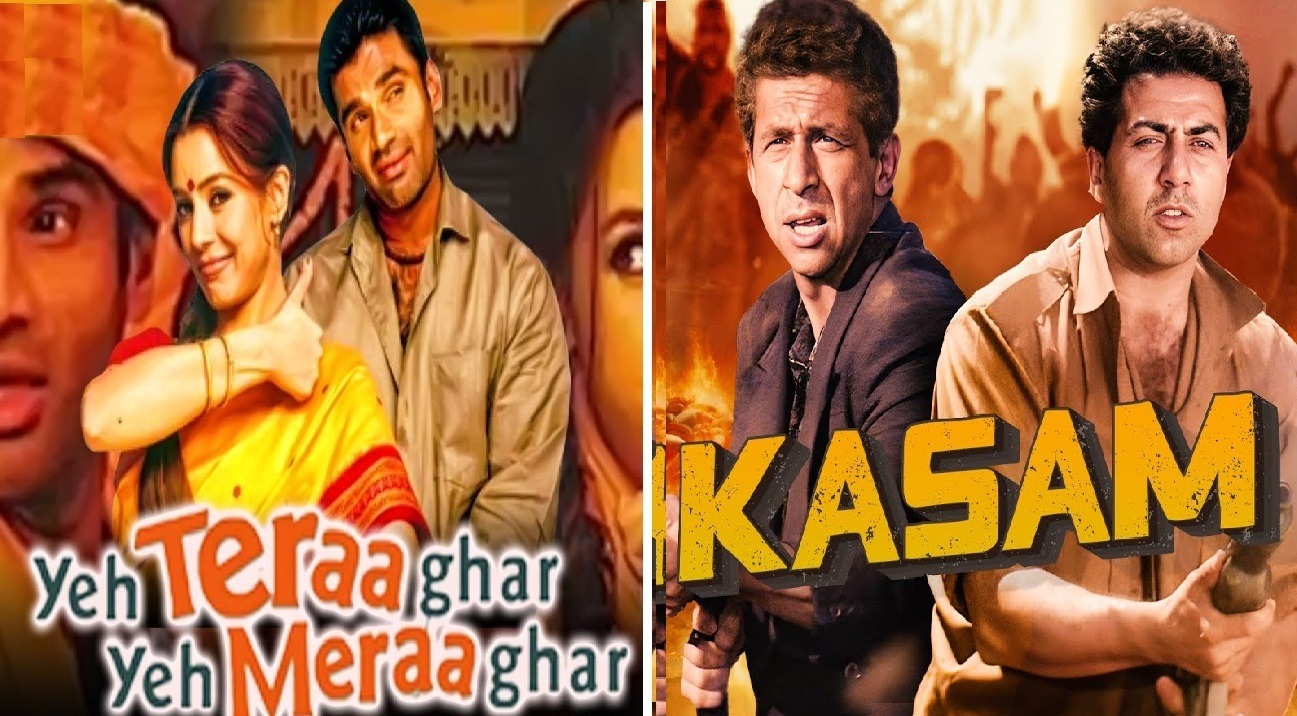
YEH TERAA GHAR YEH MERAA GHAR
Ripple Picture Entertainment’s Yeh Teraa Ghar Yeh Meraa Ghar is a social comedy. A young and simple man, living in a village and burdened with liabilities, has one hope left — to liquidate a house of his late father, in the city. He comes to vacate the tenants — a widow, her two daughters and a son — from the house but finds them unwilling to quit. He does all he can to get them out — and this includes filing a case in the court; entering his own house by force and living therein; troubling the tenants by creating nuisance at times and by using musclemen to threaten them at other times; using his police-friend who, later, changes sides when he falls in love with the elder daughter of the tenant. He even tries to arrange the marriage of the police officer with the daughter so that she and her family could stay with the police inspector and thus vacate his house. The marriage, however, is stalled by the cop’s sister. Ultimately, the village simpleton himself decides to marry the tenant’s daughter and shift with his mother and sister to the house in the city.
The comedy is farcical most of the times. The problem of tenancy is typical to cities like Bombay and Delhi and, therefore, the whole drama of the tenants refusing to vacate the premises will not be appreciated by audience in most parts of the country. Even otherwise, the story is too thin for a full-length feature film and it moves on a single track only. The treatment of the subject is of the kind which would appeal to the city audience only.
While the first three or four reels are quite hilarious, the drama deteriorates as the film progresses. The track of the police inspector’s romance with the tenant’s daughter sticks out like a sore thumb. Worse still is the track of her past in a mental asylum. If the war of words and action scenes between the village youth and his tenants do not have the desired impact consistently, it is because it looks like an unequal fight. And this is so as there’s no male member on the tenants’ side, the only males being the little son of the widow, and her neighbours. In that sense, the youth, who is the hero, fighting with the ladies looks bad even if it is in a comedy film. As such, Neeraj Vora’s writing leaves plenty to be desired. Climax has the least impact. The film is completely devoid of romance and emotions. Dialogues, however, are brilliantly witty and punch-packed.
Sunil Shetty acts very well in an out-and-out comedy role. Mahima Chaudhry is brilliant as the elder daughter of the tenant. She breathes fire in dramatic scenes of confrontation with Sunil Shetty. Paresh Rawal, as the police officer, may not be exceptionally funny but, nevertheless, evokes laughter with a performance that is as natural as it could be. Saurabh Shukla does a fair job. Sanjay Narvekar is simply superb. Neeraj Vora also does an exceptional job. Suhasini Mulay fails to impress. Usha Nadkarni acts wonderfully. Kishore Nandlaskar excels. Asrani leaves a mark. Radhika Menon and Geeta Vijayan are okay. Naghma, in a special appearance, is good in a dance number. Master Adit does a fair job.
Priyadarsan has restricted the film’s appeal to the class audience only, not just by his choice of subject but also by its treatment. While he handles the first few reels with aplomb, he falters at a good number of places in the remake of a Malayalam hit. Anand Milind’s music is nothing to dance about although ‘Saraswati, yeh tere ghar’, ‘Aala re aala’ and ‘Hansaate ho’ are well-tuned songs. Camerawork (Jeeva) is captivating. Action scenes (Thyagarajan) are well-composed. Sabu Cyril’s sets are praiseworthy. Production and other technical values are fair.
On the whole, Yeh Teraa Ghar Yeh Meraa Ghar has not taken an encouraging start and, with its restricted appeal, will find the going tough despite its reasonable price.
Released on 12-10-2001 at Metro and 18 other cinemas of Bombay thru Shringar Films P. Ltd. Publicity: good. Opening: average. …….Also released all over except in Bengal. Opening was poor almost everywhere.
KASAM
Manish Films’ Kasam (UA) is a revenge drama. The story is set in a village where the people are forced to live under the evil shadow of a notorious dacoit (Sadashiv Amarapurkar) who is aided by the zamindar’s son (Sharat Saxena), in his perpetration of terror. The saviour of the villagers, however, soon arrives in the form of a noble-hearted truck driver (Sunny Deol). The truck driver’s father, a police officer (Parikshat Sahni) was killed by the dacoit when he (the truck driver) was only two years old. At the time, his mother, who had vowed to destroy the dacoit, had left him in the care of a kind-hearted truck driver (Ranjeet).
Over the years, there have been situations in which the hero protects his own mother without both knowing how they were related to each other.
Meanwhile, a police inspector (Naseeruddin Shah) and a thief (Chunkey Panday) land up in the village. While the inspector is looking to nab the dacoit, the thief seems to have arrived for no particular reason at all. The police inspector dons a disguise and mixes with the villagers. He is soon able to win their confidence. The thief falls in love with a young girl (Neelam) whom the truck driver also loves.
When the zamindar’s son is put behind bars for attempted rape, the dacoit comes to his rescue and gets him released with the help of a few corrupt police officers. The evil duo soon unleashes a new wave of terror. The timely arrival of the truck driver on the scene, however, puts a spanner in the works. He manages to save not only his beloved but also the thief from the clutches of the villains.
In the climax, the hero and his mother, now reunited with each other, set the dacoit afire, losing their own lives in the process.
The screenplay is written in such a way that only action scenes appear every now and then. There is no drama which can even interest a child. So important are action scenes in the film that links between successive scenes often get lost. As a result, the story lacks any logical progression. Dullness creeps in in the early reels itself and stays for the most part. The audience gets very little respite from boredom in a few light scenes — like the police inspector and the thief fooling each other; and the police inspector tricking the zamindar’s son. The action scenes, though many, singularly lack thrill. Climax is long-drawn. The last 20 minutes or so in the film have the semblance of drama. The film has been delayed a long time in the making and it shows in the final product.
Sunny Deol gets his usual quota of action scenes and performs well. Naseeruddin Shah succeeds in regaling the audiences with his comic punches. Chunkey Panday is fair. Neelam hardly has anything to do except appear in a few songs and dances. Sadashiv Amarapurkar looks too tame as the dacoit. Sharat Saxena, as the zamindar’s son, is average. Hemant Birje, Parikshat Sahni, Anjana Mumtaz, Paintal, Ranjeet, Sonu Walia, Tej Sapru and others fill the bill.
Shibu Mitra’s direction is too ordinary to be true. Only one song, ‘Meri dafli teri payal’ appeals, that too, only to some extent. Cinematography is just about passable. So are the other technical and production values.
On the whole, Kasam, with its stale look and run-of-the-mill story, holds no promise at the box-office.
Released on 12-10-2001 at Dreamland and 13 other cinemas of Bombay thru Gola Brothers. Publicity & opening: so-so. …….Also released in East Punjab, C.I. and Rajasthan.
LATEST POSITION
The openings of both the releases of this week were as expected — dull.
…………
Chandni Bar is doing fairly well only in Bombay and Hyderabad. 2nd week Bombay 37,34,520 (69.13%) from 9 cinemas (7 on F.H.), total for 2 weeks 72,62,204; Ahmedabad 84,972 (1 unrecd.), Rajkot 64,000; Pune 8,10,603 from 4 cinemas, Solapur 69,200; Delhi 5,65,236 from 3 cinemas (1 unrecd.); 1 week Kanpur 92,792, 2nd week Agra 52,000; 1st week Calcutta 2,85, 890; 2nd week Nagpur 86,805 (1 unrecd.), Amravati 49,220, 1st week Yavatmal 42,717; Jaipur 1,51,591 (22.89%); 2nd week Hyderabad (gross) 3,55,248.
…………
Ajnabee 3rd week Bombay 27,28,981 (47.74%) from 13 cinemas (8 on F.H.), total for 3 weeks 1,54,77,736; Ahmedabad 2,35,709 from 4 cinemas (4 unrecd.), Rajkot 1,21,580, Jamnagar 39,005; Pune 8,73,999 from 4 cinemas, Solapur 1,34,530 from 2 cinemas (1 in matinee); Delhi 21,53,659 from 11 cinemas (3 on F.H.); Kanpur 2,29,348 from 2 cinemas, Lucknow 3,29,441, Agra 2,02,000, Allahabad 1,42,000, Bareilly (6 days) 55,469, 2nd week Jaunpur 40,000; 3rd week Calcutta 4,24,877 from 4 cinemas; 1st week Jabalpur (6 days) 1,96,182, 3rd week Amravati 84,630, Akola 73,581, total 3,90,264, Raipur (6 days) 65,436, Jalgaon 83,000 (2nd week 1,32,624), 1st week Chandrapur 1,79,380; 3rd Indore 57,000; Jaipur 2,89,420 (27.16%) from 2 cinemas, Ajmer (gross) 1,29,469, Bikaner 95,788; Hyderabad (gross) 4,28,795 from 2 cinemas; 1st week Davangere 1,89,437.
Kyo Kii… Main Jhuth Nahin Bolta 3rd week Bombay 8,20,897 (43.59%) from 4 cinemas (9 on F.H.), total for 3 weeks 72,04,026; Ahmedabad 2,16,981 (5 unrecd.), Jamnagar 38,100 from 2 cinemas (1 in matinee); Pune 3,88,768 from 3 cinemas, Solapur 47,755; Delhi 8,07,068 from 5 cinemas (4 on F.H.); Kanpur 2,04,924 from 2 cinemas, Lucknow 2,98,179, Agra 1,78,000, Varanasi 86,927, Allahabad 1,03,161, Bareilly (6 days) 49,044, Jaunpur 10,000; Calcutta 1,40,474; Nagpur 56,687 (1 unrecd.), 1st week Jabalpur (6 days) 1,34,349, 3rd week Amravati 84,184, Akola 89,560, total 3,50,702, Raipur (6 days) 42,736, Jalgaon 55,687 (2nd 75,055), Wardha 37,385, Yavatmal 20,260; Indore 85,000 (1 on F.H.); Jaipur 1,02,184 (16.91%), Ajmer 37,258, Bikaner 65,700; Hyderabad (gross) 3,97,922 from 2 cinemas; 1st week Davangere 1,37,814.
…………
Nayak 5th week Bombay 6,06,975 (49.53%) from 3 cinemas (4 on F.H.), total for 5 weeks 1,11,80,666; Ahmedabad 2,31,435 from 3 cinemas (4 unrecd.); Pune 2,51,008 from 3 cinemas (1 in matinee), Solapur 86,511; Delhi 2,34, 939 from 2 cinemas; Kanpur 69,732, Lucknow 1,32,083, Agra 1,16,000, Varanasi 50,510, Allahabad 61,738, Jaunpur 15,987, total 1,89,617; Calcutta 72,593; Nagpur 73,774, Jabalpur (6 days) 24,000, Amravati 80,223, Akola 53,400, total 5,82,825, Dhule 42,647, Raipur (6 days) 48,873, Jalgaon 68,452 (4th 84,111), Chandrapur 60,074, total 7,38,337, 4th week Yavatmal 37,443.
Gadar Ek Prem Katha 17th week Bombay 1,81,144 (26.39%), total for 17 weeks 5,98,68,970; Pune 60,145 from 2 cinemas (1 in matinee), Solapur 23,600; Delhi (TF) 14,02,859 from 8 cinemas (1 on F.H.); Kanpur 97,333 from 2 cinemas, 2nd week Lucknow (revived) 1,46,503, 17th week Agra 61,000, Varanasi 45,102, Allahabad 63,347, Bareilly 29,509; Indore 33,206 (1 on F.H.), Bhopal 50,050; Jaipur 52,699 (19.44%); Hyderabad (gross) 24,700.
CINEMA REOPENS
Ramchandra Cinema at Dombivli (a distant central suburb of Bombay) re-opened on 12th October with Kasam. The cinema has been fully renovated.
PAHLAJ NIHALANI ELECTED IFEA PRESIDENT
Pahlaj Nihalani was unanimously re-elected president of the Indian Film Exporters Association at the first meeting of its newly elected council of management, held on 10th October in Bombay. Ganesh Jain was elected vice president while Chandrakant Mehta and Hirachand Dand were elected hon. secretary and hon. treasurer respectively.
Earlier, on 6th October, at the IFEA’s 37th annual general meeting, the following members, besides the aforementioned, were declared elected to the council of management: Amar Asrani, Sunder F. Rai, Rajinder Singh Hora, Arjan Lulla, Mohan Chhabria, Jhamu Sughand, Gordhan Tanwarni and Kumar Taurani.
Vashu Bhagnani, S. Narayanan and P. Parameswaran (NFDC) were co-opted to the council.
B4U TELEVISION NETWORK LAUNCHES B4U MOVIES
B4U TV officially announced the launch of its movie channel, B4U Movies, in India, at a press conference, held at Sidewok, NCPA, Bombay on 11th October. The new channel will show films from B4U’s vast library. It also has an array of film-based programmes under two categories — filmi specials and vignettes. Filmi specials include a series of half-hour programmes every day, on different aspects of Bollywood. Vignettes are fillers.
AMRISH PURI INJURED BADLY
Amrish Puri sustained serious injuries on his head and hands on the set of Vinod Shah’s Jaal – The Trap in Manali on 10th October. He was pillion-riding on a motorcycle with Sunny Deol for an action scene of the film at Rohtang Pass when the motorbike skidded. Sunny had a miraculous escape, sustaining a minor injury on his hand, but Amrish Puri was hurt badly. He was rushed to Willingdon Hospital in Manali where stitches had to be administered on his head. He was flown to Bombay on 11th and is recuperating at home.
The shooting schedule had to be packed up mid-way following the accident. Said Guddu Dhanoa, director of Jaal, “It was a terrible sight. The motorbike was tied to the car in which the camera was placed and we were sitting. While the car and motorcycle were in motion, a sharp curve came and the motor cycle skidded. I knew, we wouldn’t be able to continue the shooting schedule and we cancelled it forthwith.”
The shooting spell began on 2nd October and was to go on till 20th.
GUILD MEETS STATE MINISTERS OVER NEW ST
The Film Producers Guild of India organised a meeting of a representation of the entertainment industry with Maharashtra finance minister Jayant Patil and revenue minister Ashok Chavan on 9th October at Sahyadri Guest House in Bombay. The ongoing issue of the 4% sales tax, levied by the state government on the turnover of sales in respect of the transfer of rights to use any goods, being made applicable to film transactions was discussed. The representatives of the entertainment industry once again cautioned the ministers about the adverse impact of the levy which would force them to shift the industry to another state. The finance minister asked the delegation to suggest other alternative areas within the industry from which the government could collect revenue. If the cabinet approved the suggestions, the 4% sales tax could be abolished, he said. The menace of video and cable piracy was also discussed at the meeting.
The entertainment industry delegation comprised Guild and AIFPC president Amit Khanna, AMPTPP president Pahlaj Nihalani, CCCA president Santosh Singh Jain, IMPDA president N.N. Sippy, Guild vice president Tilak Raj Magan, Yash Johar, Gordhan Tanwani, Shyam Shroff, Vijay Lazarus, Ganesh Jain, Vijay Singh, Shashi Gopal, Suresh Thomas, Harish Dayani and Ronald D’Mello. Govind Swarup, principal secretary to the state culture ministry, and FFI secretary Supran Sen were also present at the meeting, besides the commissioner of sales tax, Maharashtra.
NO EXTRA CHARGES TO LABORATORIES
At the first meeting of the newly elected executive committee of the Indian Film Exporters Association, held on October 10, it was unanimously resolved that no exporter would henceforth pay to laboratories any extra charges including the charges for dupe negative/DTS, unless the agreement with the producer provided for such extra payment. Accordingly, the respective laboratories will be requested to charge only Rs. 3.50 towards print processing inclusive of wastage.
YOU ASKED IT
Which, according to you, will be the next blockbuster?
– Let at least a success come first. Then, we can look out for a blockbuster.
In which years were Prithviraj Kapoor and Raj Kapoor given the Dadasaheb Phalke awards?
– Prithviraj Kapoor bagged it in 1972, and Raj Kapoor, in 1988. Incidentally, this is the only father-son team to have got the award.
You’ve been writing such hard-hitting editorials since so long. But is the situation improving?
– Corrective processes take years to yield results. You can’t expect a miracle so soon. But, don’t worry, people are at least thinking seriously.
DO YOU KNOW?
* Actor-producer-director Vikram has decided to now be known as Vikram Makandar.
* Mira Nair’s award-winning film, MONSOON WEDDING, has been picked up for all India by Idream Productions. The concern is new to the film industry, only recently having produced a film, 16TH DECEMBER.
* Gurudev Productions’ HUM HAIN BHARATWASI is doing very well in C.I. Tax-free in Madhya Pradesh, it has yielded good shares in special shows for children only, at the following stations: Mhow (10 shows) 25,000/-; Rewa (8 shows) 25,000/-; Ujjain (13 shows) 40,000/-; Betma (1 show) 3,000/-; Ratlam (4 shows) 12,000/-; and Nagda (4 shows) 8,000/-.
* Yash Raj Films’ ploy of giving away free audio cassettes of MOHABBATEIN to patrons during the 50th week of its run, at Bombay’s Novelty Cinema (matinee) has worked wonders as all 7 shows were full in advance! Earlier, too, the ploy had produced a similar result in the case of Yash Raj Films’ DDLJ in its 300th week at Bombay’s Maratha Mandir (matinee).
3-E
Education-Entertainment-Enlightenment
Blockbuster Of Epic Proportions
If the 11-minute promotional trailer, screened at Sony’s press conference for the music release of Karan Johar’s Kabhi Khushi Kabhie Gham at The Taj on 9th October, was any indication, a blockbuster of epic proportions is on its way. To say that the film has a rich look to it is an under-statement. But the grand sets, beautiful locations, exquisite costumes of the characters and the colourful look of the film apart, the promo gave an insight into what the film is all about. If the comic punches and fun scenes will have the audience laugh their guts out, the emotional ones will have them weep in cinemas. May be, tissue paper manufacturers could do brisk business in cinemas across the world, screening this potential record-smasher.
The film’s music has been composed by Jatin Lalit, Sandesh Shandilya and Aadesh Shrivastava. In one word, Sony has a true winner on its hands.
Such Keh Rahen Hain……..
Producer Vashu Bhagnani did it again on 10th October. Besides holding a special screening of the songs of his Rehnaa Hai Terre Dil Mein for the trade at the Cine Planet cinema in Bombay, he also put up a big screen in its compound for the public to see excerpts from the songs. The janata had a double treat — they caught glimpses of the songs as also of the lead stars of the film in person. Madhavan, who is a name to reckon with in Tamil cinema but whose first Hindi film RHTDM is, and Diya Mirza, who makes her screen debut with the film, were present. Madhavan has a cute boyish charm about him, which makes him an endearing face on the screen. Diya Mirza too looks promising in the songs. The Kay Kay number, Such keh raha hai, is a brilliantly rendered and composed song and, according to the film’s director Gautham Menon, “The song is a part of the climax when, usually, songs do not hold, but in the Tamil version too, of which RHTDM is a remake, a song in the climax went very well with the audience.” The four versions of the title song were also screened. It is out of these that Vashu intends keeping one in the film. Which one? “The public will decide,” is Vashu’s reply.
A Hit In Seven Days
He is only 28 years old and already has one blockbuster to his credit. That’s Gautham Menon, the director of the Tamil super-hit Minnale, which was also his first film. The guy nervously awaits the public verdict on his second film which is the Hindi remake of Minnale. About the remake he says, “Rehnaa Hai Terre Dil Mein is almost like the original except for a few scenes here and there.” He recalls how he had approached Madhavan for his first film when the latter was shooting for Mani Rathnam’s Alai Payuthe. “Madhavan liked the subject and we also clicked as friends. He recommended Vipul D. Shah’s name to me for the screenplay, and Vipul, Madhavan and myself completed writing the screenplay in a room of Hotel Sun N Sand here in Bombay in seven days flat,” explains Menon. Incidentally, the Vipul D. Shah of Minnale and RHTDM is different from writer Vipul Shah who is also currently directing the Amitabh starrer, Aankhen. Vipul D. Shah has written the television series, Dekh Bhai Dekh. Like Gautham’s, Vipul D. Shah’s first film assignment also was Minnale, and the second is RHTDM.
A Brave Effort
Not many may be aware that Sudhir Phadke’s Veer Savarkar has been made with only financial assistance from friends and well-wishers. The first donation to Savarkar Darshan Pratishthan (Trust) to make the film came in the form of gold bangles from a lady. It is a laudable effort, not just by Sudhir Phadke but also by director Ved Rahi. Shailendra Gaur, who has played the title role in the film, has done a superb job as the revolutionary freedom-fighter. It is good, the Maharashtra government has exempted Veer Savarkar from entertainment tax. Such a worthy effort deserves similar assistance from other states too.