





























KASOOR
Vishesh Entertainment Ltd.’s Kasoor (A) is a murder mystery. A rich and famous newspaper editor’s wife is murdered and the police frames him for it. The police officer, who has an axe to grind with the editor, arrests him but he is released on bail. Rather than hiring the top lawyers of the country, the editor appoints a lady lawyer to argue his case in the court of law. This lady lawyer also hates the concerned police officer for having earlier fooled her with false evidence which had led her to win a case in her capacity as a public prosecutor but at the cost of getting an innocent man hanged to death.
The mystery deepens as the lawyer receives anonymous letters, guiding her to witnesses who would help save the editor from being convicted. Even while the case is going on, the lawyer is charmed by her client, the editor, and finds herself madly in love with him. They have physical relations too. After a long-drawn courtroom drama, she wins the case. But that’s not the end of the story. Rather, it is just the beginning of another gory story for the gullible lady lawyer.
The film moves at a slow pace in the first half and has several boring and even illogical moments. It is only after interval that the drama picks up but even then, the film doesn’t have universal appeal. Remake of the English film, Jagged Edge, it has more than a fair share of flaws in its screenplay (Mahesh Bhatt). A sample of the weak scripting: the lady lawyer, on being told by the journalist that he is innocent, chides him, saying that before taking up a case, she invariably satisfies herself about the innocence or otherwise of her client. A couple of scenes later, she is shown warning the journalist not to hide any facts from her, implying thereby that she has no option but to believe his claim of innocence. Some time later, she tells her boyfriend that, being a lawyer, it was her duty to protect her client even if he was guilty. But when she had set out to take up his case — after much reluctance — she had confided in her boyfriend that she was taking it up only because she hoped, she could save the innocent journalist and thereby repay for the terrible wrong she had done by getting an innocent guy hanged to death earlier. So, at one time, she is shown as being very conscientious and at another, downright self-centred and anything but conscientious. Again, much later, she decides to leave her client midway only because she feels, there was another girl in his life. In short, the lady lawyer’s character is that of a ridiculously imbalanced mind!
If there’s no exciting suspense built, it is because the film begins from the point of murder. The journalist and his wife’s relationship is not established beforehand but unfolds only as the drama progresses. Obviously, it has been done for the sake of convenience in building suspense and not pointing the needle of suspicion towards the real murderer. The climax looks too contrived from the moment the lady lawyer tries to rob the journalist’s car keys instead of plainly and simply running for dear life! The arguments in the courtroom because of which at least three witnesses crumble under pressure, are quite childish.
Aftab Shivdasani does an utterly average job and fails to evoke either sympathy or hatred for himself, all through the time it is not known who the murderer is. Lisa Ray is an expressionless beauty. She makes a terrific attempt to act but fails terribly. Except in the climax and a couple of courtroom scenes, she is wooden. Her voice has been effectively dubbed by Divya Dutta. Apoorva Agnihotri is fair. Ashutosh Rana is truly effective as the scheming police officer. Divya Dutta acts ably. Irfan Khan is alright. Vishwajeet Pradhan is natural. Sucheta Pawse, Prithvi Zutshi, Kurush Deboo and the others provide reasonable support.
Vikram Bhatt’s direction is quite immature. He tries to camouflage the weaknesses of the script by snazzy takings. Dialogues (Girish Dhamija) impress at a couple of places only. Nadeem Shravan’s music is very melodious but the impact of the lovely music is lost, to a large extent, because of ordinary song situations and owing to some of them being dream/background songs. Cinematography (Pravin Bhatt) is beautiful. Background score (Daboo Malik) is effective in dramatic scenes. Action is functional. Editing is anything but crisp. Whereas a murder mystery ought to be fast-paced, this film is too slow to be true.
On the whole, Kasoor is a weak fare with only a very low price as its salvaging point for circuits like Bombay and South. Opening in U.P. was also good.
Released on 2-2-2001 at Maratha Mandir, Metro (matinee) and 11 other cinemas of Bombay thru Ahuja Films. Publicity & opening: good. …….Also released all over. Opening was not upto the mark in East Punjab, Bengal and Rajasthan.
‘MOR CHHAINHA BHUINYA’ SCORES A TON
Puran Entertainments’ Mor Chhainha Bhuinya (Chhattisgarhi) has created history in the newly-formed Chhattisgarh state and surrounding regions by celebrating 100 days today (February 3) at Raipur, Durg and Bilaspur. Satish Jain, who makes his debut as director with this phenomenal hit, is also the film’s story, screenplay and dialogue-writer. Produced by Shivdayal Jain, it stars Shekhar Soni, Anuj, Poonam, Jagruti Rai, Nisha Gautam, Ashish Shendre and Manmohan Singh Thakur. Music, which is a big hit, is by Babla Bagchi and lyrics, by Laxman Masturiya and Vinay Bihari.
This is the third Chhattisgarhi film. The first two were made 35 years ago, in B & W. Mor Chhainha Bhuinya is the first colour Cinemascope Chhattisgarhi film. Having completed 100 days in Raipur, Durg and Bilaspur, it is now heading towards 100 days at Bhilai, Rajnandgaon, Korba, Dhamtari, Shakti and Ambikapur (which is not in Chhattisgarh).
NAGPUR CRIME BRANCH RAIDS TWO VIDEO PARLOURS
The crime branch of Nagpur police recently carried out raids on two local video parlours, under the supervision of DCP Kulwant Kumar and ACP Sunil Phulari. Pirated VCDs of films like Kurukshetra, Mohabbatein, Fiza, Dhadkan, Farz, Dr. Babasaheb Ambedkar, Zubeidaa, Taal, Josh, Champion, Astitva, Khiladi 420, Hera Pheri, Mission Kashmir, Saali Poori Gharwali and hundreds of VCDs of English films alongwith TV sets, VCRs and duplicators were seized. The property seized is estimated to be worth Rs. 2.50 lakh. The police arrested Vashishtha Mishra of Sharda Video Parlour and Prakash Waman Chafle of Mahalaxmi Video Parlour.
The raids were carried out at the instance of K.K. Sawhney who is the convenor of the Cine Exhibitors Association, Nagpur.
‘TERA JADOO CHAL GAYAA’ SILVER JUBILEE
Producer Vashu Bhagnani’s Tera Jadoo Chal Gayaa entered 25th combined week on 2nd February at New Excelsior (matinee), Bombay. The film, starring Abhishek Bachchan, Keerthi Reddy, Sanjay Suri, Kader Khan, Paresh Rawal, Himani Shivpuri, Johny Lever and Farida Jalal, is directed and edited by A. Muthu. Writer: Ikram Akhtar. Music: Ismail Darbar. Lyrics: Sameer. Cinematography: Santosh Thundiyil.
‘MOHABBATEIN’ SCORES A CENTURY!
Yash Chopra’s Mohabbatein, written and directed by Aditya Chopra, entered 100th day today (3rd February) at Liberty, Bombay, and in Ahmedabad, Baroda, Solapur, Pune and other centres of Bombay circuit, in Delhi-U.P., West Bengal, C.P. Berar, C.I, and Nizam. The film stars Amitabh Bachchan, Shah Rukh Khan, Aishwarya Rai, Uday Chopra, Shamita Shetty, Jugal Hansraj, Kim Sharma, Jimmy Shergill, Preeti Jhangiani and Anupam Kher with Amrish Puri and Shefali Chhaya in guest appearances. Music: Jatin Lalit. Lyrics: Anand Bakshi. Cinematography: Manmohan Singh. Choreography: Farah Khan. Art: Sharmishtha Roy.
‘MISSION KASHMIR’ 100 DAYS
Vinod Chopra Productions’ Mission Kashmir entered 100th day today (3rd February) at Novelty (matinee), Bombay. Produced and directed by Vidhu Vinod Chopra, the film stars Sanjay Dutt, Hrithik Roshan, Preity Zinta, Jackie Shroff, Sonali Kulkarni and Puru Raaj Kumar in a guest appearance. Story-screenplay: Abhijat Joshi, Suketu Mehta, Vikram Chandra and Vidhu Vinod Chopra. Music: Shankar-Ehsaan-Loy. Lyrics: Rahat Indori and Sameer. Cinematography: Binod Pradhan. Art: Nitin Desai. Editing: Rajkumar Hirani. Action: Allan Amin. Choreography: Saroj Khan and Rekha Chinni Prakash.
RELEASE OF ‘CCCC’
MCOCA Court Asks State To File Reply
The Maharashtra Control of Organised Crime Act (MCOCA) court on January 30 directed the government of Maharashtra to file its reply on film financier Bharat Shah’s claim on the seized negatives of Chori Chori Chupke Chupke. The police had seized the negatives of the film after the arrest of its producer, Nazim Rizvi, on 13th December. Shah had sought an injunction from the court, restraining the police from interfering with the release of the film and its negatives.
At the last hearing, judge A.P. Bhangale, satisfied that third party rights had been created, directed issue of notices to its 13 distributors, music company Universal and state chief secretary. The distributors of various territories were present in the court on 30th January. Under-secretary R.V. Nalawade’s request for a week’s time to file a para-wise reply was granted. The matter was posted to 2nd February.
The counsels for the distributors submitted that they had acquired the distribution rights through agreements entered into with Mega Bollywood Limited, a company in which Bharat Shah was a director.
The counsels for the distributors said that prejudice shall be caused by any further delay in the release of the film since the pirated copies of its video cassettes were already in circulation in Pakistan. These copies can also come to India and by the time the film is released, there will be less attendance in the cinemas, thus causing severe financial loss, the counsels for the distributors pointed out.
The counsels further said that if delay was caused due to the state seeking time, the state should be liable to compensate for the losses suffered. Special public prosecutor Rohini Salian said that the state had to ascertain certain facts. The counsels countered that the state government ought to be aware of the complete facts since it is the police which is investigating the matter.
Shah’s counsels reiterated that Mega Bollywood Limited are the world rights controllers who have paid approximately Rs. 12.50 crore to the producers through an agreement. His counsels opposed the state’s claim of attachment and the release of the film through the court receiver, saying that Mega Bollywood Limited was a separate legal entity from its members. They said that severe losses would occur if the film was released through the court receiver.
Universal Music, which had purchased the music rights of CCCC at Rs. 2.60 crore and has been selling its music, urged the court to not put an injunction on the music sales as that could cause losses and encourage music piracy.
HEARING BEGINS ON BHARAT SHAH’S BAIL PLEA
V.R. Manohar, senior counsel for film financier and diamond merchant Bharat Shah, told the special MCOCA court on 2nd February that the entire intercepted material against his client was obtained in “violation of the provisions of the Maharashtra Control of Organised Crime Act (MCOCA)”. The senior counsel made this submission during the hearing on Shah’s bail application before the designated judge, A.P. Bhangale. Manohar said that the only incriminating evidence against Shah, which the police claimed to have, was an alleged telephonic conversation, dated 27th October, 2000, between him and Chhota Shakeel. The police had obtained authorisation to intercept calls on 23rd October under the Indian Telegraph Act and not as per provisions of the MCOCA, he added.
He further said that the first interception, out of the nine mentioned by the police in its FIR and subsequent remand applications, was dated 27th October. The senior counsel asked whether there was an interception dated 27th October and, if so, whether it was authorised by the ITA or whether it was a tape handed over by Nazim Rizvi (producer of Chori Chori Chupke Chupke) or whether the police had obtained it from somewhere else. There was no reference to Shah in any other telephonic conversation, as alleged by the police, except in the one dated 27th October, V.R. Manohar pointed out. He also said that there was no name of any applicant as mentioned in the FIR copy nor was there any reference made in its entire text nor was any panchnama made for any conversation dated 27th October in the FIR.
The senior counsel will continue with his arguments on 5th February.
BHARAT SHAH REMANDED TO JUDICIAL CUSTODY
Film financier and Bombay distributor Bharat Shah was on 1st February remanded to judicial custody by the special court in Bombay, until 14th February. He had been arrested under the Maharashtra Control of Organised Crime Act on 8th January for his alleged underworld nexus in the financing of Chori Chori Chupke Chupke. The film’s producer, Nazim Rizvi, who was arrested a few days before Shah, was also remanded to judicial custody until 14th February.
Bharat Shah’s bail application, which was to be heard on 1st, was heard on 2nd instead, as his council, V.R. Manohar, was busy in another court on 1st. A bomb scare in the high court delayed the hearing.
…….
YOU ASKED IT
If banks do decide to finance a film, what things will the banks consider as security — producers’ assets or his film’s negative?
– Maybe, only the film’s negative.
Why is script-doctoring not a success in India?
– Because producers lack vision, and writers and directors have fat egos.
In the Hindi film music market, what is the percentage share of non-film music, like pop songs, devotional songs, ghazals etc.
– About 15-20%.
How come, Adhikari Brothers have not thought of re-releasing their Bhookamp in the wake of the quake?
– Public has no bhookh for such gimmicks when the film in question is poor.
3-E
Education-Entertainment-Enlightenment
Quake Relief?
Looking to the havoc the earthquake of 26th January has created in the state of Gujarat, it will be months before business in the Gujarat and Saurashtra sub-territories of Bombay circuit returns to normalcy. Distributors of Bombay are expected to ask producers for price reductions in the case of forthcoming films. In the immediate future, of course, the losses to distributors and exhibitors of Bombay/Gujarat/Saurashtra are going to be very heavy.
Roshans Donate Rs. 21 lakh For Earthquake Victims
Hrithik Roshan accompanied his father, Rakesh Roshan, when he called on Maharashtra chief minister Vilasrao Deshmukh on 1st February to hand over a cheque of Rs. 21 lakh in aid of the earthquake victims in Gujarat. “Hrithik was to perform in a charity show for the Prime Minister’s Relief Fund on 3rd February in Delhi. Unfortunately, the show has been postponed due to unavoidable circumstances,” informs Rakesh Roshan. He adds, “In any case, we wanted to help the victims in our individual capacity, too. While we understand that money cannot wipe out the losses of so many lives, we hope and pray that our contribution helps remove at least some of the physical hardships faced by the victims.”
A Shower Of Melody
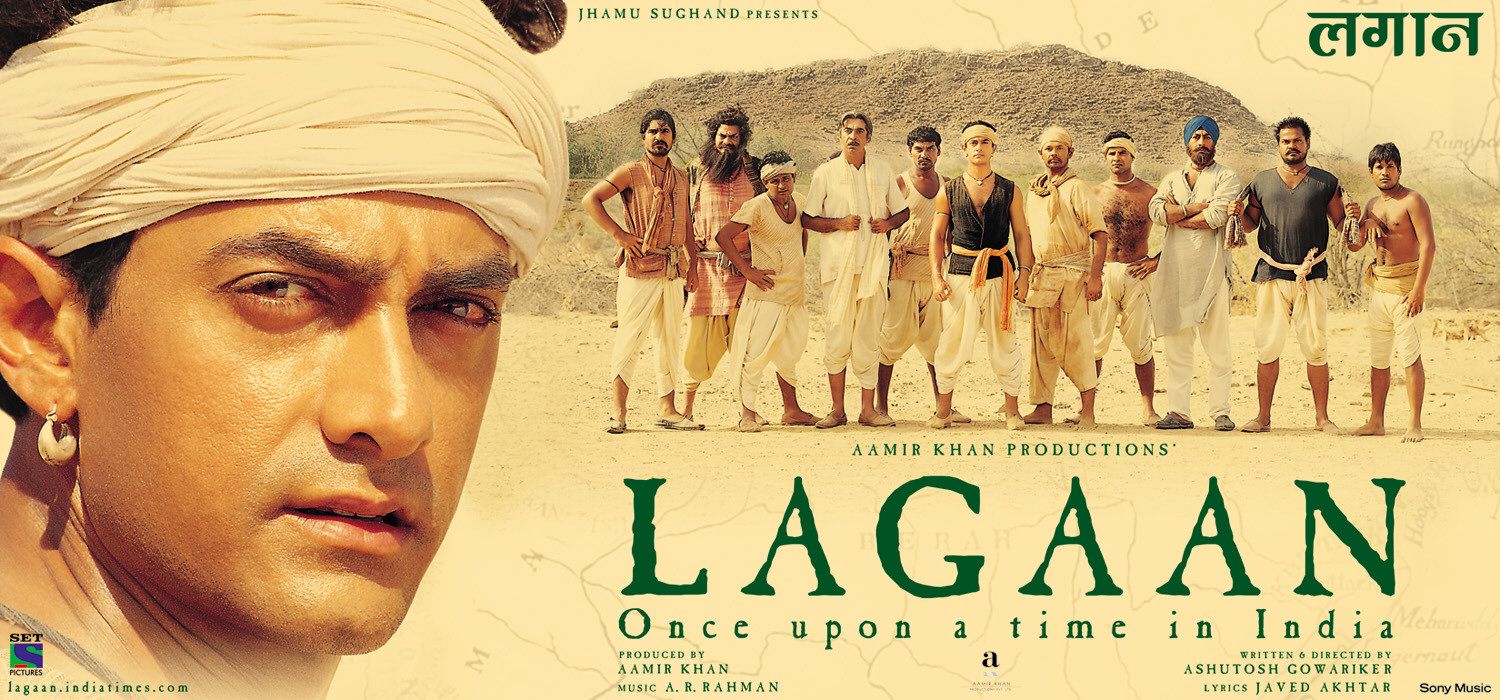
If one song of Lagaan (the Megha number) Information heard, is any indication, producer Aamir Khan has a winner in his music. The pre-monsoon song is beautifully tuned by A.R. Rahman and has a very exciting thing about it, heightened further by its immensely likeable picturisation (choreographed by Raju Khan). The magic on the viewer starts as soon as the song begins, such is the impact! Aamir will release the audio cassettes of his maiden production venture on 6th April. The film itself will hit the screens on 1st June even though its copy will be out as early as in April.
INFORMATION MEETS
‘LAGAAN’: Once upon a time in Bhuj….
– a devastated AAMIR KHAN on the
havoc created in the town which
was his home for 6 months in 2000
GAUTAM MUTHA & KOMAL NAHTA
Aamir Khan is a very sad man today. Having shot his entire Lagaan in Bhuj (in Gujarat), the charming-actor-turned-charismatic producer has taken the news of the devastation caused by the recent earthquake to the entire Bhuj town very personally.
“We’ve lived with the locals there for six months — from January to June 2000,” said Aamir with a deep sense of gratitude now mixed with sorrow. He added, “We worked like one big family. And today, I have no information about how they are, in what condition they are, what they need urgently. (After this interview was taken on 30th January, Aamir has learnt that almost all whom he knew in Bhuj are alive but their houses have been reduced to rubble.) My entire staff is just sitting in front of the television, watching the news about the tragedy. We are also constantly trying to contact our friends in Bhuj over telephone but since the lines are all down, we are still clueless about their well-being.”
Not the one to just sit helplessly, Aamir rushed his production guys to Bhuj on 30th January to enquire after those they were close to. He explained, “My guys will also contact the local organisation there, which is engaged in the work of disbursing money, food and clothing to the quake-affected. I could have sent a cheque to the Prime Minister’s Relief Fund, but the loss — of whatever magnitude if may be — has been like a personal loss to me.”
Aamir Khan plans to himself go to Bhuj as soon as his production people inform him that the necessary arrangements have been made for disbursement of goods and cash. Said Aamir, “I want to personally hand over whatever my friends and their families there need, with my own hands.”
The conscientious actor-producer has decided to personally donate Rs. 25 lakh for the cause. “Generous contributions are also coming in from all the unit members,” informed the affable actor. “Everyone in the unit wants to contribute his bit. Even the spot-boys have expressed a keen desire to help with whatever they can afford.”
Going in flashback mode, Aamir recalled how very co-operative and helpful the locals had been all through the six months of shooting and four months before that when the sets were being constructed. “I don’t recall having faced a single problem during our entire stay,” he said. “The people of Bhuj lead a very tough life, they have to often cope with drought situations, yet they are the softest people I’ve known.”
Talking of the contribution of the people of Bhuj and surrounding areas in front of the camera, Aamir said that of the 200 junior artistes in the film, only 50 had been taken to Bhuj from Bombay. “The remaining 150 were from the local theatre groups of Bhuj and the commoners there.” Elaborating further, Aamir added, “And the junior artistes are not junior artistes in my film. Each of them is a character. For instance, the role of Raj Zutshi’s wife is played by a local girl. She may not have a single dialogue in the film but she is there by Zutshi’s side all along in the film.
“We knew half the people by their first names. It is frightening to think in what state they might be.” Lagaan has several British actors too and they’ve been calling Aamir’s office from abroad to enquire after the well-being of the Bhuj people. The foreign actors have also very considerately volunteered to help financially.
So emotionally overcome was Aamir that he volunteered to show us a song from the film to drive home the point of the immense contributions of the people of Bhuj to his film. The Megha song is a joyous number in which the entire parched village (Lagaan has a village backdrop) dances on sighting the first clouds of the season, in the hope that it would rain soon. On his personal computer screen, Aamir paused the pictures at regular intervals and pointed out to the large number of locals dancing in the song.
That the song is an exceptional number composed by A.R. Rahman is beside the point. In normal circumstances, a producer would be thrilled when told that his song is a hit number. But the pain in Aamir’s heart was too palpable to make him appreciate our genuine fondness for the song.
Aamir’s cousin, director Mansoor Khan, too, was keen to donate his mite for the quake victims, together with the Lagaan team, but Aamir advised him to use one of the traditional channels. “I told Mansoor, we will not be able to give him the tax benefits which one derives from donating to charitable organisationas. I don’t mind paying the tax on my contribution, so we aren’t going to apply for exemption and all that,” explained the actor.
Talking of his stay in Bhuj for six months, Aamir rued, “Today, our guys, who’ve gone to Bhuj, called up to say that the apartment in which the entire unit was staying had been reduced to rubble.” Aamir had rented an entire building which had been newly constructed. In place of that building where Aamir, director Ashutosh Gowariker, art director Nitin Desai and the other cast and crew of Lagaan ate, drank and slept, is today just mounds of debris. “On the sets, we used to eat and chat with the locals like they were part of our family. I used to often smoke with them.”
About the film, Aamir informed that he was amused when a section of the press reported that he had gone in for heavy re-shooting. “I’ve not reshot for a single day,” he smiled. Nor had Aamir ever planned to release the film either on Diwali last year or Idd this year. Describing it as a film which deals with the problem of tax (lagaan) as it existed in British India, the actor stressed that it was a completely commercial film. Just because the story is based in drought-stricken Bhuj, Aamir dispelled fears that the film would turn out to be a dry fare. It is a love triangle with a lot of emotional content and humour thrown in. Gracy Singh and Rachel Shelly are his two love interests in the film.
Aamir discarded rumours that Lagaan was his baby. “It is totally Ashutosh’s baby, I’m only the producer and hero,” he emphasised, adding, “It’s the most exciting story I’ve heard, and I don’t say this because it is my film.” The actor had no problem whatsoever with his music director, A.R. Rahman, whose late-night working hours are known to have irked several filmmakers. “I too like working in the nights,” informed Aamir. “So there was no problem on that count. Otherwise also, I used to attend the music sittings only when the tunes were almost finalised. As I said, the film is only Ashutosh’s creatively.”
When asked what price he expected for the distribution rights, Aamir revealed that irrespective of the ratio, “For an honest distributor, I’m prepared to make concessions. As an actor, I used to feel bad if my film did not make money for the producer and distributors. I used to interpret that as my failure. The same principle applies even now that I have turned a producer. I want that every single distributor of mine should make money on the film, otherwise I will have failed them.” The actor-producer has started finalising deals only now, from last month. Although Jhamu Sughand is the presenter of the film, dealing with the distributors is Aamir’s domain. So far, Aamir has finalised his distributors for Bombay and Nizam.
Lagaan has been totally shot in sync-dubbing. Which means, the original sound, recorded whilst the film was shot, will be used in the final copy, obviating the necessity for dubbing all the dialogues after shooting. Lagaan should, perhaps, be the first commercial Hindi film to have been shot using the sync-dubbing technique which, according to Aamir, “is much more expensive than dubbing the dialogues later”. Aamir went in for sync-dubbing as it “captures the ambience of the scene and also brings in the right emotions”.
Talking of emotions, Aamir also emphasised that emotions were a very strong point of Lagaan. “No film can succeed unless there’s an underlying emotional point. The seed of Lagaan is very emotional.”
Little had Aamir known that the emotional tale called Lagaan would test his and his unit’s emotional strength even before the film was released, with a national calamity that has hit Bhuj so hard. Recounting the deal he had struck with the farmers on whose land he erected the set of an entire village, he explained, “I asked the farmers how much they earned every year from their agricultural produce and I gave them the entire amount before I started construction of the set on their land. I also employed them for the set construction and as junior artistes in my film — so they earned more than they would have in any year. And last year, too, was a year of drought, so they had what they earned from us, to tide over their bad times.”
But one wonders how many of them are alive today. It’s rather eerie but the catchline of Aamir Khan’s period film, Laagan, set in pre-Independence India, reads: ‘Once upon a time in India’. With a large part of Bhuj being buried by the quake, it almost appears like it was also meant to read: ‘Once upon a time in Bhuj…..’