



























GRAHAN
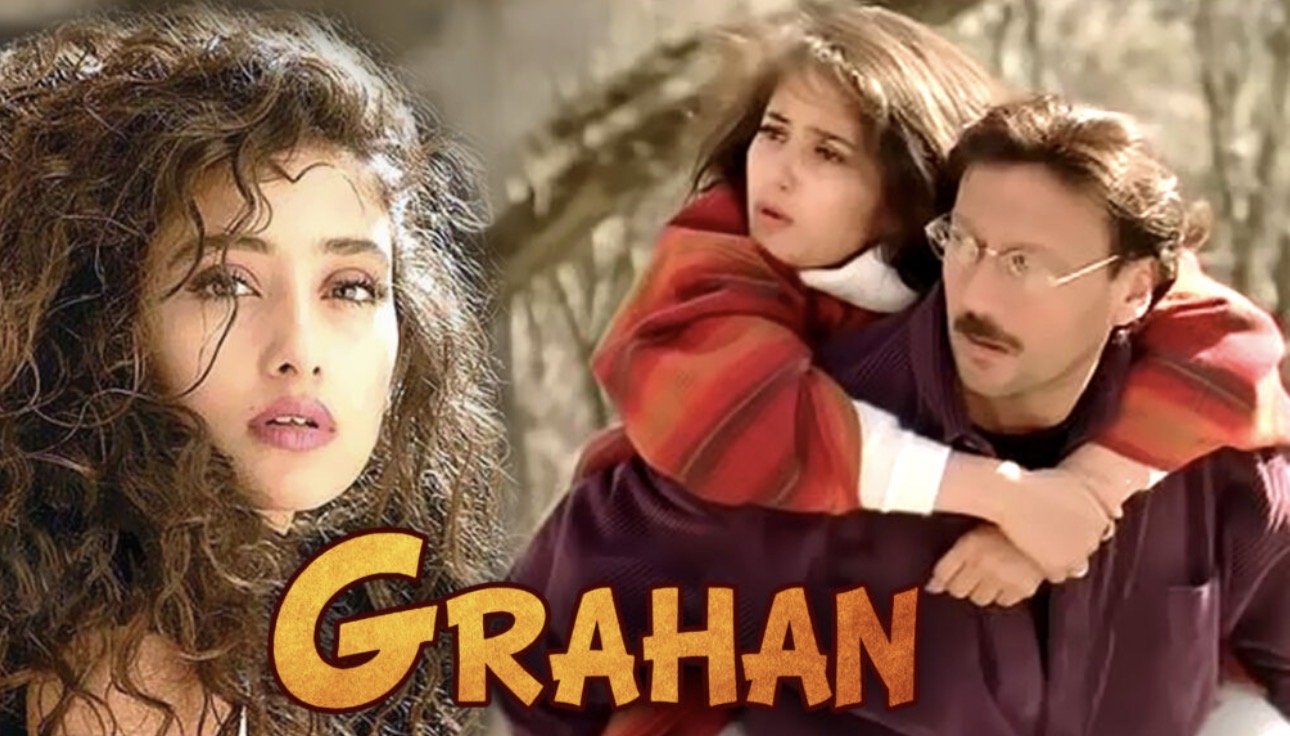
Jackie Shroff Entertainment Ltd.’s Grahan (A) is a social film with the theme of ‘fight for justice’. A beautiful, innocent and poor girl (Manisha Koirala) is raped by the son of the chief minister. The matter goes to court with the noble chief minister’s approval. In the meanwhile, the scandalised chief minister dies of shock due to his wayward son’s ghastly act. The ruling party makes the chief minister’s daughter (Anupama Verma) the acting chief minister with the motive of garnering sympathy votes in the forthcoming elections. The new chief minister’s beloved (Jackie Shroff), an astute but honest advocate, comes to the aid of the accused (rapist) by proving the rape victim to be a girl of loose character. He is unaware of the girl’s innocence. However, when he soon comes to know the truth, he goes in search of the girl to express his apologies. But finding the girl in an almost insane state, he first gets her medically treated. When the girl recovers, the lawyer tries to get her married to the boy to whom she was engaged. But the girl’s prospective in-laws refuse to accept her because of the rape stigma.
On the other hand, after the elections, when the lady chief minister and her cabinet, including the CM’s rapist-brother, are sworn in at an open-air function, the rape victim shoots the rapist to avenge her rape. The man dies on the spot. The conscientious lawyer holds brief for her despite his beloved’s (the new CM’s) strong objection and, in doing so, he also goes against the advice of his brother who had earlier fought the case as a prosecution advocate. Finally, justice prevails.
The story has an ennobling theme. But the drama has very few fine and very many dull moments. The court scenes before and after the interval keep the drama going but the pace is slow. Further, the single (rape) track of the film gets too irritating after a while. The love songs between the hero and his beloved in the beginning brings in dullness. The song situations between the insane girl and the lawyer-hero lack conviction. The happy ending, too, looks like a compromise. Thus the drama is of a switch on – switch off kind. Dialogues are appropriate. The narration is of the kind which will be liked, if at all, by only the elite.
Jackie Shroff gives an excellent performance. Manisha Koirala is superb, delivering a versatile performance, both as a chaste innocent belle and a mentally-tormented rape victim. Anupama Verma fails to impress as she is wooden. She doesn’t pass off as a chief minister by any stretch of imagination. Prasad Purandare, as the rapist, is also not up to the mark. Raghuvaran is fair.
Director K. Shashilaal Nair has made a spirited attempt to present an unusual drama but he fails miserably. Music director Karthik Raja makes an impressive debut on the Hindi screen with very melodious songs. Asha Bhosle’s rendition of Ae sochta hai kya is masterly. Cinematography is good. Other technical aspects are fair. The film looks stale, having taken a long time to reach the screens.
On the whole, Grahan will prove to be a disaster, its poor start only further eclipsing any bright prospects.
Released on 16-2-2001 at Metro and 9 other cinemas of Bombay thru Vishal Distributors. Publicity: average. Opening: dull. …….Also released all over except in C.I.
‘CHORI CHORI….’ RELEASE CERTAIN
Santosh Singh Jain Appointed Receiver
Hectic preparations are on for the release of the much-delayed controversial film, Chori Chori Chupke Chuke, following the appointment of CCCA president Santosh Singh Jain as receiver by the special court, in the matter of release of the film. The order appointing 34-time president of the Central Circuit Cine Association, the largest association of the film industry, as receiver was passed by judge A.P. Bhangale on 12th February.
While Mahesh Bhatt was tipped to be the receiver, the crime branch of the Bombay police is reported to have objected to his appointment tooth and nail as he was perceived by the police to be Bharat Shah’s man.
It may be recalled that the release of Chori Chori Chupke Chupke was thrown in jeopardy when its producer, Nazim Rizvi, was arrested on 13th December, for his alleged underworld links. Soon thereafter, the film’s negatives were seized by the crime branch. Bharat Shah, whose presentation CCCC is, was arrested on 8th January and, after being kept in police custody for several days, both, Shah and Rizvi, have since been remanded to judicial custody.
Soon after the order appointing Jain as receiver was passed, the seized negatives were released (on 15th February). One reel was still to be mixed when the negative had been seized in December last. The mixing will be completed at Empire and once the first copy is out, the film will be ready for release. With not many major films set for release in the coming four to six weeks, it is very likely that CCCC may at long last hit the screens in early or mid-March (2nd, 9th or 16th).
ED QUESTIONS SANJAY DUTT
The Enforcement Directorate (ED) interrogated Sanjay Dutt on 14th February in connection with investigations relating to Bharat Shah – Chhota Shakeel – Bombay film industry nexus. It is for the first time that a star has been questioned by a government agency other than the Bombay police. ED officials have refused to reveal the reason for summoning Sanjay Dutt. Since ED’s area of investigations includes transfer of money abroad or vice versa, it is presumed that the actor may have been questioned about some money transactions.
Some actresses have also been summoned by the ED, it is learnt.
MAHESH BHATT EXPRESS JOY AT JAIN’S APPOINTMENT
Mahesh Bhatt expressed pleasure over Santosh Singh Jain’s appointment as court receiver in the matter of the release of Chori Chori Chupke Chupke. He said in a statement, “I am very happy that a person of the calibre and experience of Santosh Singh Jain has been chosen to carry out the responsibility as the court receiver….” Saying that Jain’s appointment “has removed a burden off my shoulder”, Bhatt expressed confidence that Jain Sahab would do a better job at the assigned task.
VIJAY KONDKE LODGES POLICE COMPLAINT
Producer-director and Bombay distributor Vijay Kondke has complained to the commissioner of police, Bombay, DCP Zone II and ACP, D.B. Marg police station, of the alleged threats issued to him by MLA Shabir Sheikh, deputy commissioner of income-tax, Pune, Padmakar More and others after barging into his office on the sixth floor of Naaz building, Bombay on 10th February.
Kondke has also alleged that inspector Dhanavade of the D.B. Marg police station had refused to register his complaint and was favouring those who had threatened him and his relatives who had come to meet him (Vijay Kondke). He was also roughed up and threatened about his life, Kondke has said in his complaint.
According to the traders in Naaz, the fracas was a result of some internal dispute over the property and assets of Vijay Kondke’s late uncle, Dada Kondke.
RAMESH SIPPY’S SON TO WED
Rakesh, son of Bombay distributor Ramesh Sippy, will wed Sweetu on 2nd March in Bombay at the NSCI, Worli. The wedding reception will be held the same evening at the same venue.
DULAL GUHA PASSES AWAY
Producer-director Dulal Guha breathed his last on the morning of 14th February at Lilavati Hospital, Bombay, where he was being treated for jaundice and diabetes. He was 71 and is survived by his wife, three sons — Gautam, Putul, Pintu — three daughters-in-law and six grandchildren.
Born in Barisal (now in Bangla Desh) on 2nd April, 1929, Dulal Guha was brought to Bombay in 1953 by Bimal Roy. He worked as an assistant to Satyen Bose. He got break as an independent director with Ek Gaon Ki Kahani (1956) which was produced by Satyen Bose. The film, starring Mala Sinha, Nirupa Roy, Abhi Bhattacharya and actor-singer Talat Mahmood, with hit music by Salil Choudhry, became a big success, and Dulal Guha was roped in to direct three films, all of which ultimately got shelved!
He, therefore, launched his own banner, Ganga Chitra, in 1962 and made Chand Aur Suraj, starring Ashok Kumar, Dharmendra, Nirupa Roy and Tanuja. Released in 1965, it remained a moderate success.
Dulal Guha achieved top success as director with Dharti Kahe Pukar Ke (1969), starring Jeetendra, Sanjeev Kumar and Nanda. He was much in demand, but in the same year came Jyoti, and Mere Humsafar in the following year. Barring Premji, all the other producers, who had approached him to direct their films following the big success of Dharti Kahe Pukar Ke, kept away following the failures of Jyoti and Mere Humsafar. He directed Dushmun (1971), a super-hit, for Premji. Since then, Guha remained among the most active directors. He directed Premji’s Dost (1974), Dharmendra’s home production, Pratiggya (1975), Do Anjaane (1976), Khan Dost (1976), Dil Kaa Heera (1979), Dhan Daulat (1980), Dhuan (1981) and Do Dishayen (1982).
Dulal Guha then took a break after which he tried his hand at production once again. He made Sagar Sangam (1988).
After producing two films and directing 15 films, the producer-director called it a day and decided to move far away from the Bombay film industry. He shifted to Nasik where he looked after his farm, Sai Baug, for the last 10 years.
On 3rd January, the three Guha brothers rushed to Nasik when they learnt of their father’s illness. He was brought to Bombay and admitted to Lilavati Hospital on 8th. After a fortnight’s treatment, he was back home (Bombay residence). Guha had to be re-admitted to the ICU of Lilavati Hospital on 27th January. On 14th February, he breathed his last at 7.40 a.m. He was cremated the same day at Oshiwara crematorium.
Paying tributes to the departed soul, Premji said, “Dulal Guha had always been an accomplished technician. He never used to promote himself unlike others of his tribe. Village subjects used to fascinate him. His first film was Satyen Bose’s Ek Gaon Ki Kahani which, incidentally, is the only Satyen Bose film which was not directed by Satyen-da himself. And Dulal-da vindicated Satyen-da’s faith in him. His two other rural subjects were Dharti Kahe Pukar Ke and Dushmun, both of which were super-hits. And what’s more, when he retired from filmmaking, he spent his time in the solitude of a village in Nasik…. I will never forget his dedication, his erudition. He was a voracious reader of Bengali books and he used to quote passages word for word. We’ve lost a great man.”
According to Premji, “Even today, Shatrughan Sinha considers his role in Dulal Guha’s Dost as his lifetime’s best role.”
RAM MAHESHWARY BIDS ADIEU
Noted director Ram Maheshwary passed away in the early morning hours of 10th February at his residence in Bombay, following a brief illness. He was 74.
Before starting his film career as a director, Ram Maheshwary was a lecturer at Hindu College, Amritsar, where he was the head of the department of political science. His debut-making film, Kaajal (1965), proved a super-hit. His second film, Neel Kamal, also proved a runaway hit. He directed both these films for his home banner, Kalpnalok.
He later made a Punjabi film, Nanak Naam Jahaz Hai, a Sikh devotional, which created history in Punjab. It also won for him the President’s award. Ram Maheshwary then directed Karmyogi and Chambal Ki Kassam. Incidentally, all his four Hindi films starred Raaj Kumar. He directed one more Punjabi film on Sikh religion, Sarbans Daani Guru Gobind Singh. A little before his death, Ram Maheshwary had completed the script for another Sikh devotional on Guru Tegh Bahadur. He had also recorded five songs for the film which he considered an ambitious project. But Death did not wait!
RAVI MALHOTRA NO MORE
Producer Ravi Malhotra (maker of Khel Khel Mein, Rahi Badal Gaye, Jhoota Kahin Ka and Hum Dono), brother of Rakesh Malhotra (producer of Hadh Kar Dil Aapne), expired on 13th February following cardiac arrest at Nanavati Hospital in Bombay. He is survived by his wife, a daughter, a son, three sisters and a brother. Chautha ceremony was held on 16th at Arya Samaj Mandir, Santacruz.
DINESH ANAND SHOT DEAD
After Hanif Kadawala, yet another film personality was gunned down on 14th February by the underworld. Actor Dinesh Anand, who has done bit roles in scores of films, was shot to death on Wednesday at National Park, Borivli, Bombay.
Dinesh used to be a permanent face in slain producer Mukesh Duggal’s films like Fateh and Platform. He used to generally play the villain’s henchman or a lawyer. He was very recently seen in Kuch Khatti Kuch Meethi.
BHAKTI BARVE-INAMDAR DIES IN ACCIDENT
Actress Bhatkti Barve-Inamdar was killed in a road accident on the Bombay-Pune expressway near Panvel on 12th February. She was returning from Wai after participating in a stage-show when the car in which she was travelling collided with an electric pole. She died on the spot.
She was rushed to a hospital in Vashi, near Bombay but was declared dead on arrival. Bhakti, the widow of actor Shafi Inamdar, was 55.
A veteran actress of Marathi stage and films, Bhakti Barve-Inamdar began her carrer as a Marathi newsreader on Bombay Doordarshan in the ‘seventies. She made her debut in Hindi films in the role of a firebrand newspaper editor in Kundan Shah’s Jaane Bhi Do Yaaro (1984). She later married actor-director Shafi Inamdar. Shafi had died of a massive heart attack at the young age of 47 in 1996. Among the Marathi dramas Bhakti had acted in was Tee Phulrani.
Bhakti Barve-Inamdar’s body was taken to Shivaji Mandir at Dadar where her last rites were performed. She was cremated the same afternoon.
YOU ASKED IT
When the negatives of Chori Chori Chupke Chupke were under police custody (and kept in the lab), how did its pirated videos come out, as claimed by the Overseas distributors?
– Have you seen a pirated video cassette of CHORI CHORI CHUPKE CHUPKE? If the film had, in fact, been pirated, why didn’t the pirated video cassettes reach India?
Some of the serials which come on channels these days are very much appreciated by the audience, for their story content. Why don’t our producers, who complain about the dearth of good stories, tap the talents of such writers?
– You’ve got a point. Several television writers are doing films also. But let me add, film writing and television writing are very different things.
In a film production budget, how much percentage is allocated for publicity, including paper, radio, TV, posters, banners, hoardings etc.
– Between 5 and 10%.
3-E
Education-Entertainment-Enlightenment
The Fall Story!
Subhash Ghai, Hrithik Roshan and Kareena Kapoor. Each had a nasty fall last week. And that will remain a part of their yaadein. This is how the mighty fell!
Subhash Ghai was shooting on an island location of Langkawi in Malaysia for Yaadein. On 10th February, after pack-up, Ghai was walking up the stairs to the dockyard from the yacht in which they were shooting. With Hrithik lending him a helping hand, Ghai rushed his way up. Suddenly, the wooden stairs beneath creaked and gave way! The next moment, both, Hrithik and Ghai, found themselves in the waters!! It was only with Hrithik’s help that Ghai managed to come out of the waters. He, however, suffered injuries on his right arm, while Hrithik ended with very few bruises.
Kareena, on the other hand, was riding a bicycle for a shot of Yaadein when she lost her balance and bit the dust, hurting her knees in the process! Well, that’s all about falls bizarre….
A smart Alec rhymed:
Those rickety steps seemed to do it all
As Ghai and Hrithik in waters did fall
While Kareena, cycling for a shot,
Fell and found her knees to be a sore spot!
Sunny’s Hair-Raising Experience
For Sunny Deol, Zee’s Gadar Ek Prem Katha was a truly hair-raising experience. And not just because it was shot for 39 days in Amritsar and other places in Punjab where son of the soil Sunny is revered as God! That surging crowds used to disrupt shootings on the streets and railway platforms, if only to see, touch and feel Sunny Deol, is not the only hair-raising experience one is talking about. This one has a literal connotation too! Sunny sports a beard in a fair part of this period film, set in the times of the Partition. And rather than using a false beard, Deol decided to sport a natural one. That’s hair-raising, isn’t it?
Small Screen Before The Big Screen
Even before Miss Asia Pacific Diya Mirza makes her big-screen debut, she will face the cameras for the small screen. Diya has been pencilled in to shoot for the title track of Tips’ romantic album, ‘Khoya Khoya Chand’.
While Anupam Kher will direct the beauty in her first big-screen appearance, Om Jai Jagadish, it is choreographer Farah Khan who will call the shots in ‘Khoya Khoya Chand’. The album has ten songs rendered by Alka Yagnik and Babul Supriyo, penned by Sameer and composed by Sajid Wajid.
SPOT INTERVIEW
“There is no question of any price reduction or
increase whatsoever in the case of
CHORI CHORI CHUPKE CHUPKE”
– Court Receiver
SANTOSH SINGH JAIN
GAUTAM MUTHA
The appointment of Santosh Singh Jain as the court receiver for the release of Chori Chori Chupke Chupke is felt to be a judicious decision, by the trade. There is much relief among the distributors of the film, not only because their film will at last be released but also because Santoshji has been an expert in taking quick decisions. He has helped disentangle many knotty problems as president of the country’s strongest film body, the Central Circuit Cine Association (CCCA). Over to the grand old man of the industry.
What is the latest position about the release of CHORI CHORI CHUPKE CHUPKE?
The film’s mixing is going on and within a couple days, its first copy should be out. The film is scheduled for release on either 2nd or 9th March. Many distributors are in favour of its release on 2nd March to avail of a mid-week (Idd) holiday on 6th.
So, how will you be handling the situation vis-à-vis the distributors?
I have called upon all the distributors to come ahead with their papers/agreements and accounts. We will sort out the matters according to the documents available with them.
What about the claims from the artistes, technicians and others involved with the production?
Whoever proves his claim through proper documents shall be entitled to payment.
Has a separate bank account been opened?
Obviously! It will be operated by the court receiver, that’s me. After the recovery from the distributors and others, and disbursements therefrom, the balance will be deposited in a fixed deposit scheme. The court will decide to whom the monies should go.
Supposing the film clicks, what about the overflow money?
I don’t have to bother about that. The court has already instructed all the distributors to give undertakings that they would keep their accounts in a proper manner.
Has any of the distributors asked for price reduction due to the delay in delivery? Or, have you asked the distributors for price increase due to shortfall?
I will go purely by the agreement. There is no question of any price reduction or increase whatsoever.
Has any distributor got the film on outright basis? According to Vinay Choksey (VIP Enterprises, Bombay), he has the film on outright basis.
I have already told him to give me the agreement in support of his claim. On Tuesday (20th), I have a meeting with the solicitors to go through the agreements.
Have you engaged anyone to assist you in this matter?
I am not carrying a burden on my head that I would be in need of a person to share my burden. Anyway, the good part of being appointed the court receiver is that I am getting to learn the ropes of production insofar as the release goes.
INFORMATION MEETS
YEH RAASTE HAIN PYAAR KE
A Labour Of Love
It is a typical wintry morning in New Delhi. The only difference is that crowds outside a Mataji’s temple in New Friends Colony are getting restless. The road on which they stand is nearly jam-packed. One also notices the presence of several policemen. The crowds, of course, have gathered for darshan — though not of the Goddess. They are here to get a glimpse of two of their favourite stars — Madhuri Dixit and Ajay Devgan.
Inside the temple, the shooting of the opening sequence of Yashish Enterprises’ Yeh Raaste Hain Pyaar Ke is on in full swing. The film, Deepak Shivdasani’s ninth as director, stars Ajay Devgan, Madhuri Dixit and Preity Zinta, with Sunny Deol in a guest appearance. The scene being picturised is that of Ajay-Madhuri’s wedding. The on-screen couple has gone to school together once. Later, they have fallen out of touch, only to meet up once again at a school reunion. They have become friends again and their proximity has culminated into love. For some reason, the couple is getting married secretively, with only the officiating priest being present at the wedding.
Madhuri’s bridal look is nothing short of stunning. Her jewellery and the dress are, in one word, exquisite. Designed by Ritu Beri, the bridal outfit glimmers in enhancement of Madhuri’s gorgeous beauty. Ajay Devgan’s, on the other hand, is an understated look for the occasion. He is dressed in a sedate navy blue suit, with a pink upvastram thrown over it.
Madhuri is required to look upset during the sequence. In the next shot, she calls up her parents to inform them of the wedding. Her enraged father disowns her. The newly-wed is distraught and bursts into tears.
Producer-director Deepak Shivdasani is all smiles, happy with Madhuri’s performance. “Cut!”, he shouts. “This is the third time we are shooting this sequence,” informs he, adding, “The last time we shot it, Om Puri played Ajay Devgan’s father. Unfortunately, the film got delayed and Om Puri couldn’t give us the dates we needed. If things would have gone as we had planned, the film would have been released by now. But we had two long lay-offs from shootings — one, seven months long and another, four months. In the eleven months that we didn’t shoot the film, everyone’s dates went haywire.” And what was the cause for the delay? Deepak admits, “Partly, Raju Chacha. Anyway, when things began to move again, Om Puri was not available.”
Later, in April last year, Shivdasani erected a huge set in Bombay to shoot the same sequence. However, the heat on the set became so unbearable for the actress — what with the elaborate bridal outfit and heavy jewellery etc. — that the shooting was abandoned and set, demolished.
Finally, the sequence was completed during the present schedule at the temple in New Delhi, much to the unit members’ joy. Quips Deepak, “Everyone is so relieved, now that the sequence is canned. It is as if we’ve broken the jinx!”
Among the cast, Ajay Devgan was signed first. A lot of people felt then that his was a surprising choice, considering the fact that several of Shivdasani’s films, including his last, Bhai, starring Sunil Shetty, was a success. Shivdasani explains, “When I finished Bhai, Sunil had already signed films with Priyadarshan, Gulzar, Ram Gopal Varma and a few other makers. Also, at that time, the script of YRHPK was not complete. So, Sunil suggested that we wait for about two years. However, when I began working on this film, its subject had me excited almost immediately. At that point, I knew, I couldn’t wait for two years. As for Ajay, I had known him for a long time. He assisted me in the direction of Madam X. I also felt that he would suit the role. Hence, his presence in the cast of YRHPK.”
In the case of heroines, Shivdasani had decided to sign only those who had never been paired opposite Ajay on screen. This, so that the film had fresh casting. While there was no hitch in getting Madhuri to sign on the dotted line, it was the other heroine who remained elusive for some time.
Initially, Rani Mukerji was signed to play the role now being played by Preity Zinta. However, according to Shivdasani, she signed another film soon after the work on YRHPK, due to which a problem over dates arose. The producer-director adds, “She also seemed more keen to do Lagaan at the time. Since things between us weren’t matching, we mutually agreed to part ways.
Next, Shivdasani approached Karisma Kapoor in spite of the fact that Karisma and Ajay had been paired on screen before. Shivdasani defends his decision, “Ajay and Karisma had worked together many years ago. So, we thought, that wouldn’t make a difference. Besides, the Madhuri-Karisma combination had worked well in Dil To Pagal Hai. Hence, we opted for Karisma.” Little did Shivdasani know at that time that it was a decision he was going to regret later. As it turned out, Karisma opted out of the film. When asked why she did that, Shivdasani plainly says, “The reason why she chose to walk out of the film can be best answered by her. I was disappointed when she returned me the signing amount I had given her. She gave me the excuse that she was planning to get married. Later, of course, she denied that she was getting married.”
Eventually, the choice fell on Preity Zinta who plays an ebullient and spontaneous young girl in the film. Ajay plays dual roles in the film. The other, a car thief, falls in love with Preity who is also a thief. However, it is Madhuri who has the author-backed role. Says the actress about her role, “I play a woman who lives in a make-believe world of her own. The people surrounding her do not have the gumption to tell her to snap out of it. Her condition gets worse and she begins suffering from what is known as Traumatic Selective Amnesia.”
Seems like an original subject, one remarks, to which screenplay writer Robin Bhatt quips, “It is original. After all, it’s not my subject!” The story idea actually came to Deepak Shivdasani’s mind some twelve years ago and remained on the back-burner for all these years. He says, “The idea had germinated from L.V. Prasad’s Khilona. I had this plot, but had never got around to working on it. It so happened that, after Bhai, I was looking to remake some film, but couldn’t find one that excited me enough. One day, I was sitting with my family, discussing on what I could make next. I just happened to bounce this particular idea and everyone jumped at it. That’s how the ball was set rolling.”
Later, Shivdasani narrated the idea to a lot of people and got positive response. Finally, when Ajay gave his nod, he began working on the screenplay. For the next whole year, he just worked on the screenplay and on planning the film. Rues he, “It is unfortunate that, in spite of planning, the film got delayed.”
Shivdasani’s entire family is involved in the making of YRHPK. All seven members of his family, including his wife, his daughter and his sister-in-law, have been “integrally involved” with YRHPK. It is a labour of love for each one of them. Yeh rishte hain pyaar ke….
Turning to economics of the film, Shivdasani says, “A lot of money has gone into the making of YRHPK. It has cost me three times more than my last release, Bhai, which was made at a budget of Rs. 5.25 crore. You may be surprised to know that the entire star cast of Bhai cost me only Rs. 36 lakh. But, in the case of YRHPK, the economics is completely different.”
It is a big film for Shivdasani in more ways than one. He is looking to establishing his banner, Yashish Enterprises, with the film. To meet this goal, he has planned the smallest of details about the film way in advance, like deciding, right at the launch time, that he would not sell the film till it had been completed. He explains, “I haven’t tried to sell my film as yet. I’d rather finish the product first, show it to distributors and then, sell it. I feel, it is a wise thing to do in times when the market conditions are so bad. Given the unprecedented number of flops in the past one year, the situation is such that one cannot hike the price of his film at his whim. There are times when the distributors raise their hands and say, ‘We can’t pump in the required money.’ I know, it’s a tough decision to wait for selling it until the film is complete, but, if you ask me, it is also the best thing to do. We had planned it so right from the start. In that sense, it is a much bigger gamble one is playing this time.”
On the music side, YRHPK has seven songs, penned by Anand Bakshi and composed by Sanjeev Darshan, with the title song as well as Jo pyaar karta hai being clearly the pick of the lot. Tips will be releasing the audio in due time.
The film, which went before the cameras in June 1999, will release all over on 19th July this year.
– RAJ VAIDYA