


























DEEWAANAPAN
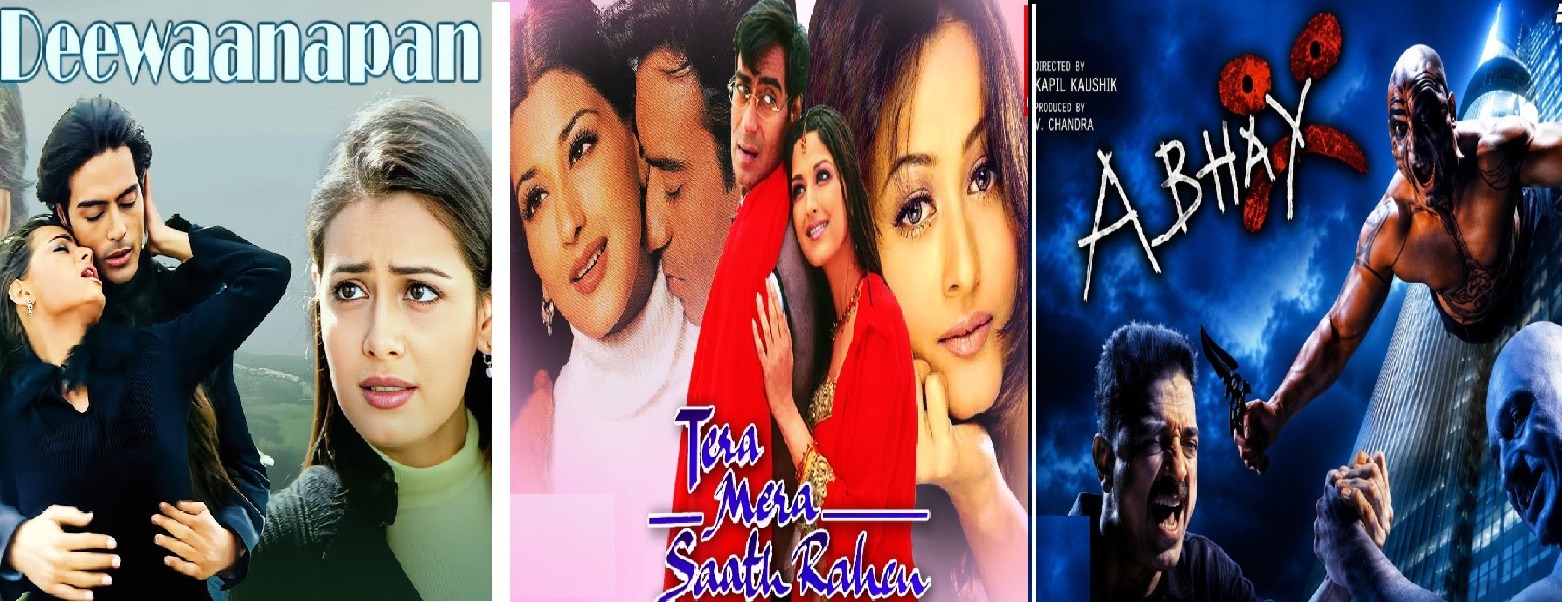
Puja Entertainment (India) Ltd.’s Deewaanapan is a routine love story minus the fire and passion so necessary in a film of this genre. A girl and a boy fall in love with each other but the girl’s rich and proud father will not hear anything of this alliance. He orders the boy to leave the city and forget his daughter forever, threatening him of dire consequences if he did not obey him. While the boy refuses to be brow-beaten, the girl’s father makes life miserable for him and his parents. He even gets the boy’s noble-hearted father framed for a crime he never committed. The boy bears all the humiliation heaped upon him and his family, quite like a mute spectator, till he ultimately losses his patience. He then proves his love for the girl by beating up all the henchmen sent by her father to finish him off.
The story and screenplay (Ashu Trikha) are devoid of any novelty. The first half has precious little movement and the scenes and incidents fail to excite the viewer. The romance has no magic because of which the tension in the post-interval part doesn’t build up to a level which could involve the audience. The characterisations of both, the hero and heroine, are weak. The hero doesn’t retaliate for far too long — not when his mother is humiliated in the market place, not when his father is manhandled, not even when his father is sent to police lock-up on false charges. Likewise, the heroine hardly defies her arrogant father because she loves him too much. Resultantly, the drama looks insipid, at least in the first seven to eight reels. The pace does pick up after interval but not to the desired level. Action scenes, nevertheless, add zing to the drama and are about the best part.
Comedy is almost conspicuous by its absence. Climax is predictable but has plenty of action for the masses. Dialogues are commonplace except in the scene in which the hero challenges the girl’s father at interval point and the one in the police station. Confrontation scenes between the hero and the heroine’s father are otherwise dull.
Vinod Khanna does an average job as the father of the girl. Arjun Rampal is excellent in action scenes. As for acting, he tries hard but it’s the effort which shows more than the acting. Diya Mirza continues to be plastic. Her dialogue delivery is expressionless. She also needs to improve a great deal in dancing. Om Puri does well but doesn’t get a role to suit his calibre. Smita Jayakar is fair. Sharat Saxena, Vikas and Kabir Sadanand lend average support in the very limited scope they get.
Ashu Trikha makes a poor debut as writer-director. Like his script, his direction has no stamp of individuality. Aadesh Shrivastava’s music is a mixed bag. ‘Satrangi’, the title song, ‘Nach nach nach’ and ‘Kamli Kamli’ are well-tuned numbers. Suhas Gujarathi’s cinematography is eye-pleasing. Foreign locations are fabulous. Action (Abbas Ali) is super. Production and other technical aspects are very good.
On the whole, Deewaanapan is weak in merits but has action and the bountiful Diwali period to salvage it to some extent in some circuits.
Released on 15-11-2001 at New Excelsior and 6 other cinemas and on 16-11-2001 at 12 more cinemas of Bombay thru Raksha Distributors. Publicity: excellent. Opening: good. …….Also released all over. Opening was very good in U.P. and some other circuits and fair in others.
TERA MERA SAATH RAHEN
Ratan International’s Tera Mera Saath Rahen is the story of two brothers (Ajay Devgan and master Dushyant Wagh) who live all by themselves in a middle-class locality. The younger one, Dushyant, is afflicted by cerebral palsy because of which Ajay has to tend to him day and night. So emotionally attached is Ajay to Dushyant that he decides never to marry any girl as he fears that she may not feel the same way towards his kid-brother. His neighbour’s daughter (Namrata Shirodkar), who is fond of him and Dushyant, makes advances towards him but he doesn’t take her seriously. Another girl (Sonali Bendre) comes into his life and she requests him to be her friend even if he didn’t have marriage on his mind. Slowly but surely, Ajay falls in love with Sonali but the latter advises him to send Dushyant to a home for the spastics. At first, this disturbs Ajay terribly, but he agrees in a bid to win her over and to provide a better future for him.
He admits Dushyant to one such home but feels miserable about it. In just a couple of days, he gets him back from the home and promises never to be separated from the brother. Sonali, having sensed Ajay’s anguish, also sees reason and agrees to marry Ajay.
Although the film is very sensitive, the story about a patient of cerebral palsy is also very depressing. The latter part of the film, especially, disturbs the viewer with its gloomy goings-on. More than drawing tears, it evokes a feeling of despair and depression in him.
Writer-director Mahesh Manjrekar has tried to draw a great deal from real-life incidents in middle-class families, which makes the film quite realistic. But he needs to appreciate the fact that the paying public views cinema as an escapist fare, more so in today’s tension-ridden times, and wants to be entertained rather than burdened with morose stuff.
The story and screenplay have some weak points. For one, there is hardly any interaction of the ailing child with members of his society, because of which there’s not much sympathy (among the characters in the film) for him. Even Ajay’s love for his brother doesn’t come across as beautifully as it should have. It often appears that he is merely doing his duty. Because of the above, when Ajay actually shows his frustration before admitting him to the home for the spastics, there’s not enough emotion in those scenes so that they don’t appear heart-wrenching. Frankly, Ajay starts looking selfish when he plans to admit him. Also making Ajay’s character selfish is the fact that he begins by telling Sonali that he can’t get married to her (implying thereby that he is so selfless) but ultimately pleads for her hand in marriage — this even after she has made it clear that he should leave his handicapped brother in somebody else’s care! If he was really selfless, he would never think of Sonali after that. For that matter, if he was so selfless, why did he not agree to marry Namrata who was madly in love with him and would also have lovingly accepted his brother? Such questions in the audience’s mind rob the sensitive subject of its emotions. They also combine to weaken the character of the hero. While the writer-director may explain all of the hero’s actions as being true-to-life, this is exactly what is the film’s undoing. One does not want to see a hero with so many faults — not in a commercial film.
The film has quite a depressing flavour and even the light scenes have more of a class appeal. Climax could have been more heart-warming.
Ajay Devgan does a fair job. But his performance fails to tug at the audience’s heart at several places. Sonali Bendre is average. The film actually required two great actors to evoke sympathy. Namrata Shirodkar does a very fine job, living her character of a spurned lover first and a deserted wife later. Master Dushyant Wagh essays a very difficult role with a good amount of ease. Considering his young age, he comes out trumps as the handicapped boy. Shivaji Satam shines, as always. Reema is also good but her track of English dialogues remind very heavily of Shilpa Shirodkar in Gopi Kishen. Prem Chopra and the rest of the cast lend good support.
Direction is fair but some more tear-jerking scenes as well as enjoyable comedy would’ve given the film a completely different colour. Anand Raaj Anand’s music comprises three good songs — the title track, ‘Pehli nazar mili tumse’ and ‘Haqh jata de’. A couple of songs are dull. Camerawork (Vijay Arora) is appealing.
On the whole, Tera Mera Saath Rahen has some appeal for a small section of the audience only.
Released on 15-11-2001 at Liberty and 5 other cinemas and on 16-11-2001 at 13 more cinemas of Bombay by Ratan International thru Devgan Entertainment & Software Ltd. Publicity: very good. Opening: so-so. …….Also released all over. Opening was poor almost everywhere.
ABHAY
V. Creations’ Abhay (A) is the story of twin brothers. While one (Vijay) grows up to become a commando, the other (Abhay) lands up in a mental asylum because of a traumatic childhood. A very intelligent man, Abhay hates women and thinks that all women are out to ruin men. He goes out of control very easily and when that happens, he doesn’t bat an eyelid before murdering people. In short, he is a psychopath. When Vijay tells him of his marriage plans, Abhay takes it upon himself to kill his wife-to-be. He escapes from the asylum and sets out on their trail and continues to stalk them even after they are married. Ultimately, after a very long chase, Abhay catches up with Vijay and even tries to kill him because he won’t allow him (Abhay) to murder his wife. Finally, Abhay kills himself when he is ‘told’ by his dead mother that his sister-in-law is not an evil lady.
The screenplay abounds in abstract scenes involving Abhay talking to his dead mother and others who are not really with him. The drama is terribly tense and leaves the viewer in a tizzy rather than entertaining him. Abhay has been shown to be unbelievably super-intelligent and super-human so that not even ten people can overpower him. The film reminds of Aks.
Firstly, because the story is not quite believable and also since there is so much abstractness about it, the film becomes a boring affair that may be enjoyed by the very elite crowd only. Several action scenes, at least in the first half, have been shown in animated form, making them look like stunts between cartoons. The Hindi film viewing audience will find this concept quite ridiculous.
The second half is very dull in parts. The portion of the brothers’ flashback (childhood) is not just boring, it is also very gross. Abhay’s chase to kill Vijay’s wife appears never-ending.
Kamal Haasan excels in a double role. He plays Vijay and Abhay with aplomb and gives yet another memorable performance. Raveena Tandon acts ably and stands her own in the story of two brothers. Manisha Koirala leaves a mark in a special appearance with her free acting. She should, however, take care of her weight and figure. Kitu Gidwani is effective. Milind Gunaji does an average job. Vikram Gokhale passes muster. Navin Nischol, Smita Jayakar, Vallabh Vyas, Major Ravi, Yashpal Sharma, Krishna Bhatt and Nissar Khan lend good support. The two child artistes are very natural.
Suresh Krissna’s direction couldn’t have been better, given the weird screenplay (Kamal Haasan). Music doesn’t add anything to the drama except more boredom. ‘Hans de’ and ‘Zingoria’ are fairly good songs because of their picturisations. Background score is splendid. Thiru’s camerawork is excellent. Dialogues (Amitabh Srivastava) are natural. Action (Vikram Dharma) is breathtaking. Computer graphics are well-executed. Production and other technical values are appropriate.
On the whole, Abhay is too dry, abstract and heavy a film to be enjoyed or even tolerated.
Released on 16-11-2001 at New Empire and 18 other cinemas of Bombay thru Shringar Films P. Ltd. Publicity: very good. Opening: fair (affected due to cancellation of matinee shows everywhere). …….Also released all over except in Delhi-U.P., East Punjab, Bihar, Assam and Orissa. Opening in several places was dull.
LATEST POSITION
None of the Diwali releases could make a big impact at the box-office universally.
………….
Indian reaped the benefit of Diwali by recording good collections on the opening day of 4th week. 3rd week Bombay 11,99,860 (55.05%) from 3 cinemas (7 cinemas unrecd., 8 on F.H.); Satara (6 days) 1,10,485 from 2 cinemas (1 in matinee); Bijapur 65,000; Delhi (5 days) 8,65,991 from 8 cinemas (3 on F.H.); Lucknow 3,33,363 from 2 cinemas, Agra 3,25,000, Bareilly (6 days) 47,950; Calcutta (6 days) 5,67,495 from 6 cinemas; Nagpur 2,61,206 from 3 cinemas, Jabalpur (6 days) 50,707, 2nd week Balaghat 55,248, 3rd week Amravati 1,83,689, Akola 1,27,664, total 5,08,831, Raipur (5 days) 99,260, Jalgaon (6 days) 1,69,700, Wardha (6 days) 33,609, Chandrapur (6 days) 1,01,659, Yavatmal 57,188, total 3,02,470; Indore (6 days) 61,227 (2 on F.H.); Jaipur 2,95,230 (50.46%); Hyderabad (gross, 6 days) 5,27,214 from 3 cinemas (1 in noon).
Asoka 3rd week Bombay 36,99,474 (60.42%) from 11 cinemas (8 on F.H.), total for 3 weeks 1,39,90,642; Satara (6 days) 42,730 (gross); 1st week Bijapur 1,20,000; 3rd week Delhi (5 days) 12,29,355 from 11 cinemas; Lucknow (22 shows) 1,87,916, Agra 1,46,000, Bareilly (6 days) 31,712; Calcutta (6 days) 3,78,815 from 2 cinemas; Nagpur 1,30,817, Jabalpur (6 days) 66,701, Amravati 75,146, Akola 52,263, total 2,80,386, Raipur (6 days) 30,076, Jalgaon (6 days) 54,637; Indore (6 days) 32,748 (2 on F.H.); Jaipur 4,87,872 (57.61%); Hyderabad (gross, 6 days) 7,94,054 from 4 cinemas.
TWO MORE SCREENS OPEN AT IMAX
The tally of screens at IMAX Adlabs Multiplex at Wadala in Bombay has risen to four with the opening of screens 1 and 2 on 15th November. Screens 3 and 4 of the multiplex have already been functioning since a couple of weeks. Screen 1 has 351 seats and Screen 2 has 261 seats. Both the auditoria are equipped with Dolby Digital sound system. Various Hindi and English films are being shown at the new screens.
The multiplex is controlled by Shringar Cinemas Pvt. Ltd.
SOHAIL KHAN FREED ON BAIL
Actor-director Sohail Khan, brother of Salman Khan, who was arrested by the police for allegedly beating up a young boy on 11th November, was released on bail the same afternoon. It is said that when Sohail’s brother-in-law, Bunty, and another person were involved in a fight in a hotel lobby, Kabir, a young struggling actor, went to pacify them. But Sohail lost his cool and hit Kabir with a broken bottle. Sohail denied that he had beaten Kabir.
The young guy was admitted to Lilavati Hospital where he was operated upon. Sohail and Kabir are said to have known each other even before this incident.
‘ABHAY’ PREMIERE
The premiere screenings of Kamal Haasan’s Abhay were held on 15th November at screens 1 and 2 of the IMAX Adlabs multiplex at Wadala, Bombay. Kamal Haasan introduced the cast and technicians of the film to the audience which comprised Amrish Puri, Randhir Kapoor, Urmila Matondkar, Saurabh Shukla, Atul Kulkarni, Ramesh Sippy, Tushar Gandhi, Vashu Bhagnani, Dinesh Shailendra, Hansal Mehta, Suresh Wadkar, Hariharan and others. The film’s Bombay distributor, Shyam Shroff, as well as Adlabs’ Manmohan Shetty and Pooja Shetty were also present.
M.P. GOVT. HONOURS B.R. CHOPRA
Dr. B.R. Chopra, one of the doyens of Indian cinema, has been honoured by the government of Madhya Pradesh with the prestigious Kishore Kumar Sanman. This honour adds one more feather to Dr. Chopra’s already decorated cap.
NEW CINEMA OPENS IN BOMBAY
A new cinema, Cine Gold, opened at Bhiwandi (Thane district) on 15th November with Tera Mera Saath Rahen. The 199-seater, equipped with Dolby DTS sound system, is situated in the compound of the existing Cinemej cinema. The capacity per show of Cine Gold is Rs. 4,052.35 and that for 28 shows is Rs. 1,13,465.80. It is controlled by Umakant Singh and owned by Haji Yunus Aghadi. The telephone nos. of the cinema are 952522-52794/53622.
NEW CINEMA OPENS IN BHOPAL
A new cinema, Shri Ram Chitra Mandir, opened this week in Bhopal with Abhay.
INFORMATION MEETS
“Leave me or like me — that’s the way I am!”
SHAH RUKH KHAN on himself
KOMAL NAHTA
Shah Rukh Khan has been quite an enigma. At a time when entry from television to films appeared an impossibility, not only did Shah Rukh cross over from the small screen to the large, but also rose to the top position by sheer dint of hard work coupled with unbridled talent. When heroes considered it taboo to touch negative roles, the actor not only attempted them in three films but also made two of them (Baazigar and Darr) hits. When, after Hrithik Roshan’s arrival on the scene, his detractors thought, he was losing ground, he not only stood his own but also delivered yet another big hit in Mohabbatein and proved that he is still as much a darling of the masses as he was when he first became a superstar.
An insight into the mind of Shah Rukh Khan, the actor, the star, the producer and the human being:
“I don’t take signing amount: Even today, I am too embarrassed to discuss money and signing amounts with producers. Which is why I rarely take signing amount for a film. In fact, I don’t charge too much for films. I make my money through endorsements and stage-shows. Even if a producer is unable to pay me the price he had committed, I don’t create a fuss. If he is genuinely in a problem, there’s no sense in insisting on the money because he won’t be able to pay it to me. And if he is playing a game for saving money, well, he will be exposing himself. I’ll refrain from working or dealing with him in the future. Why, I’ve even helped my producers in need by shelling out money to complete their films. Nazir Ahmed is an example. I lent him many lakhs to complete One 2 Ka 4, and I’ve not got it back till today.
“I never charge money for friendly, guest or special appearances in films: Boney Kapoor’s film is, perhaps, the first film for which I am taking remuneration for a guest appearance. That too, because I had to pay heavily this year to get a clean title for the house I live in. Actually, I rarely do special appearance roles. But this particular role in Boney’s film, starring Nana, Karisma and Sanjay Kapoor, was liked by Karan (Johar) who insisted that I did it. Kajol also liked the character I would be playing. Earlier, she was to have played the heroine’s role which is now being essayed by Karisma Kapoor.
“I don’t sign a film till….: …..till I feel that the director can do better than me. After all, he is the captain of the ship and he must inspire that kind of confidence in me to get my nod to work in his film. Frankly, even before the script, I look at the people I have to work with, when I have to decide on accepting an acting offer. That is first and foremost because if I’m not comfortable working with them, how will I act on the sets?
“Ashutosh (Gowariker) had narrated the idea of LAGAAN to me some six years back: Ashu, who is a close family friend, had this subject of Lagaan in mind even six years ago. He told me the story but since I didn’t have a production company of my own then, I could only recommend his name to producers whom I knew. Unfortunately, while I had liked the subject, producers whom I spoke to did not seem to agree with me or Ashu. I suggested Ashu’s name to several producers who approached me during those days, including Mushir-Riaz, Ratan Jain and the Moranis. Mushir-Riaz were not enthusiastic because Ashutosh had a flop (Baazi) behind him. You know, how a director or actor is judged by his last film, in this industry! Ratan Jain, whom I am close to, was polite in his rejection. I still remember, the Moranis were narrated the subject of Lagaan in the US. Aamir and I were participating in stage-shows produced by them and directed by Ashu. But the Moranis also said “no”.
Ultimately, Ashu gave a narration to Aamir who finally made the film. Before that, as you know, even Aamir had rejected Ashu’s subject of Lagaan. Dharmesh Darshan, however, had liked it.
“I generally keep some item of clothing or personal effects from every film I work in, as a souvenir: In Mohabbatein, I took home the bracelet with my name (in the film), Raj Aryan, embossed on it. I gifted it to my son whose name is Aryan. Sometimes, I take a pair of jeans, sometimes shoes, sometimes a chain which I may have worn in a film. But I like to keep one souvenir from each of the films I have acted in.
“I intend to quit smoking soon: Currently, I smoke 60 cigarettes a day, almost all of them to the last puff. I want to give up the habit completely. I think, I’ll do it once Asoka is released.” (The star-producer is still to kick the habit!)
“Non-seriousness irritates me terribly: I am passionate about whatever I do. Whether it is my work or even a friendly game of cricket I may be playing, I become very serious on the job. Half-heartedness or frivolity are not for me. That is why I am appalled by the importance some heroes give to looking good when they should be equally bothered about performing well before the camera.
“I live the moment in front of the camera: When a scene belongs to me, I get completely immersed in it. Then, if my hair are not in the best style or my tie is not in perfect place, I don’t care.
“I cry naturally before the camera: Rarely do I use glycerine to bring tears to my eyes in emotional scenes. The surprising part is that while I cry so easily while acting, I never cry while watching a film! Yes, I use glycerine in my eyes during action scenes.
“I don’t get unduly excited about anything: Not even a hit script. That is why Adi (Aditya Chopra) and Karan (Johar) are very scared to narrate their scripts to me. For, even if I like them, I can say only that much, I can’t gush over them or use superlatives like ‘mind-blowing’ etc. to describe the stories.
“Bad times come visiting me at intervals of ten years: My father passed away in 1981. Then, I lost my mother in 1991. In 2001, I had to face so much problem for my bungalow at Bandra. I think, now I will be safe from trouble till the year 2011.
“I paid up the alleged tax arrears for my bungalow because I love my family: I didn’t want my family to be hounded by TV camera crews which would shoot the exterior of my bungalow when the authorities had put up a notice of tax arrears and an auction notice at the entrance. I thought, I should pay up the huge amount of money even though, like the other 14 people involved in similar cases like mine, are battling it out in the Supreme Court without paying up. I am also fighting it out in the court but I chose to pay the disputed arrears for the peace of my family. I owe that much to my wife, my children and my sister. Some people advised me against settling the dues, saying that my court case would become weak therefore, but I don’t think that’s true.
“I am wary of ministers, customs people, income-tax people and collectors: I don’t understand them. I can’t cultivate them. Some years ago, the industry was hosting a stage show in Delhi for a charitable cause benefitting the income-tax people. Pahlaj Nihalani almost forced Juhi and me to perform at the show, saying that the income-tax people would raid our houses if we didn’t. We did perform but not so much out of fear as because we thought, it would be a good platform to publicise our Phir Bhi Dil Hai Hindustani which was due for release soon thereafter. Anyway, at the show, on the stage, I revealed exactly how Pahlaj Nihalani had goaded me into performing at the show as otherwise the I-T people would raid my house. The top income-tax officials, obviously, couldn’t take it; my frankness annoyed them and they wanted me to publicly apologise for what I had said. I refused. I explained to them later that whether rightly or wrongly, that was the way their names were being misused.”