





























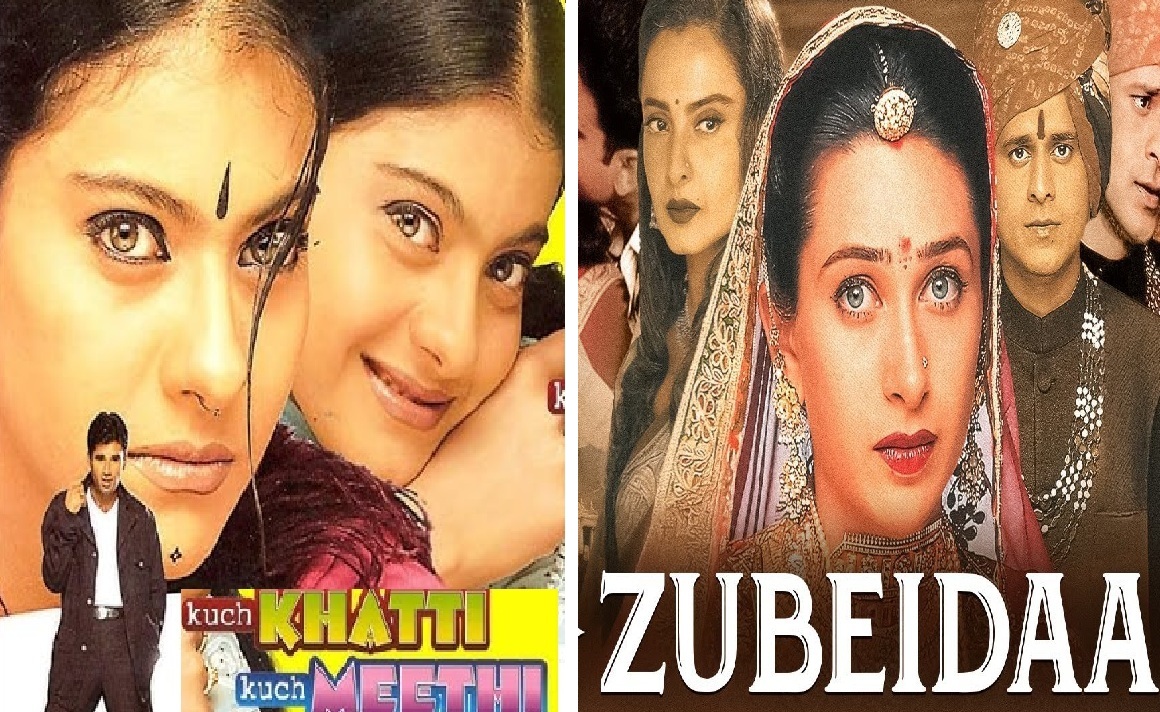
KUCH KHATTI KUCH MEETHI
Saboo Films Pvt. Ltd. and Bharat Film Works’ Kuch Khatti Kuch Meethi, inspired from Parent Trap (English) and Do Kaliyan (Hindi), is about two girls who are identical twins and whose parents were separated before they (twins) were born. While one girl stays with the father, the other lives with the mother. But neither the two girls nor the parents are aware of the existence of the other daughter/sister. The two girls meet by chance in Glasgow and decide to bring back their estranged parents together. For this, they trade places. After they do so, the film draws heavily from Ram Aur Shyam and Seeta Aur Geeta.
Not only is the subject an old and trite one, the screenplay writer (Raju Saigal) has also done a shoddy job. Nothing is established and scenes come and go in a jiffy, as a result of which they create little impact, especially in the first half. For instance, the break-up of the couple looks too hurried and the reasons given for the separation of the two kids, just too kiddish. It is because of the poorly scripted first half that the inherent emotional appeal of the drama doesn’t come through at all. The second half may not be without its glaring flaws but, nevertheless, its light scenes do entertain. A fair deal of credit for this would also go to the performers and the dialogue writers (Bholu Khan and Aman Jafri). An example of faulty scripting post-interval comes in the scene when the twins decide to trade places. The girl staying with her father confesses to her twin sister that it was their father’s step-sister who had ruined their father’s life. Pray! if she knew that, why had she, all her life, been rude and insulting to the father. Further, she tells her comparatively tamer sister to go to her father’s house in her place and teach her devilish aunt a lesson. Why couldn’t she have done it all these years?
While the comedy portions are good after interval, the climax is a letdown.
Kajol plays the double role very well despite being let down by a weak script. But she looks out of shape. Sunil Shetty impresses in comedy scenes, with a restrained performance. To his credit, it must be said that he doesn’t go overboard in a single comedy scene. Rishi Kapoor has no role in the first half except to gulp down liquor and fall asleep. In the first half, he looks too much of a drunkard — a sight not very pleasant. However, he is natural in the second half. Rati Agnihotri stages a successful comeback with a refreshing performance. Mita Vashisht is natural but a more glamorous aunt would have been more appropriate. Razzak Khan is very entertaining. Pramod Moutho and Mayur are alright. Dinesh Anand, Dinesh Hingoo, Guddi Maruti and Jaspal Sandhu are average. Parmeet Sethi impresses in a guest appearance. Pooja Batra is just too cute.
Rahul Rawail’s direction looks like a job hurriedly done. For instance, no care has been taken to clearly define the characters of the twin sisters so that they could appear different. Resultantly, there’s not much difference between the two — something which would’ve made the drama interesting. Nevertheless, the director has managed to make the second half light and a bit entertaining. Anu Malik’s music comprises four good songs (‘Saamne baith kar’, ‘Tumko sirf tumko’, ‘Aise na mujhe dekho’ and ‘Chup chup aankhen char karenge’) and a couple of really weak numbers. Background score (Anjan Biswas) is average. Cinematography (Nirmal Jani) is appreciable. Foreign locations are well-captured. Computer effects are of a good standard.
On the whole, Kuch Khatti Kuch Meethi has some masala for circuits like Bombay, Maharashtra, Nizam and cities like Delhi. But its overall dull opening (except in Bombay where the opening was fair) will mar the box-office prospects because the pick-up will happen only on weekends. Despite a very reasonable price, the film will remain an average fare in some circuits and in the red in others.
Released on 19-1-2001 at Eros and 16 other cinemas of Bombay thru Anugraha Entertainment. Publicity: very good. Opening: fair. …….Also released all over. Opening all over was as cold as the cold wave in North India.
ZUBEIDAA
F.K.R. Productions’ Zubeidaa (UA) is the story of a pretty Muslim girl who dreams of becoming an actress but whose orthodox filmmaker father instead forces her to get married to a Muslim boy of his choice. The marriage is annulled on the day she delivers her first child, a baby boy. After a few years, a Hindu prince of Fatehpur falls in love with her and proposes marriage to her. This, even while her father decides to get her married off to a Muslim guy. Much against her father’s wishes, she marries the already-married Hindu prince but she has to leave back her little son in the care and custody of her mother as her strict father will hear nothing of letting her take away his grandchild. Once in Fatehpur, she realises over the years how lonely she is as her husband gets busy in his work and with his other wife. She has also to cope with sexual advances made towards her by her lecherous brother-in-law. Driven by dejection, jealousy and over-possessiveness, she encounters her husband one day and literally pushes out his other wife to be able to fly with him. The private plane, in which they are flying, crashes and the two are killed.
The entire story is told in flashback as the woman’s only son tries to unravel the mysterious life of his mother. His main source of information is his granny, with whom he lives, and the personal diaries his mother used to write and which have been in the grandmother’s possession.
The film has a dull start but becomes interesting as the drama unfolds in the first half. The latter part of the first half is quite interesting, especially when the girl’s budding career of a heroine is nipped by her father, she is married off, she delivers her child and then is divorced from the husband. The drama takes a dip thereafter and the second half becomes very boring and tedious. Several portions of the film’s screenplay have been written in a docu-drama style, which fail to keep the audience’s interest alive. The scenes after the dissolution of the princely states are too overtly historical for audience’s liking and the language of the dialogues is also difficult.
A major drawback of the film for the Indian audiences comes when the mother opts for her second marriage to the prince even at the cost of leaving her little son behind. So unmotherly is her choice that a good section of the audience will lose all sympathy and respect for her after this scene. This would be bad for the film because she is, after all, the heroine.
Zubeidaa, the character, is Karisma Kapoor and Zubeidaa, the film, is also Karisma Kapoor. The actress has never looked so gorgeous and the pains taken in giving her a Muslim look are worth their while because Karisma looks very inch a Muslim in the film. Her performance is outstanding and the wide gamut of emotions she portrays in the two-and-a-half hours is marvellous. Rekha, playing the prince’s other wife, is restrained and very natural but she looks a bit too old even in the earlier reels. Her role is not of much significance. Manoj Bajpai does not fit into the character of the prince. He acts fairly well. Surekha Sikri-Rege is natural to the core as Karisma’s mother. Rajit Kapur also acts well. Amrish Puri plays his part with the utmost sincerity. Lilette Dubey is effective. Farida Jalal, Shakti Kapoor, Parzaan Dastur, Ravi Jhankal, S.M. Zaheer, Smriti Mishra, Rahul Maharya and Vinod Sharawat lend able support.
Shyam Benegal’s direction is limited by the single-track story and documentarish screenplay (Khalid Mohammed and Shama Zaidi). His treatment of the subject will appeal only to the elite audience. Dialogues are appropriate to the mood of the film, but simpler words at places would have been in order. Music (A.R. Rahman) is very good. The ‘Piya’ song is the pick of the lot. Other melodious numbers are ‘Rangeeli ho’, ‘Mehndi hai rachne wali’ and ‘So gaye hain’. Camerawork (Rajen Kothari) is eye-filling. Technically, well made. Costumes (Pia Benegal) deserve special mention. Sets are realistic.
On the whole, Zubeidaa, a class film, has chances only in some cinemas of some big cities.
Released on 19-1-2001 at New Excelsior and 8 other cinemas of Bombay thru Yash Raj Film Distributors. Publicity: very good. Opening: fair. …….Also released all over. Opening was dull everywhere.
HC UPHOLDS BHARAT SHAH’S PLEA FOR F.I.R. COPY
Film financier Bharat Shah’s plea for being given copies of the FIR and remand application was upheld by the Bombay high court on 18th January. This is the first time that an accused under the MCOCA (Maharashtra Control of Organised Crime Act) will be given a copy of the FIR and of the remand application. Justice S.S. Parkar deemed this a constitutional right of a citizen. The judge also held that Bharat Shah was entitled to meet his lawyers while in police custody.
The main prayer in Shah’s application was for grant of bail. But Shah’s lawyers, headed by Ashok Desai, did not press for it as they contended that it would be “meaningless” to seek the bail without knowing the grounds of arrest and the details in the FIR against him. Justice Parkar, therefore, rejected the bail plea as “not pressed”.
The court directed that on receiving a copy of the documents, Shah was at liberty to plead for bail before the special court designated to hear MCOCA cases. It also clarified that Shah could apply for bail even before the police investigations were complete. The direction set aside the restriction clamped on Shah by special judge A.P. Bhangale who had said that bail could be applied for only after the investigation was complete.
The remand of Bharat Shah, in the meantime, was extended by the high court to January 22. The special court had, on January 8, remanded Shah to police custody till 18th January. The topmost film financier was arrested by the crime branch on 8th for his alleged links with the underworld. It is believed by the police that Shah used underworld funds to make Chori Chori Chupke Chupke and other films.
SHAH’S FILMS PROGRESSING
In the meantime, shootings of films presented by Bharat Shah are progressing at full speed. Sanjay Leela Bhansali’s Devdas is being shot at Film City. Shootings of Rahul Gupta’s Hum Panchhi Ek Daal Ke and Bubby Kent’s untitled film, and post-production work of K.C. Bokadia’s Hum Aapke Hain Sanam are to begin shortly. Another Bharat Shah presentation, Kasoor, is being readied for release on February 2.
‘CCCC’ RELEASE
As regards Chori Chori Chupke Chupke, there now seems to be a possibility of its release. On 15th January, the prosecution told the high court that a court receiver may be appointed to release the film and the proceeds may be deposited in the government treasury. Until then, the police had maintained that it would not permit the release of CCCC. As producer Nazim Rizvi and presenter Bharat Shah on 15th January made counter-claims in the special court on the seized negatives of the film, the special public prosecutor urged the court not to accept their claims but to instead appoint a receiver so that the film could be released and the interest of innocent distributors and exhibitors was not jeopardised.
RAIDS CONTINUE
Earlier, on 13th and 14th January, the Enforcement Directorate raided offices and residential premises of Nazim Rizvi, Bharat Shah and the latter’s chartered accountant. The special court on 19th January further remanded Nazim Rizvi to judicial custody until 22nd January.
AKSHAY, TWINKLE TIE THE KNOT
Akshay Kumar and Twinkle Khanna became man and wife on Wednesday (17th January) evening following a wedding ceremony held at Arya Samaj, Bombay. The wedding had been kept a closely-guarded secret. The marriage was held in the presence of family members and close friends.
While their engagement, held in December, was much publicised, their marriage had been kept a secret. Even Twinkle’s mother, Dimple Kapadia, was unaware of the plans and was surprised to learn at the last moment of the hurriedly-decided wedding date.
SHAKILA HOSPITALISED
Actress Shakila, who was suffering from a heart ailment, was admitted to Lilavati Hospital in Bombay last week. Dilip Kumar, Johnny Walker and other veteran artistes have been visiting the ailing heroine of such films as C.I.D., Raj Mahal, Alibaba & 40 Thieves, Halla Gulla, Post Box 999, Guest House, Kali Topi Lal Rumal, Reshmi Roomal, China Town, Tower House, Kahin Pyar Na Ho Jaye (1963) and Ustadon Ke Ustad. “She is now fine,” said Mrs. Johnny Walker to Information. It may be mentioned here that Mrs. Johnny Walker is close to the veteran actress of over 60 films.
S.K. KAPUR DEAD
Producer-director S.K. Kapur breathed his last at Hinduja Hospital in Bombay on Thursday (19th January) following failure of lungs. He was 72 and is survived by his wife, a son and daughter-law.
Siri Krishan Kapur, besides producing a number of films and directing a couple of them, also had distribution offices in Delhi-U.P. and East Punjab. Among the films he had produced were Night In London, Inspector, Dharma, Durga, Shankar Dada, Maan Gaye Ustad, Seetapur Ki Geeta and Sazaa. He had directed Heeron Ka Chor, besides producing it. In all, S.K. Kapur had produced 20 films under the banner of Kapur Films International. His distribution concern was called Kapur Film Distributors and its offices were in Delhi, Gorakhpur and Jalandhar. He had distributed about 100 films in the two circuits.
Kapur Sahab, as he was respectfully referred to, had been on the executive committee of the IMPPA for more than 25 years. He was the honorary treasurer of the Film Makers Combine at the time of his death. He used to be the hon. treasurer of the IMPPA too. The offices of IMPPA and FMC remained closed on 19th.
S.K. Kapur was cremated in the afternoon of 19th. His funeral was largely attended by industry veterans.
Chautha will be held this evening (20th January) at ISKCON, Juhu, Bombay, between 4.30 p.m. and 5.30 p.m.
HAT-TRICK OF SILVER JUBILEE FOR SAJID, SALMAN
Nadiadwala Grandson Entertainment’s Har Dil Jo Pyar Karega entered combined silver jubilee week on 19th January at Alankar, Bombay. The film marks a silver jubilee hat-trick for its producer, Sajid Nadiadwala, and lead man, Salman Khan. The two earlier films of Sajid and Salman, which celebrated jubilees were Jeet and Judwaa. Har Dil Jo Pyar Karega stars Salman Khan, Rani Mukerji and Preity Zinta in the lead. Directed by Raj Kanwar, it is scripted by Rumi Jafri. Music: Anu Malik. Lyrics: Sameer. Cinematography: W.B. Rao. Choreography: Farah Khan.
YOU ASKED IT
I want to remake an updated version of a vintage Hindi film classic in Hindi. Do I need to buy the remaking rights of that old film?
– Yes, you do need to buy the remaking rights.
Has any villain of a Hindi film been applauded by the audience for his cruel acts or for mouthing a dialogue challenging the hero?
– The audience generally does not applaud the villain for his cruel acts on the screen. It does applaud the villain for his challenging dialogues. A few instances: Amjad Khan in SHOLAY; Sanjay Dutt (as a negative hero) in KHAL-NAYAK; Sunil Dutt (as a negative character) in MOTHER INDIA; and Pran in most of his old films.
In the event that the court appoints a receiver in the case of Chori Chori Chupke Chupke, will any exhibitor screen the film knowing well that the box-office receipts will have to be deposited with the court?
– Why not? It doesn’t make a difference because not all exhibitors have the motive of withholding the box-office collections from distributors.
DO YOU KNOW?
CENSOR HIGHLIGHTS: 2000
* A total of 855 feature films in 21 Indian languages and English were certified in the year 2000. Of these, 273 were certified with clear ‘U’ while 174 were given ‘U’ certificate, with cuts; 38 were issued clear ‘UA’ certificates and 73, ‘UA’, with cuts; among adult films, 75 were given clear ‘A’ while 222 were certified ‘A’, with cuts. In all, 386 films got clear certificates while the remaining 469 were subjected to cuts.
* 243 Hindi films were certified in 2000, which constituted 28.42% of the total number (855) of certified films. There were 157 Tamil films (18.36%), 143 Telugu films (16.73%), 87 Malayalam films (10.17%), 76 Kannada films (8.89%), 43 Bengali films (5.03%), 29 Gujarati films (3.39%), 23 Marathi films (2.69%), 11 English films (1.29%) and 10 Nepali films (1.17%). The number of films made in the other 12 languages/dialects is in single digits.
The Underworld: A Nightmare For The Dream Merchants
(Following is an article, written by your editor and the abridged version of which appeared in The Economic Times in its issue dated 16th January, 2001 in the Debate section. Your editor was one among the three guest writers invited to write on the topic ‘Can we clean Bollywood?‘ The other two writers were Tanuja Chandra and Amit Khanna.)
The Bombay film industry is once again in the public eye but this time, for undesirable reasons. To assume that all of Bollywood is linked with the underworld is too cynical as also a simplistic view. As in other industries, there are some black sheep in the film industry too. Talking figures, of the 143 Hindi films (excluding those dubbed in Hindi from other languages) released in 2000, barely 5 to 7 producers of those films may be linked to the underworld — that, too, is for the police to investigate and ascertain. By no stretch of imagination can 4 or 5% be taken as representing the entire production sector.
Viewed differently, of the 143 Hindi films released, barely 17 managed to prove profitable. With a success ratio, therefore, of barely 15%, is the underworld foolish to invest money in as many films as being made out? The underworld looks for guaranteed returns but the highly speculative film industry offers no guarantee, thanks to the ever-changing preferences of cinegoers. On the other hand, let it be clarified here that big-budget and star-cast films generally assure huge under-production profits to their producers. But how many star-cast films are made in a year? And even out of those, some remain losing propositions for producers after all rights — distribution, music, satellite and Doordarshan — are sold!
The underworld’s earlier brushes with the industry have been hawala transactions for foreign shootings, star presence at foreign parties thrown by dons, and extortion. Perhaps, the glamour is too much to avoid.
In the recent cricket match-fixing scandal, the media didn’t drag the entire cricket team of India and the BCCI into it even though the percentage of the tainted names was far more than 5! Still, the same media, which, very rightly, kept the names of cricketers like Sachin Tendulkar out of the scam, lost no time in generalising when it came to the film industry. The Barjatyas, Chopras, Kapoors and Ghai are an integral part of the film industry but, with one stroke of the pen (in the case of the print media) and one click of the camera (in the case of the more potent electronic media), the image of the entire film industry took the severest beating in its 103-year history.
Black money in Bollywood is yet another black spot on its face. Having said this, it required neither the knowledge of a Chartered Accountant (which I happen to be, by qualification) nor the insight of a film trade analyst (which I am, by choice) to add that black money exists in every industry. As with the underworld nexus, so also with dealings in black money, only the transactions in the film industry get blown out of proportion because
(a) they make sensational reading or viewing material;
(b) Bollywood personalities are role models for millions and under constant public scrutiny; and
(c) there exist umpteen film gossip magazines and satellite chancels which thrive on films but don’t bat an eyelid before painting the very industry black.
Here, it must be added that the percentage of black money dealings in Bollywood, too, has now gone down tremendously because of the reduction in income-tax rates.
So, both, black money transactions and underworld nexus, do exist in the Bombay film industry. But not anywhere close to what is imagined! While lowering the income-tax rates a little more (the human species is never content, right?) and income-tax raids would go a long way in further reducing black money dealings, the issue of breaking the underworld involvement in films is a different ball game altogether. It would require concerted efforts by both, the film industry and the law and order machinery in the country. Of the people who are linked, there may be some who join hands because they fear for their lives. The state needs to be sure that such gullible people are not penalised at any cost. It is people like these whose confidence the police needs to win. If the industry feels secure with the police, at least these gullible people will not link themselves with dons. Then, the police would have to tackle only those who join forces for profit.
If the industry somewhere needs to shoulder part of the blame for succumbing to either pressure or profit motives and, in the process, falling prey to underworld advances, the police too can’t absolve itself of the responsibility for letting Bollywood land itself in the murky state of affairs. How the police now breaks the nexus is for it to decide. On its part, the industry must also set its house in order. It has embarked upon corporatisation which is a step in the right direction. This will enable filmmakers to obtain institutional finance — a sure way to free the industry from the stranglehold of the mafia, howsoever limited. Why, if the industry were to be cleansed, it would also attract foreign and NRI finance.
Finally, I think, the task before the film industry and the government may be difficult but it definitely isn’t impossible. Honest and sincere efforts to wipe out the underworld from the film world can never go in vain. As Sunny Deol, playing a patriotic and spirited Punjab police officer posted in Bombay (make that Bollywood), says, in last week’s release, Farz: Where there’s a will (pause), there is a way.
Yes, there is a way for the film industry and the police. There now seems to be a will too. Only thing, the pause between getting the will and the way to meet has been a bit too long. Consequently, those who sell dreams are today seeing a nightmare.
Let’s Celebrate The Success And His Steely Nerves
Now that Aditya Chopra’s Mohabbatein has clicked all over — beyond doubt — it would be interesting to recount how, once again, the public opinion has been at variance with the trade verdict. Almost everybody in the film trade had been quick in dismissing the second directorial venture of Aditya Chopra as a flop. Its length (running time of over 3½ hours) was considered the biggest drawback which, people in the trade felt, would spell its death-knell. But the public patronised the film and made it a hugely successful one too. Of course, not everyone in the audience felt, it was a great film but then, mixed reports are always there. What was important was that the majority voted in favour of Mohabbatein even if they may have found it a bit too lengthy. Several in the industry had opined that the love story sent wrong signals to the youth as it encouraged romancing in school premises. But what such industry people, perhaps, overlooked was the purpose behind the encouragement given to romancing. Shah Rukh Khan’s intentions were extremely noble and to achieve his aim, the audience didn’t mind even if he ‘used’ three young love pairs. It cannot be denied that Amitabh Bachchan and Shah Rukh Khan elevated their scenes to great heights but one cannot help lauding Aditya for his conviction. After all, how often do you come across a film in which the topmost heroine of the country (Aishwarya Rai) plays merely a ghost; in which one superstar (Amitabh Bachchan) has no heroine opposite him and another superstar (Shah Rukh Khan) has a ghost and mere memories as his co-star? And how often do you come across a director who throws economics to the wind and opts for screening his film in 3 shows daily while paying theatre rentals for 4 shows rather than sacrificing the length of the film by making a slight compromise in the story? While lauding the success of Mohabbatein, one must also praise young Aditya’s courage of conviction.
– Komal Nahta