


























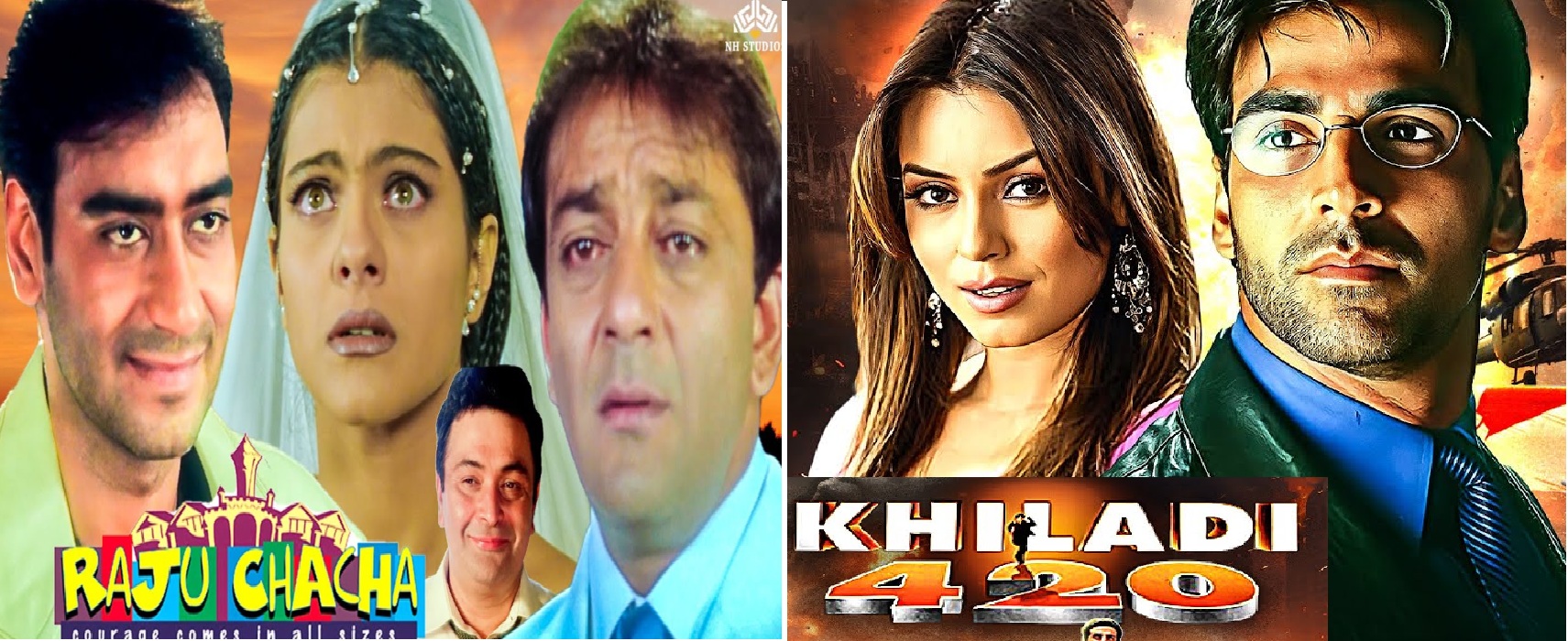
RAJU CHACHA
Devgans Films’ Raju Chacha is an extravagant drama about three kids whose multi-millionaire father is killed by evil relatives to escape a jail sentence. Not just that, the relatives then get down to torturing the kids with the aim of usurping the property and wealth of the deceased. But a famed crook, who robs cars and banks for a living, comes to the rescue of the kids, posing as their long-lost uncle. This ‘uncle’ knows the kids because he had tried to get married to their pretty governess a while ago. The marriage had been stopped by the kids’ father when he learnt that the guy was a fraud. Even while the kids forgive the ‘uncle’, the governess views him with suspicion till she is convinced that the guy wants to turn over a new leaf. How the ‘uncle’, the governess, the kids and their loyal chef unitedly eliminate all the evil relatives, after learning that it was they who had killed the father, forms the climax.
Anees Bazmee’s story and Robin Bhatt’s screenplay are directed at children mainly. But the handling of the subject by debut-making director Anil Devgan is so insensitive that emotions are almost absent when that is what should have been the film’s mainstay. Grandeur and special effects are often used to make up for the lack of feeling in the drama but, unfortunately, they are poor substitutes for emotions. Yes, a couple of scenes do touch the viewers’ hearts but the continuous yearning for the children’s well-being — which is what should be the emotion experienced by the cinegoer in a film of this kind — just doesn’t happen. The physical and mental torture inflicted on the kids by the villains would rather hurt the sensibilities of kids and their parents — the target audience for the film. Except for a couple of dialogues, which are really sensitive, even Javed Siddiqi’s dialogues don’t really create any impact.
Ajay Devgan does a fair job but the chemistry between him and the kids, whose messiah he comes as, just doesn’t work, thanks to the incompetent handling by Anil Devgan. It is sad to see an extraordinary actress like Kajol being wasted in an insipid fare as this. There’s not a single scene which could justify the casting of Kajol in the role of the governess. Her costumes are quite sad and it is difficult to believe that they’ve been designed by ace costume designer Manish Malhotra. Rishi Kapoor acts with utmost sincerity and is very good. Of the three kids, it is baby Sakshi Sem who performs very well. Master Harsh Lunia and master Kinshuk Vaidya are fair. Johny Lever’s comedy is enjoyable, though not hilarious always. Sanjay Dutt’s guest appearance comes as a wonderful surprise and will excite the audience enough to break into an applause. The gang of villains is weak. Govind Namdev, Pramod Moutho and Mayur play the evil relatives of the kids and they are average. Shahbaaz Khan’s get-up is more menacing than him. Tiku Talsania does a fair job. The dog has been wasted. Smita Jayakar, Usha Bachani, master Kewalya Chheda, Adi Irani, Vikas Anand and the rest of the cast lend average support.
Anil Devgan’s direction is not what the script demanded. He has given the film a rich look but it looks like a case of body beautiful without a soul. Jatin Lalit’s music is quite weak. ‘Tune mujhe pehchana nahin’, ‘Kahin se aayee rani’ and the title song are fair but a couple of songs are boring. Showing the animation song in the rolling titles in the end is a colossal waste. Action scenes are good. Some thrilling scenes are exciting although none has novelty. Camerawork is very good. Sets (Nitin Desai) are grand. Computer graphics are very beautiful.
On the whole, Raju Chacha lacks in emotions and entertainment. Thanks to the dull music, it has taken a poor start; thanks to lack of entertainment, it has bleak chances of a pick-up. A dull show which will do well only in selected cinemas.
Released on 28-12-2000 at Metro and on 29-12-2000 at 17 other cinemas of Bombay thru Devgan Entertainment & Software Ltd. Publicity: very good. Opening: fair. …….Also released all over. Opening was dull in most other circuits. It was excellent in Bihar.
KHILADI 420
D.M.S. Films’ Khiladi 420 (UA) is an action film with a complex story which has very little novelty. The hero (Akshay Kumar) plays a double role — one, a negative character, and the other, his twin brother who is noble-hearted. Revealing the second hero (noble-hearted guy) only after the death of the first hero (negative character) looks like a very simplistic approach to the drama.
The daughter of a multi-millionaire is pursued by two men. She opts for the friend she met in Canada and rejects the proposal of the other man who is her childhood friend. To her dismay, she finds that the guy she has married is a murderer who only wants to usurp her property. On the wedding night, she kills her husband in self-defence. All along till then, she doesn’t even know that her father had not died due to natural causes but had actually been murdered by her husband-to-be. After the death of her husband, emerges his identical twin brother. Except for her, nobody knows that the new man is not her husband. This brother is nabbed by the police for the father’s murder. Being a noble soul, he agrees to the crime he has never committed so that he can save his sister-in-law who has murdered her husband. If he reveals his identity, the law will catch up with his sister-in-law for her criminal act. If he doesn’t, he will be hanged to death, something which the sister-in-law will not allow to happen as she is in love with him.
How the twin brother saves her as well as himself from the clutches of law, even as the villains get to know of his true identity, forms the climax.
If the story is confusing, the screenplay has several weak links. The dead body of the negative hero being stored safely by his girlfriend for days together for no obvious reason is one such weak link. The twin brother’s barrage of questions to his sister-in-law-turned-beloved in the courtroom does not impress at all and surely doesn’t have to result in her being silenced! A matter of convenience to further the drama! In short, Uttam Gada and Neeraj Vora’s screenplay is more a piece of convenient writing than convincing writing. Even their dialogues are commonplace.
Akshay Kumar does well in both the roles. But there’s little he can do to rise above the poor script. Mahima Chaudhry acts with a lot of conviction and is especially brilliant in dramatic and emotional scenes. Mukesh Rishi is good. Sudhanshu Pandey makes an average big-screen debut as Mahima’s childhood friend. Alok Nath does an able job. Baby Lekhinee is natural. Antra Mali leaves a mark with a spirited performance. Viju Khote, Dilip Joshi, Sudhir Joshi, Dolly Bindra, Sayaji Shinde, Razzak Khan, Gulshan Grover, Subbiraaj and the rest provide average support.
Neeraj Vora’s directorial debut is nothing to write home about and for this, his weak script is also to be blamed. An unintentionally hilarious scene — to give an example of Vora’s direction — is the one in which Mukesh Rishi is holding Mahima Chaudhry in air, thousands of feet above ground level while himself safely placed in a cabin in an air balloon. Rather than clinging on to Mukesh Rishi for dear life, Mahima is shown as struggling to be let free. The discerning audience realises that if she is really let free by Mukesh Rishi, she will fall to her death! What she should have been directed to do was to cling on to Mukesh Rishi rather than trying to get free from his clutches! In the climax, Akshay Kumar is surrounded by villains who can easily shoot him dead, but they don’t do so for no apparent reason.
Sanjeev Darshan’s music is rather poor. A couple of songs are just about tolerable. Camerawork (Prabhu and S. Pappu) is of standard. Editing (Mohammed Ashfaque) is loose, especially in the second half. Some action scenes are exciting but there’s too much of action post-interval. The entire sequence of Akshay atop a moving aeroplane is breathtaking. Production values are rich.
On the whole, Khiladi 420 is weak in merits and has only action to lure the masses in small centres. A reasonable price is a point in its favour, but a dull opening, unexciting content and a dragging second half are danger points. Below average.
Released on 29-12-2000 at Alankar, New Excelsior and 20 other cinemas of Bombay thru Raman Pictures. Publicity & opening: good. …….Also released all over. Opening was poor in most of the other circuits.
LATEST POSITION
The Idd festival did nothing to boost the sagging morale of the industry. Rather, the dull opening of the two big releases of this week served only to demoralise the industry further.
Champion, after a very good start, dropped rather badly from 4th day onwards. 1st week Bombay 48,91,910 (59.79%) from 14 cinemas (10 on F.H.); Ahmedabad 6,70,086 from 3 cinemas (3 unrecd.), Patan (gross) 2,63,370 (77.92%), Kalol (gross) 1,89,628 (61.57%), Vapi 5,62,697 from 2 cinemas, Rajkot 1,72,800 (2 unrecd.), Adipur 1,78,368, Bhuj 1,54,657; Pune 11,92,475 from 5 cinemas, Solapur 2,81,054; Delhi 40,90,675 (45.33%) from 14 cinemas (4 on F.H.); Kanpur (6 days) 3,56,278 from 3 cinemas, Lucknow 4,83,200 from 2 cinemas, Agra 3,35,650, Varanasi 2,61,270, Allahabad 2,30,000, Bareily (6 days) 1,38,455; Calcutta 18,48,818 from 10 cinemas; Nagpur 5,67,633 from 4 cinemas, Jabalpur (6 days) 1,44,994, Amravati 2,05,334, Akola 1,93,347, Raipur (6 days, gross) 2,77,005 (1 unrecd.), Jalgaon 1,87,111, Katni (gross) 1,45,000, Wardha 1,01,860, Chandrapur 1,95,781; Indore 2,50,000 from 2 cinemas (2 on F.H.); Jaipur 8,06,408 (45.46%) from 4 cinemas, Ajmer (29 shows, gross) 2,76,002; Hyderabad (gross) 19,91,720 from 9 cinemas.
Raja Ko Rani Se Pyar Ho Gaya is a super-disaster. 1 week Bombay 3,86,042 (18.96%) from 4 cinemas (6 cinemas unrecd., 1 on F.H.); Ahmedabad 4,32,544 from 3 cinemas; Delhi 1,69,991 (9.44%) from 3 cinemas; discontinued from Bangalore after 3 days.
Jallad No. 1 is dismal. 1 week Bombay 1,35,862 (16.72%) from 2 cinemas; Jaipur (29 shows) 38,145 (10.24%).
Trishakti (dubbed) 1 week Bombay 1,86,078 (27.11%, 1 unrecd., 1 on F.H.); Ahmedabad 3,08,672 from 2 cinemas; Delhi 7,88,566 (23.64%) from 4 cinemas (1 on F.H.); Kanpur (6 days) 71,499 from 2 cinemas, Lucknow 89,494, Agra 1,60,000, Varanasi 1,15,778, Allahabad 65,144; Calcutta 3,27,676 from 8 cinemas; Amravati 1,54,298, Akola 1,52,442, Jalgaon 91,583; Jaipur (29 shows) 1,76,555 (33.16%). Poor.
………..
Dr. Babasaheb Ambedkar (dubbed, TF) is doing excellent in C.P. Berar. 2nd week Bombay 16,82,093 (52.46%) from 6 cinemas (2 on F.H.); Pune 3,42,327; Nagpur 4,51,120 from 2 cinemas, 1st week Amravati 2,02,447, 2nd week Akola 1,76,440, total 4,07,765.
Saali Poori Gharwali 1st week Nagpur 2,02,511 from 2 cinemas.
________
Mor Chhainha Bhuinya (Chhattisgarhi) 9th week Raipur (nett) 1,92,227, total 18,19,357, city record, 5th week Rajnandgaon 1,41,000, total 8,02,653, city record. Should do over 2 crore in Chhattisgarh.
U.A. THADANI NO MORE
“Firebrand leader”, “pillar of the film industry”, “an untiring worker”. These were only some of the ways in which leading Bombay exhibitor-distributor U.A. Thadani was described in the industry. Udharam Aildas Thadani breathed his last on 26th December at 10 a.m. at Breach Candy Hospital in Bombay, where he had been admitted about 20 days back for malfunctioning of the lungs. He was cremated the same afternoon. His funeral was well-attended by distributors, exhibitors and producers too. His chautha on 28th was attended very largely.
Thadani is survived by his wife, two sons and a daughter. His younger son, Rajesh, married Anjali just last week. The marriage took place at a simple ceremony in a temple because of U.A. Thadani’s critical condition.
Thadani had been the president of the Theatre Owners’ Association (TOA) for several terms. He was a selfless worker who served the industry for years. Not just in association meetings, U.A. Thadani was often seen in court rooms too, whether it was a case between the industry and the government or between an exhibitor and a distributor. A hot-tempered man, it wasn’t rare for Thadani to blow his top in matters concerning not just him or his business but the industry or association too. However, he used to cool down in a matter of minutes.
U.A. Thadani loved to socialise and, despite failing health in the last one year, he used to oblige people by attending their functions and parties. His son, Rajesh, who helped him and his (U.A. Thadani’s) brother, Kundan Thadani, in business, used to often escort his father, like a loving son would do, to parties as the doctors had advised him against going alone anywhere.
The Thadanis own New Era (Malad), Ganesh (Lalbaug) and Sona (Borivli) cinemas of Bombay, Deccan and New Excelsior cinemas of Pune, Alankar, Nadiad and Gopi, Amreli. All the cinemas owned by them remained closed on 26th. Gopi cinema, Amreli remained closed for 3 days. The Thadanis control Maratha Mandir, Gaiety, Galaxy, Gemini, Glamour, Gem and Shreyas (Ghatkopar) cinemas of Bombay, and Vijay and Mamta cinemas of Nasik. Thadani had distributed several films including Soldier and Kya Kehna! in recent times. He had also produced a film, Do Premee.
All distribution and exhibition offices at Naaz, Bombay remained closed on 26th as a mark of respect to the departed soul. Offices of the IMPDA, CEAI and TOA also observed a day’s closure.
IMPDA president N.N. Sippy was very sad on hearing the news of Thadani’s demise. Said he, “For me, his death is more than merely a professional loss. He was by my side, whether in personal matters, business matters or association matters. I will miss him very much. Just before he was hospitalised, I recall he telling me excitedly about how many whisky bottles he had arranged for his son’s wedding reception on 20th December. He was looking forward to the wedding.”
NOOR JEHAN BIDS ADIEU
Pakistan’s melody queen Noor Jehan struck the last note of her life and departed for the world beyond on 23rd December. The mallika-e-tarannum passed away following heart failure, in the port city of Karachi in Pakistan. She leaves behind two sons and five daughters, besides a number of fans in the two neighbouring countries, India and Pakistan. She was 75.
Noor Jehan started out as a singer and actress in undivided India when she was barely eight years old. K.D. Mehra, known as the father of Punjabi films, introduced her in a Punjabi film. Noor Jehan shot into prominence when Dalsukh Pancholi introduced her in Khandan in 1942, opposite Pran. To further her singing and acting career, she migrated from Lahore of the undivided India to Bombay. Mehboob cast her in his Anmol Ghadi (1946) in which she played the leading lady and rendered her career’s best songs under the baton of Naushad. This was the only film for which she sang under Naushad who gave evergreen tunes like Aawaz de kahan hai, Jawan hai mohabbat and Mere bachpan ke saathi mujhe bhool na jaana, which were a rage then and even now, a listener’s delight. Noor Jehan recorded hundreds of songs in Hindi and Punjabi.
Dilip Kumar, who acted opposite her in Jugnu (1947), said in his tribute, “She will remain immortal and, through modern technology, her voice will reverberate and echo…. May God be generous in his reward to Noor Jehan for the golden melodies with which she enriched generations in India and Pakistan.”
Lata Mangeshkar, who was mentioned as baby Lata when she acted in Badi Maa (1945) with Noor Jehan said, “She treated me as her younger sister and whenever we met, she used to hug me. Her death has created a vacuum in the world of music, which cannot be filled.” Suraiya, who co-starred with Noor Jehan in Anmol Ghadi, remembered how she (Noor Jehan) had prodded her (Suraiya) to sing. “The world is yet to see a singer like Noor Jehan,” she said.
“Mere geeton mein Noor Jehan apni noor bharke chali gayi,” said music director Naushad.
In its editorial tribute, The Times Of India has said, “Noor Jehan encapsulates the undying allure of the great Indo-Pak amity story. Decades of political acrimony, war and hate-mongering have failed to dim the charisma of this two-nation, one-human tale, for, Noor Jehan belongs to our virasat (heritage) as much as she belongs to their virasat.”
In a message sent to the High Commission of Pakistan in New Delhi, Guild president Surinder Kapoor has condoled the death of Noor Jehan. The message says that the singer “has made a special place in the hearts of millions of Indians. Her death has caused an irreparable loss to the film industry.”
SHAKTI SAMANTA ELECTED FFI PRESIDENT
Shakti Samanta was unanimously elected president of the Film Federation of India at the first meeting of its executive committee held on 29th December in Bombay. Santosh Singh Jain, Prabhat Bhushan, G.S. Mayawala and L. Suresh were elected vice presidents. Tilak Raj Magan and Surinder Kapoor were elected hon. general secretary and hon. treasurer respectively.
SANJEEV’S WEDDING RECEPTION
A large turnout of the industry bigwigs marked the grand reception held on 21st December at Juhu Centaur, Bombay, to celebrate the wedding of music director Sanjeev (of Sanjeev Darshan duo) with Ritika. Music director Shravan, father of Sanjeev, personally received the guests. His partner, Nadeem’s absence was made up by the presence of Nadeem’s parents.
NAZIM RIZVI’S REMAND EXTENDED
Citing police investigations being at a delicate stage, the special court in Bombay on 27th December further remanded Chori Chori Chupke Chupke producer Nazim Rizvi and his assistant Abdul Rahim Allah Baksh to police custody till January 8. The judge observed that the police had come across material evidence and valuable information during investigations.
Meanwhile, the prosecution questioned the locus standi of the film’s financier, Bharat Shah, in the matter. Shah had intervened in the case by filing a vakalatnama. However, he did not stake his claim on the negatives of Chori Chori Chupke Chupke which have been sealed by the police.
YOU ASKED IT
When the government of Uttar Pradesh grants 100% tax-exemption to films shot entirely in the state, why don’t our producers avail of the benefit?
– Uttar Pradesh does not have too many unexploited beautiful locales and also lacks in infrastructure facilities for shooting.
How come there was no satisfactory initial for star-cast films like Raju Chacha and Khiladi 420 which opened on Idd day?
– Mainly because of lack of hit music which is essential for a good opening. Besides, the musical promotion of KHILADI 420 was not up to the mark.
It is indeed enlightening to note the total collections of films released in Bombay city and suburbs in your box-office section. Can you tell me the total collections of Hum Aapke Hain Koun..! and the number of weeks it ran for in Bombay city and suburbs?
– HUM AAPKE HAIN KOUN..! ran for 150 weeks in Bombay city and suburbs in its first run and it collected a total of Rs. 12.12 crore (excluding FH cinemas and Thane district)!
CENSOR NEWS
D.M.S. Films’ Khiladi 420 (social) was given C.C. No. CIL/2/49/2000 (UA) dt. 22-12-2000; length 5119.69 metres in 17 reels (cuts: 28.04 metres).
Saboo Films P. Ltd. and Bharat Film Works’ Kuch Khatti Kuch Meethi was seen on 26th.
Trust International’s Yeh Kaisi Chahat (dubbed; length 2402.07 metres in 5 reels) was applied on 21st.
F.K.R. Productions’ Zubeidaa (length 4100.20 metres in 15 reels), applied on 22nd, was seen on 27th.
NFDC Ltd.’s Daman (length 3466.49 metres in 14 reels), applied on 22nd, was seen on 27th.
Visuals P. Ltd.’s Moksh (length 4330.01 metres in 17 reels), was applied on 26th.
Vishant International’s Farz (length 4860.07 metres in 18 reels), applied on 26th, was seen on 27th.
CFSI’s Bhago Bhoot (length 2286.58 metres in 9 reels), was applied on 27th.
R.N. Films’ Hasina Dacait (length 2485.94 metres in 12 reels), was applied on 27th.
Hrithik Controversy In Nepal
THE TRUE STORY
So what sparked off the Hrithik controversy in Nepal? Now that it is established that Hrithik Roshan never uttered a single word against either Nepal or the Nepalese, in any TV or other interview, how did his name get dragged into the controversy which claimed four lives in Nepal on 26th December and is now threatening the very tenure of the ruling Koirala government?
Reportedly, it is the handiwork of a handful of Nepal distributors of Indian films, who are also producers of Nepalese films. It was their intention to disturb the smooth running of Hindi films in Nepal. This, in turn, would also help boost business of Nepali films, they thought.
The reason why the trouble-makers wanted to disrupt the screening of Hindi films in general is that they have not been successful in bagging the distribution rights of some coveted films of late, including the Hrithik-starrer Mission Kashmir. It may be mentioned here that it was recently decided by Nepal distributors — at the behest of vested interests, of course — that no Nepal distributor would pay more than Rs. 15 lakh for any Hindi film. Before some months, the Nepal Motion Picture Association had resolved that producers should sell distribution rights of their films for the Nepal territory directly to Nepal distributors instead of selling them to Bihar distributors who then either sell the same to Nepal distributors or release the films in Nepal themselves, which has been the practice for years. This, says a Bihar distributor wishing to remain anonymous, was done with a view to keep Indians out of Nepal territory.
The handful of people, it is learnt, instigated a group of gullible students to launch a tirade against Hrithik Roshan. It just happened to be Hrithik; it could have been anybody else. Another theory has it that Hrithik was targetted intentionally so that the screening of Mission Kashmir (which one of the miscreants had coveted but not succeeded in getting) could be disrupted.
In either case, this is how things seem to have transpired:
Simi Garewal’s interview of Hrithik Roshan is aired on Star Plus. Seeing this as a Godsent opportunity to create controversy over Hindi films in Nepal, the disgruntled local distributors instigate a group of rowdy college students of Chitwan. The youth march to a local newspaper (Chitwan Post) and demand that their condemnation of Hrithik’s anti-Nepal statements on the Simi Garewal show be published. The newspaper editor refuses, saying, he would rather wait and see if more people felt that way. The next day, the students set afire an effigy of Hrithik Roshan and send Chitwan Post a press release alongwith a picture. The paper publishes the news in its 15th December edition. On reading the news, the president of an all-Nepal students’ union issues a statement in Biratnagar, condemning Hrithik’s alleged remarks and he calls for a boycott of the actor’s movies. The situation precipitates when the secretary of the same union repeats the statement in Kathmandu. The statement is reported in all major newspapers on 25th December. On 26th, angry mobs take to the streets of Kathmandu and threaten to burn down the local Gopi Kishan cinema, owned by Udhab Paudwal, which is screening the Hrithik-starrer, Mission Kashmir. They heavily damage the cinema. In the police firing that follows the mob violence, four people are killed and 180 others, injured. The issue snowballs into a national crisis and refuses to die down even after the students’ union president admits to not having seen Hrithik’s interview. Hrithik’s denial fails to reach out to the angry masses as the only independent cable network in Nepal has by then stopped the telecast of Indian channels. Nepal’s newspapers, however, carry an apology attributed to Hrithik. The violence continues unabated on 27th as the protesters clash with the police and block streets with burning tyres and trees. The public ire turns on the Indian community, and the State Bank of India’s Kathmandu office sees its windows pelted with stones. The city of Kathmandu witnesses unprecedented violence. All work comes to a standstill as several political parties call for a strike on 28th. The prime minister’s chair is endangered as nearly half of the 113 ruling Nepalese Congress MPs move a no-confidence motion against Koirala.
Even those who master-minded the entire false drama had, perhaps, not dreamt that it would take such an ugly turn with such far-reaching consequences as to ultimately go on to shake the ruling government in the Himalayan kingdom.
An unrelated incident relates to Raju Chacha which could not be sold for Nepal as the powerful lobby of the same handful of distributors had spread the word a few weeks back that nobody should pay more than Rs. 10 lakh for its distribution rights! Khiladi 420, the other release of this week, opened in the Terrai region of Nepal yesterday (29th December) but not in Kathmandu. All Hindi film screenings in the capital city have been suspended following the horrendous riot that broke out there on 26th.
3-E
Education-Entertainment-Enlightenment
Lata, Rafi & Noor Jehan
Both, Lata Mangeshkar and Mohd. Rafi, had acted in films starring late Noor Jehan. Lata Mangeshkar had acted in a small role in Badi Maa, released in 1945. She was billed as baby Lata in the film’s credits. Mohd. Rafi had also acted in a small role in the Noor Jehan-starrer Jugnu, released in 1947. He also rendered for Jugnu that hit number, Yahan badla wafai ke siva kya bewafa kya hai with Noor Jehan. Jugnu was produced and directed by Shaukat Hussain Rizvi whom she married and migrated with to Pakistan after the Partition. The other actor-singers who acted with Noor Jehan were Surendra and Suraiya — in Mehboob’s Anmol Ghadi, released in 1946. Surendra played the lead opposite Noor Jehan while Suraiya was the other heroine of the film. The evergreen hit song of Anmol Ghadi, Awaaz de kahan hai, was rendered by Noor Jehan and Surendra.
Hrithik-Abhishek In Legal Battle
Hrithik and Abhishek are involved in a court battle. Only thing, Hrithik Roshan is not directly involved, and Abhishek is not Abhishek Bachchan but Abhishek Poddar! The latter has dragged S. Kumar’s to the Madras high court over the use of the brand name, Cinnamon, which is being endorsed by Hrithik Roshan. The court has restrained S. Kumar’s by an interim injunction from advertising their readymade menswear line under the brand name Cinnamon following the application by Abhishek’s Bangalore-based company, Sua Explosives & Accessories, which has claimed ownership over the name. The petitioners own a fashion store called Cinnamon in Bangalore, which sells clothes under that label. The store, which opened in 1999, has clothes designed by Italian fashion designer Andrea Anestasio. Abhishek plans to soon open similar stores in other cities too.
No Idd Celebration, This!
The dull opening of Raju Chacha and Khiladi 420 this week has sent shock waves in the industry. Not just because they both are star-cast and big-budget films, which are extensively publicised, but also because their releases coincided with Idd, a festival eagerly awaited by producers, distributors and exhibitors.
The Idd festival has traditionally been known for bountiful box-office collections as many Muslims, who abstain from frequenting cinemas during the preceding Ramzan month, throng cinema halls on the festive day. The following day (Baasi Idd) is also considered very good for the box-office. But this year, collections were generally dull on both, Idd and Baasi Idd days (December 28 and 29). In fact, several distributors released the films on Thursday (December 28) to take advantage of the festival, but were disappointed with the 40 and 50% collections!
Dull music of both the films contributed to the poor openings. Bombay city, of course, recorded good collections. In Bihar, collections of Raju Chacha were excellent.
Besides dull music, there are other reasons too. It appears that without music, Ajay Devgan and Akshay Kumar can’t pull in the crowds. Deewane, Ajay Devgan’s last release, too, had had a poor initial. Dhadkan (Akshay Kumar), despite super-hit music, had opened to ordinary houses. In the case of Ajay Devgan and Kajol, their first release together, after their marriage — Dil Kya Kare — was also a damp squib. Is the hit pair of Pyaar To Hona Hi Tha losing ground after marriage?