























INDIAN
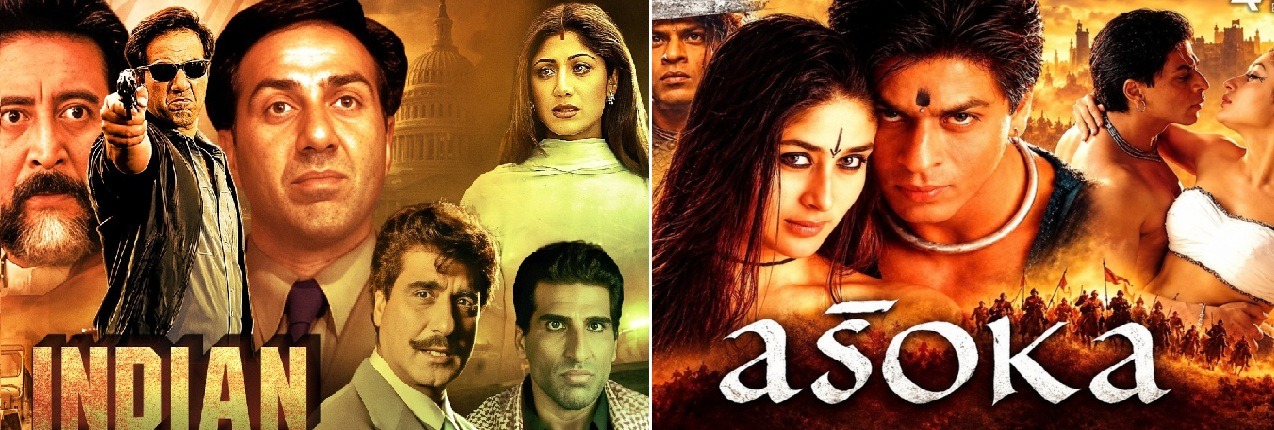
Sunny Super Sound’s Indian (UA) is an action film on terrorism. An honest police officer (Sunny Deol) is out to wipe out terrorism and terrorists and, in this fight, he fears nobody. In his relentless battle against the modern-day menace, he even sacrifices his own father-in-law (Raj Babbar) who is his senior but who, he realises, is hand-in-glove with terrorists (Danny Denzonga and Mukesh Rishi). Even as he is on a hot trail of the enemies of the nation, his wife (Shilpa Shetty) decides to divorce him when she learns that her own husband had murdered her father. For such a duty-conscious police officer, fighting to finish the evil-doers is his mission in life.
Remake of the Tamil hit, Vallarasu, the film has a brilliant screenplay in the first half. Although the story offers nothing new, it is the triple blend of fast-paced screenplay, splendid dialogues and a heady combination of action (fist-to-fist fights) and intelligent games of one-upmanship which makes the film extremely interesting to watch. The pace drops at places in the post-interval portion mainly because there are too many tracks on which the story movies. Yet, the second half also has its share of glorious moments of action and intelligent games of the mind. So good are those that the viewer doesn’t really mind the minor weaknesses.
Some scenes which deserve special mention in the film are: when Sunny uses the ploy of a bomb scare to save his friend in distress (this is, perhaps, the most exhilarating experience for the audience); when Sunny orders the commandos to take an about-turn and shoots down the terrorist’s stooge; the way Sunny masterminds the bringing of all BEST buses to a halt; the masterplan of killing Danny’s son; Sunny’s passionate outburst about the reputation of police personnel in the public eye. The introduction of one new character after another through the film is yet another major plus point. Court-room dialogues are great! Even otherwise, the patriotic dialogues as also the witty ones draw tremendous applause from the viewers.
Besides Sunny Deol, director N. Maharajan, dialogue writer Sanjay S. Masoom and action co-ordinators Rocky, Rajesh, Paul and Western are the heroes of the film. On the minus side are lack of: (i) novelty in subject, and (ii) hit music score. Besides, the approach to checking criminal activity appears too simplistic at times. However, the pluses are far more than the minuses. Comedy is less but the sequence in which Sunny bashes up two political leaders is very funny and also novel. The scene in which Shilpa’s mother slaps her has good appeal for ladies.
Sunny Deol does an exceptional job as the upright police officer. He acts wonderfully and is mind-boggling in dare-devil stunts. The best part about his persona and acting is that he makes everything so believable. Clearly, one more great performance from the hero of the masses! Shilpa Shetty looks sexy and acts ably. Although she gets limited scope, she leaves a mark in dramatic and emotional scenes. Danny Denzongpa is superb as the villain and lends a lot of credibility to the terrorist drama. Mukesh Rishi is also very effective. Raj Babbar leaves a mark with a restrained performance. Sanjay Narvekar shines and will become a major mass attraction in the film. Rahul Dev is pretty impressive. Om Puri entertains in his inimitable style. Rajat Bedi looks handsome and acts well. Pramod Moutho, Shakti Kapoor, Salim Ghouse, Balwinder Singh, Reema, Shiva, Vivek Shauq, Rana Jung Bahadur, Surendra Pal, Anil Nagrath, Rakesh Pandey, Viju Khote, Avtar Gill, Raj Tilak, Ankush Mohit, master Lakshya Lathar and baby Drishti Mohite lend creditable support. Deepak Shirke is lovely. Siddharth Ray is effective. Malaika Arora and Sophiya Haque provide sex appeal in a dance.
N. Maharajan’s screenplay and direction complement each other beautifully. Considering that this is his first Hindi film, it is a praiseworthy effort. Maharajan lets himself go wild in scenes catering to the masses, and the result is simply splendid. Anand Raaj Anand’s music is fair. Had the songs been better, the film could have proved a big hit. Nevertheless, ‘Deewana main na tha’ and ‘Thhaat nawabi’ are fairly good. The theme song has lyrical value. Action scenes are not just fresh and novel, they are also simply marvellous. Camerawork (A. Ramesh Kumar) is splendid. Editing (B.S. Vasu and Saleem) is crisp. Background music (Louis Banks) deserves special mention. Other technical aspects are of top standard. Production values are rich.
On the whole, Indian, which intelligently and effectively exploits the patriotic feelings of the audience, is a winner all the way. In circuits like Delhi-U.P., East Punjab and Rajasthan, it can do A1 business. In the rest, overflow is assured but possibility of proving class A is not ruled out. The film has repeat value.
Released on 26-10-2001 at Novelty and 22 other cinemas of Bombay thru Sunny Sounds P. Ltd. Publicity & opening: excellent. …….Also released all over. Opening in North India was sensational.
ASOKA
Arclightz & Films’ Asoka (UA) is a fictionalised account of the eventful part of the life of the legendary Samrat Ashoka. Grandson of Chandragupt Maurya, Ashoka ascended the throne of Magadha in 3rd century B.C. In his quest for more and more power, he waged one of the bloodiest battles ever with the neighbouring kingdom of Kalinga, killing thousands of innocent people. When realisation about the futility of such power dawned upon him, he renounced the path of violence and embraced Buddhism to spread the message of peace across the world.
It is this reality about the life of Ashoka that’s juxtaposed with a fictionalised account of his love story. In the film, Ashoka falls in love with a pretty girl, Kaurwaki, who is the daughter of the king of Kalinga. Without knowing her identity and also without revealing his own, he marries her, but circumstances separate the couple. Unaware of his real identity, Kaurwaki searches for him but remains unsuccessful. Meanwhile, Ashoka gets news of his wife’s death and loses interest in life. Slowly but surely, he comes out of his depression and is forced by circumstances to marry another girl. After his marriage to her, his step-brother hatches a plot to kill his unborn child, but his mother is killed instead. This infuriates Ashoka so much that he kills all his step-brothers and eventually launches the war against Kalinga. After this war, he meets his first wife in the battlefield, now a land strewn with corpses of people of Magadha and Kalinga.
Though the film has a contemporary feel, thanks only to choreography and music, the film’s subject dates too far back in history to make an impact on the young generation of today, which forms a large chunk of the audience. Although the success of the recent historical, Lagaan, has no relevance to this film, it must be pointed out that Lagaan had a very contemporary game (cricket) woven into the main (historical) tale set in pre-Independence India.
Coming back to Asoka, the screenplay (Saket Choudhary and Santosh Sivan) has several weak moments. The pace is so leisurely that it tests the viewer’s patience. Although a good part of the film’s first half is devoted to the romance between Ashoka and Kaurwaki, the magic doesn’t work. The film looks more like a stage-drama, which is its biggest undoing. While paying too much attention to camera angles and shot compositions, director Santosh Sivan has missed the soul of the romance. He has not been able to get into the psyche of Emperor Ashoka, which, therefore, defeats the very purpose of making a film about the legendary figure. It could as well have been made as any other love story. Coming back to the romance, because the love between the two is not intense, their separation does not draw emotions in the post-interval portion. Yes, a couple of scenes do tug at the heart-strings, but they are too few and far between to make much of an impact. The impact of Ashoka’s renunciation of worldly pleasures fails to move the viewer. Abbas Tyrewala’s dialogues, though not of the kind one expects in a historical, are well-written and add to the drama let down by a weak screenplay.
Shah Rukh Khan does very well in the title role, living his character and delivering an extremely restrained and natural performance. However, he sporting long hair for a good part of the film will not be liked by many of his fans. Kareena Kapoor looks bewitching and seductive. She is simply mind-blowing as far as her acting goes. Whether in romantic or emotional scenes or in the action scenes during the battle, Kareena is absolutely mesmerising. Suraj Balaji, as Kareena’s kid-brother, is superb and natural to the core. Ajit does a fair job as Shah Rukh’s ambitious step-brother. Danny Denzongpa, in a different role, is very effective. Rahul Dev impresses a lot. Hrishitaa Bhatt has a brief role but leaves a mark. Johny Lever, Raghubir Yadav and Suresh Menon are alright in humorous parts. Shweta Menon, Subhasini Ali, Gerson da Cunha and the rest lend excellent support.
Santosh Sivan’s camerawork is not just better than his direction but is also of international standard. The cinematography leaves the viewer asking for more, so captivating is it! However, Sivan’s narration has elitist appeal and his treatment is of the kind that’s more suitable for a stage-play. The slow pace gets irritating after a while.
Anu Malik’s music is lovely. ‘San sanananan’, ‘Raat ka nasha’, ‘Aa aa taiyyar ho ja’ and ‘O re kaanchi’ are superbly tuned numbers. Their picturisations (Farah Khan, Brinda and Geeta Kapoor) are also very appealing and sexy. The picturisation of ‘Roshni se bhare bhare naina tere’ also has tremendous sex appeal. Action in war scenes is effective. Background score (Sandeep Chowta) adds tremendously to the narrative. Sets (Sabu Cyril) are wonderful. Production values are so-so.
On the whole, Asoka, based on the life of Ashoka, is a shocker. It will appeal to the class audience while the masses will like the songs, Kareena Kapoor and the sex in the film, but not the film itself. Despite a reasonable price, the strange combination of war and sex will not yield the desired box-office results. A film for metropolitan cities and parts of Overseas only.
Released on 26-10-2001 at Metro and 16 other cinemas of Bombay thru UTV-Shringar Films P. Ltd. Publicity & opening: excellent. …….Also released all over. Opening was superb in Delhi but not up to the mark in some circuits.
LATEST POSITION
The bumper opening of INDIAN all over has brought happy tidings on the festive occasion of Dassera.
Rehnaa Hai Terre Dil Mein has not found any appreciation in spite of appealing music. 1st week Bombay 30,71,243 (52.38%) from 11 cinemas (5 on F.H.); Pune 7,92,423 from 4 cinemas (1 in matinee), Solapur 1,09,721; Bijapur 75,000; Delhi (6 days) 33,16,717 (33.94%) from 11 cinemas (1 on F.H.); Agra 1,23,000, Bareilly (6 days) 53,569; Nagpur 2,84,254 from 3 cinemas, Amravati 89,987, Akola 74,240, Raipur (6 days) 61,222; Indore 90,104 (1 unrecd.); Jaipur 2,40,521 (19.46%) from 2 cinemas, Bikaner 60,657; Hyderabad (gross) 11,27,975 from 6 cinemas (2 in noon).
………….
Yeh Teraa Ghar Yeh Meraa Ghar crashes further. 2nd week Bombay 20,15,328 (31.83%) from 11 cinemas (6 on F.H.), total for 2 weeks 64,95,956; Pune 4,80,887 from 2 cinemas, Solapur 39,470; Delhi (6 days) 7,47,268 from 7 cinemas (1 on F.H.); Agra 58,300, Bareilly (6 days) 14,461; Nagpur 1,09,851 from 2 cinemas, Jabalpur (6 days) 22,268, Amravati 49,087, Raipur (6 days) 36,100; Indore 52,041; Jaipur 1,30,936 (16.52%); Davangere 1,29,618.
Chandni Bar 4th week Bombay 19,35,163 (32.59%) from 10 cinemas (7 on F.H.), total for 4 weeks 1,11,11,624; Pune 85,126; 1 week Bijapur 79,580; 4th week Delhi (6 days) 5,14,666 from 5 cinemas; Agra 36,500; 1st week Jalgaon (6 days) 58,440; 3rd week Jaipur 77,474 (9.24%) from 2 cinemas; 4th week Hyderabad (gross) 1,72,985.
Ajnabee 5th week Bombay 2,63,180 (28.49%; 6 cinemas unrecd., 3 on F.H.), total for 5 weeks 1,75,64,834; Pune 1,82,565, Solapur 51,465 from 2 cinemas (1 in matinee); Delhi (6 days) 1,67,706; Agra 92,000, Bareilly (6 days) 28,152, Jaunpur 7,000; Nagpur 34,975, 3rd week Jabalpur (6 days) 52,815, 5th week Amravati 34,545, Akola 35,100, total 4,71,500, Raipur (6 days) 34,008; Jaipur 92,297 (15.77%); Hyderabad (gross) 2,66,193 from 2 cinemas (1 in noon); 2nd week Mangalore 1,87,349.
BAN ON HINDI FILMS IN MANIPUR
On being informed by the Eastern India Motion Picture Association of a ban on Hindi films in the state of Manipur, the Association of Motion Pictures & TV Programme Producers has dashed off letters to the Prime Minister, home minister, union I & B minister and the Manipur chief minister, decrying the same. The ban has been in effect since over a year now. Manipur has a total of 11 cinema halls.
NO NEW FILMS ON CABLE TV?
A meeting of the committee, set up by the ministry of information & broadcasting to find out ways and means to control cable piracy, was held recently. At the meeting, representatives of the cable operators assured the committee that no new film would be broadcast on cable for one year after its theatrical release. The modalities for the implementation of the same are being worked out.
The film industry representation on the committee includes Guild and AIFPC president Amit Khanna, Guild and AIFPC vice president Yash Chopra, and Yash Johar. Anjuly Duggal, joint secretary to the I & B ministry, is the convenor of the committee.
YOU ASKED IT
How did Asoka take such a good start in cities like Bombay and Delhi despite giving the impression of an art film?
– Anu Malik’s hit music, the lead stars (Shah Rukh Khan and Kareena Kapoor) and Shah Rukh’s promotion of the film did the trick. Besides, the trailers suggested that the film has a lot of sex.
What is the sanctity of a lien letter if a producer sells prints, taken out for another territory, to a distributor for a circuit on which there is a lien of a financier?
– In such a case, the financier finds himself helpless because the laboratory has not given delivery of the prints to the distributor, but yet, the latter can release the film in his circuit. Producer Mansoor Ahmed Siddiqui recently sold the prints of his DIL NE PHIR YAAD KIYA to his Nizam distributor who did not need to go to the laboratory. Needless to add, there was a lien on the Nizam territory, but the financier holding the lien letter now finds himself cheated by Siddiqui who did not take an NOC from him (financier).
If hit music is so important for a good opening, how did Indian take a bumper start all over?
– Hit music is not as important in an action fare like INDIAN as, say, in a love story. The music of GADAR, another action film, was also not hit when the film was released. Yet, GADAR took a terrific start.
3-E
Education-Entertainment-Enlightenment
Long & Short Of Circuits
A producer is always concerned about the various circuits. Before release of his film, it is the prices which it will fetch from the different circuits that are his constant worry. After release, it is how the film fares in every circuit which gives him cause for anxiety/nervousness/excitement. But for producer-director Rakesh Roshan, it was neither the all-India circuits nor the Overseas circuit that was at the back of his mind before the launch of his Koi…Mil Gaya this week. Rather, it was a short circuit which affected not just Rakesh Roshan but the entire Roshan family. An electric short circuit in Roshan’s house on Friday last (19th October) had the entire family shift to the nearby Sun N Sand Hotel for the weekend. Circuit alright, but a short (and not sweet) circuit, this!
Starting In Right Earnest
Metalight Productions, a new distribution office which opened in Bombay on Dassera day, has acquired the rights of Vashu Bhagnani’s Deewaanapan and Om Jai Jagadish for Bombay distribution with Raksha Distributors. Rehnaa Hai Terre Dil Mein is also being distributed by Metalight with Raksha. Besides Bombay, it also has offices for East Punjab (released Yeh Teraa Ghar Yeh Meraa Ghar and has acquired Aamdanni Atthani Kharcha Rupaiya and Kyaa Dil Ne Kahaa), Nizam (released Sai Baba) and North Karnataka (Nayak and Kyo Kii… Main Jhuth Nahin Bolta). Metalight plans to produce films too — 12 films in five years.
Dutta-Devgan Deal
Ajay Devgan has bought the distribution rights of J.P. Dutta’s new film too. After releasing Dutta’s Refugee in Bombay, Devgan’s distribution company has now acquired his multi-starrer, L.O.C.. The war film was launched last week and is planned to be released next year.
Sunny Days Are Here Again
So at last, the bad spell in the industry has been broken. The bumper opening of Sunny Deol’s Indian on Dassera day set hearts aflutter in the industry as the drought of hits appeared to be nearing its end. The audience response in cinemas across the nation was absolutely wild, with people clapping and applauding Deol and his dialogues and stunts. Almost 100 years after the swadeshi movement of pre-Independence India, when the freedom fighters gave a call of ‘Be Indian, buy Indian’, the slogan seems to have changed to ‘Be Indian, see Indian‘.
INFORMATION MEETS
“It is the subject that comes first. You can hire a good action director and add stunts to your film, but the basic script should be good. I believe in content.”
– SUNNY DEOL
RAJ VAIDYA
He takes on an entire army of Pakistan single-handedly in Gadar Ek Prem Katha and still makes the audience believe in the film. The mere raising of his finger is enough to send a chill down the spines of the terrorists in his Indian. Sunny Deol today has come to represent the patriotic youth of India as his starrers, dealing with the themes of desh bhakti, are being lapped up by classes and masses alike. He may not be a great dancer but in 2001, this actor, who debuted in Betaab in 1983, has danced his way into the hearts of the people like never before. Audiences in Punjab, Delhi, U.P. and Rajasthan in particular go into raptures in cinema halls whenever this Deol bashes up a baddie or screams his lungs out at a scamster. But in real life, Sunny is a shy, introverted guy. He has come a long way from the Sunny of the ‘eighties and early ‘nineties when he used to carry his temper on the tip of his nose. Today, he is more restrained and cool. Rather than extending his screen persona in real life, this Deol prefers to laugh off banter about him if it is not complimentary of him. He conserves all his lung-power and muscle-power for the camera.
This interview with the shy Sunny was taken three days prior to the release of his Indian, in his spacious cabin on the fifth floor of his Sunny Super Sounds. And so, some super sounding quotes from Sunny, the patriotic puttar from Punjab:
How did you come to buy the rights of the Tamil hit, VALLARASU, for remaking as INDIAN?
Actually, I had worked with N. Maharajan, the writer-director of Indian, in Zor and Champion. He was involved in the writing of those two films. After those films, he wrote and directed Vallarasu. He told me, he wanted to remake it with only me. I’m thankful to him for that.
It was actually the subject of Indian that caught my attention rather than its action. The emphasis in my film has always been on content, more than anything else. It is the subject that comes first. You can hire a good action director and add stunts to your film, but the basic script should be good. I believe in content. The most difficult thing in filmmaking is to get the right subject.
Is it true that one of the reasons for your doing GADAR was a dialogue which ultimately was never there….
No, no. No such thing happened! (Laughs) You know how it is. They say all kinds of things… Take Maa Tujhe Salaam, for instance. The publicity of the film centres around this one line, purported to have been spoken by me in the film — Doodh maangoge toh kheer denge, Kashmir maangoge to cheer denge… The reality is, this is not my line in the film. In fact, that dialogue is mouthed by Shahbaaz Khan! Anyway, I don’t really mind that because one dialogue is not the whole film, right? So, I believe, these things don’t really make or mar a film.
How different is Sunny of the pre-GADAR days from Sunny after GADAR?
There is no difference really. I am the same person I was before Gadar happened. People have changed. It is just that the perception of people around me has changed. There is more looking up to me now. Of course, there are some who will also bitch about me more, now that I am more successful. (Laughs) You know how it is, if they can’t get you, they will merrily bad-mouth you.
How do you cope with this back-biting?
I just laugh it off when I hear of what these people have to say. I don’t bother much about them simply because the people who constantly bitch are the people who aren’t really doing much work. Their energies are wasted on all these things. Jo kaam karte hain, unko toh sirf kaam se matlab hai.
Stars are generally surrounded by people who’d never like to hurt their feelings. Then, what mechanism do you have to ensure that you get authentic reports about your films?
I believe that you can gauge the outcome of the film only after it has completed a week’s run. Before that, you get conflicting views about the film from people everyday. So, I usually wait for a week after the release of my film to get the true picture.
Don’t you see your films with the public?
I’d love to, lekin chhupke toh koi cinema mein ja nahin sakta, na! Once the audience around you know that you are there, then, obviously, the reaction you get from them is different from what it should be. In any case, the major reason why I don’t see my films with the public is that I am basically a shy guy! (Laughs)
What about your brother, Bobby’s career? Do you get the time to look after it?
Bobby is my younger brother, but now he handles everything by himself. If there is anything that he is not clear about, he comes and speaks to me, as any young brother would. I try and advise him in the best way I can.
Are you working on any film to be directed by yourself?
No, right now, there is nothing going on, at least as far as film direction is concerned. As it is, I get such little time from my acting assignments. When I direct, I can only do one film at a time. But, at present, I have several commitments as an actor, which require my attention. I fail to understand how people manage to direct more than one film simultaneously. If I had my way, I wouldn’t have directed Dillagi too. However, I was forced by circumstances then to do it. I chose to do it because I had no other option at that time. I had to postpone several of my other films because of that, which is not the best thing to have happened.
What about your film on Bhagat Singh?
The project is definitely on. Bobby will play Bhagat Singh in the film and I may or may not play Chandrashekhar Azad. In fact, I haven’t even decided whether I’d play a role in the film.
I want to make Bhagat Singh with the same standards as Richard Attenborough’s Gandhi — at least as far as authenticity and the look of the film are concerned. Of course, I am making the film for the Indian audience, unlike Gandhi which was more for the international audience.
But are you keen to make the film even though there is at least one more film on Bhagat Singh being planned by Rajkumar Santoshi and Tips?
I don’t know about others, but I have been working on this project for two to three years now. Actually, I fail to understand why anybody else is making a film on Bhagat Singh because it is common knowledge that I have been working on the subject since a couple of years. It will be directed by Guddu Dhanoa. Since it is a historical, my unit wasn’t sure whether it should be made at all although I have always wanted to make a film on the life of the great martyr. It was only after the super-success of Gadar that my people felt, we could go ahead with the project.
So it was the success of GADAR that inspired your confidence in BHAGAT SINGH?
Actually, I was always sure of the potential of Bhagat Singh. It was really the people around me (associates) who were scared because it is a historical. And we work as a team.
Given the fact that there is another film being made on Bhagat Singh, besides yours, do you feel, the one that releases first will have a distinct advantage over the other? Of course, this is not to say that quality bears no weight.
It all depends on how each film shapes up. I know one thing, this is a subject that is very close to my heart, and I am making this film with all my conviction. What I am trying to do is to make a film where the audience get completely immersed in the story, in the character. Yeh nahin ki log bolein, yeh shot achchha tha, ki yeh crane ka use achchha hai. They should say, it is a good film to see.
Going by the current trend, one would have expected you to hike the price of INDIAN after the success of GADAR…
There was no question of it. We had already got from our distributors what we wanted. We were happy with that.
What is your take on the trend of hiking the price of a film if the hero or director of that film has delivered a hit in the recent past?
Dekhiye, yahan koi sadhu-sant toh hain nahin! This is true for the entire industry and I don’t want to comment on it. See, when the distributors get their chance, vey producer ki left-right le lete hain. Likewise, when the producer has an upper hand, he extracts the most out of the distributors. So, it works both ways. Iss industry mein, sab Ravan hi Ravan hain! Koi Ram nahin hai!!
Being a producer and an actor simultaneously must be taxing….
Yes, it gets very exhausting and stressful. I am always trying to be more and more organised in my work because that is the only way one can cope with the two roles.
Besides BHAGAT SINGH, are you planning to produce any other films in your home banner?
There’s Gandhi already, which Guddu Dhanoa is directing. Then, we will shortly launch my cousin, Abhay Deol’s film which is being directed by a newcomer, Imtiaz. I am also toying with the idea of making a film with my dad and Bobby together. This one, I hope to produce along the lines of Hollywood films. Then there will be one more with just me.
So many films at a time?
Yes, we want to work like the studios in Hollywood work.
Any plans of taking your company public?
Not really. I don’t understand the corporate culture, so there’s no question of going public. Besides, filmmaking is a creative profession and I strongly believe, a creative person shouldn’t have to be answerable to anyone about the creative decisions he makes. Also, I don’t think, it is really necessary to know how corporate firms function, to run a successful film production house. Jin logon ko computers nahin aata, vay log bhi kaam toh karte hee hain, na? What I am trying to do is imbibe the good points from both, the corporate and non-corporate ways of functioning. Then, it makes no difference whether you are a corporate or non-corporate entity as long as you consistently come out with good products.
There is a constant charge against you that you take too long to complete assignments other than those made by your home banner…
No, I don’t agree. My only handicap is my back problem. Every once in a while, I have to take one or two days’ bed-rest so that the problem doesn’t aggravate. If I don’t do that, it gets so bad that I have to be bedridden for a month, to become alright again. Now, this is a problem I can’t do anything about. All my producers know this and are extremely cooperative about it.
About my outside films getting delayed, I do concede that when I was making Dillagi, I got bogged down by financial difficulties. At that time, I did ask my producers to cancel their shootings. But that was then. Sometimes, producers, too, are incapable of finishing their films on time. Now, what do you say to that?
But there are so many instances of films getting delayed due to the unprofessional attitude of the stars.
To that, I’d say, why take such stars for your films? A star is a star because the public likes to watch him on screen. A producer makes a film with a star because he wants to profit monetarily from the star’s popularity. In return, he pays the star his price. Now, after paying the price, if the producer cannot get his star to behave, then who is at fault? The problem with our producers is, they do not know how to behave like bosses.
But how can they, when the stars won’t let them? You are a star. Tell us, would you tolerate being pulled up when, say, you report late for a shooting?
Of course, if I am wrong, I am wrong. Likewise, if any star has made a mistake, he can’t argue. He must be sorry for his wrong action. He must admit to his mistakes. If you are wrong, you should have no qualms in accepting that.
But then there are also producers who will come to you and beg of you to sign their film even if you don’t have dates to spare. If you try to explain, for example, that you can allot dates only next year, they plead for just a week or a couple of days in the current year so that they can start their film. Is the actor responsible in such cases? A star doesn’t go to the producer, it is the other way round. If a star is unprofessional, don’t sign him.
Changing tracks now… Rajkumar Santoshi has lodged a complaint against you with the Film Makers Combine for non-refund of the signing amount he paid you for acting in LAJJA.
I don’t really want to comment on this. If I went around making counter-claims, wouldn’t I be stooping down to his level?
Still…
Well… See, I admit that the artiste must return his signing amount if he chooses to walk out of a project. However, if the producer, after giving the signing amount to the actor, drops him or abandons the film due to his own reasons, then the artiste is not liable to refund the signing amount. I didn’t even know, I wasn’t doing Lajja.
If you are asking me whether I am hurt by all this, my response would be — what can I expect of someone who was my friend and, yet, reduced me to being a mere production controller (during Barsaat)? Thankfully though, people in the industry are wise enough not to always believe people who have a way with words.
Finally, what makes the angry young man of films angry in real life?
I hate it when people lie. I used to get very angry with liars. Over the years, I have mellowed down and learnt how to control myself when I get angry…
…And does the toughie cry in real life?
Whatever an actor does on screen, somewhere, he is that in real life, too. We all cry, laugh, get angry… No, I don’t cry when my film flops. That is no reason to cry. Yes, I feel very bad that something for which I’ve worked hard hasn’t worked, but that doesn’t make me cry. No way…