





























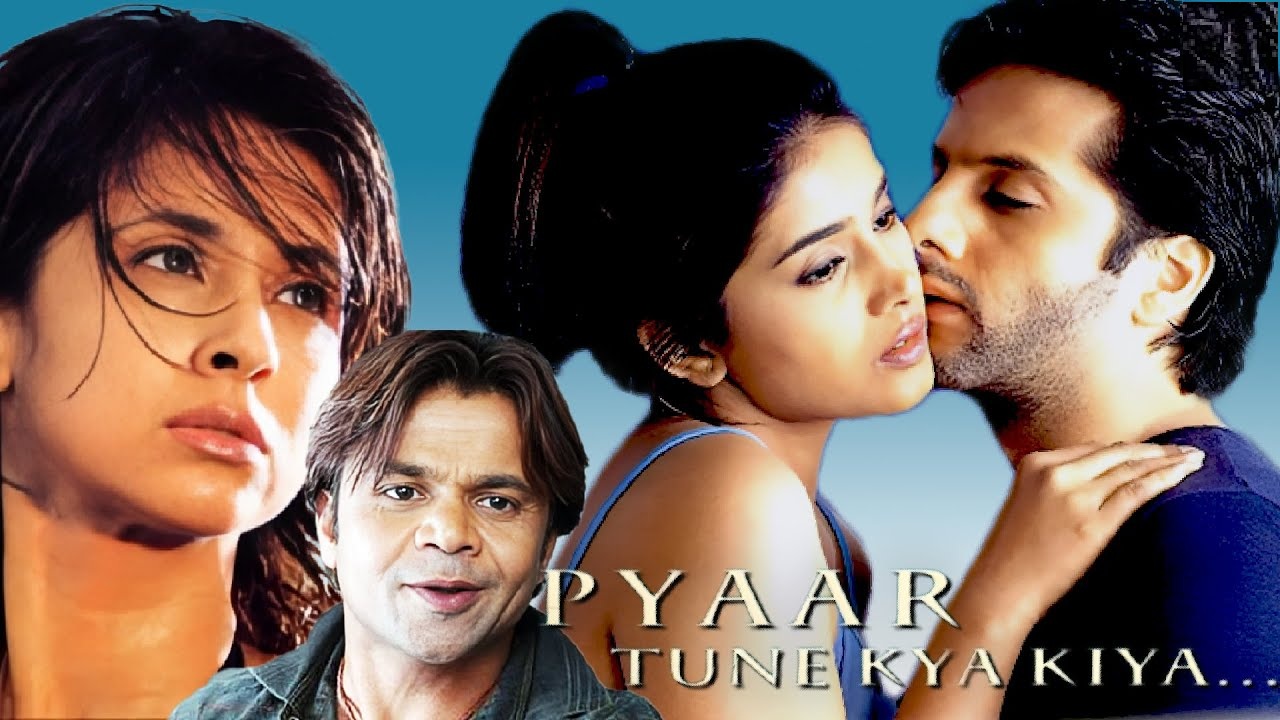
PYAAR TUNE KYA KIYA…
Varma Corporation Ltd.’s Pyaar Tune Kya Kiya… (A) is yet another Indianised version of the Hollywood film Fatal Attraction. The danger with remaking such an oft-repeated subject is that one such remake (Darr in this case) has already been adored by the audience and, therefore, the new remake has to be better than the previous best if it is to be lapped up by the audience. Unfortunately, Pyaar Tune Kya Kiya… doesn’t come anywhere close to Darr so that even if it is good in parts, its constant comparison with Darr mars its box-office prospects.
The film is about a girl (Urmila Matondkar) who is madly in love with a fashion photographer (Fardeen Khan) and stalks him in her quest to possess him. She can’t bear it when she learns that the photographer is a happily married guy. Since she is a dangerously obsessive case, she doesn’t retreat from the scene, rather her resolve to possess the photographer becomes even stronger. All hell breaks loose in the married life of the guy as his wife starts suspecting him of infidelity. This, even though the photographer has no intentions of a relationship — leave alone marriage, as desired by the obsessed lover-girl — with her. Ultimately, the girl attempts to kill the guy’s wife as she thinks, that is her only way to unite with her beloved.
The film moves at a terribly slow pace in the first half. The media background of the film will go down well with the city audience only, but will not be much understood by the cinegoers in the interiors. Besides the ‘class’ nature of the drama and its treatment, as well as the boring portions in the film, there are other weak points too. For one, Fardeen Khan, a relative newcomer on the film firmament, has a lover-boy image, but he has been shown as a married man — something which the audience will not digest at all. The need of the character was a much more mature actor. Secondly, Fardeen’s wife — Sonali Kulkarni — looks older than him. The third ‘defect’ of the film is its short length; it has a running time of barely two hours. Climax, in which Urmila Matondkar is shown in a mental asylum, is bad and morose. Characters in the film are too few, the film revolving mainly around the three main players.
Fardeen Khan looks suave and handsome and acts quite well. However, his dubbing in dramatic scenes (example, the scene in which he shouts at Urmila for threatening to jump off the terrace) is poor. He needs to work very hard on his dubbing if he is to make his mark. Urmila Matondkar exudes a lot of sex appeal although her face looks tried. Her performance in many scenes is excellent. Sonali Kulkarni is natural but her costumes could’ve been far better. Suresh Oberoi is alright. Ravi Baswani does a fair job. Rajpal Yadav is brilliant and evokes laughter. Kannu Gill is average.
Debut-making Rajat Mukherjee’s story and screenplay lack originality and are found wanting in many respects. His direction, therefore, doesn’t impress too much. Dialogues (Rajneesh Thakur and Jaideep Sahni) are natural. Sandeep Chowta’s music is a mixed bag. The ‘Kambakht ishq’ song is a hit and its picturisation (by Ganesh Hegde) is extraordinary. The title song is also very melodious. A couple of other songs are okay. Camerawork (Sanjay Kapoor) is a job neatly done. Sameer Chanda’s sets are fairly nice. Action scenes (Amin Gani) lend thrill.
On whole, Pyaar Tune Kya Kiya… has some masala for the audience of only good cinemas in ‘A’ class centres. It has nothing for small centres. It can hope to do average business in Bombay and South only. In other circuits, even its low price won’t be of much help. A loser.
Released on 27-4-2001 at Liberty and 15 other cinemas of Bombay thru Venus Records & Tapes Ltd. Publicity: excellent (but very class-appealing). Opening: very good. …….Also released all over. Opening was way below the mark almost everywhere else.
LATEST POSITION
Success continues to elude the box-office, and tension continues to chase the trade.
Albela did extremely well on the first 5 days in Bombay, Gujarat and Saurashtra, but dropped thereafter. In most other circuits, collections are unimpressive. 1st week Bombay 61,52,830 (80.48%) from 15 cinemas (5 on F.H.); Ahmedabad 5,27,576 from 2 cinemas (3 unrecd.), Vapi 4,38,960, Jamnagar 1,62,766 from 2 cinemas; Pune 16,69,517 from 4 cinemas, Solapur 2,53,511 from 2 cinemas (1 in matinee), Satara 1,58,785 from 2 cinemas (1 in matinee); Bijapur 1,48,459 from 2 cinemas (1 in noon); Delhi 45,62,993 (49.86%) from 12 cinemas (1 on F.H.); Kanpur 3,51,822 from 2 cinemas, Lucknow 6,57,249 from 2 cinemas, Allahabad 2,36,310; Calcutta 14,42,488 from 9 cinemas; Nagpur 8,01,874 from 4 cinemas, Amravati 2,06,796, Raipur (6 days) 1,47,105, Durg 98,312, Jalgaon 1,84,410, Wardha 91,001, Chandrapur (27 shows) 1,72,008, Yavatmal 1,18,664; Indore 1,80,000 (3 on F.H.); Jaipur 9,54,439 (65.69%) from 2 cinemas, Ajmer (29 shows, gross) 2,96,653; Hyderabad (gross) 24,39,351 from 9 cinemas (3 on F.H.).
………….
Jodi No. 1 maintains well in Bombay and South but drops elsewhere. 2nd week Bombay 40,00,148 (85.55%) from 11 cinemas (6 on F.H.), total for 2 weeks 1,27,92,356; Ahmedabad 12,30,625 from 6 cinemas, Vapi 1,54,975, Rajkot 1,90,000, Jamnagar 69,000; Pune 12,00,055 from 5 cinemas (1 in matinee), Solapur 3,25,384 from 2 cinemas (1 in matinee), Satara (gross) 1,15,813; Delhi 29,06,984 from 10 cinemas (6 on F.H.); Kanpur 2,61,533 from 2 cinemas, Lucknow 4,27,099, Agra 3,65,315, Allahabad 1,78,000; Calcutta 3,19,103; Nagpur 4,05,441 from 3 cinemas, Balaghat 64,070, total 1,76,431, Amravati 2,31,047, Raipur (gross, 6 days) 2,25,784, Jalgaon 1,16,025, Wardha 70,364, Chandrapur (27 shows) 1,47,495, total 4,47,700; Indore 1,37,000 (2 on F.H.); Jaipur 1,99,487 (40.69%), Ajmer (gross) 1,23,892; Hyderabad (gross) 13,87,501 from 4 cinemas (2 on F.H.); Mangalore 2,67,345.
‘LAGAAN’ POSTPONED?
Rumours were rife in the trade on Friday (27th April) evening that LAGAAN had been postponed by two weeks — to 15th June. When contacted, Ashish, secretary to Aamir Khan, said, “We are still working towards the date of 1st June. As of now, the chances of the film being postponed are nil.” Aamir was not available for comment.
GULSHAN KUMAR CASE ACCUSED GETS PARDON
Shafi Ahmed alias Shafi Mamu, one of the accused in the murder case of T-Series boss Gulshan Kumar, was discharged by additional sessions judge M.L. Tahiliani on the grounds of lack of evidence. In a rare incident, special public prosecutor Ujjwal Nikam sought and secured the discharge of Shafi Ahmed. The judge lauded the fairness of the prosecutor as there was no direct evidence to nail the accused.
The case was opened on 25th January by Nikam. He chargesheeted 19 persons in connection with the daylight shootout in which Gulshan Kumar was killed in 1997. Shafi Ahmed had been named a conspirator. He was out on bail for about six months after being imprisoned for almost a year.
JAGAT GUPTA’S DAUGHTER WEDS
Marriage of Anubha (Aabha), daughter of Jagat Gupta of Film Information family, with Vijay, was solemnised in Bombay on 26th April. The reception, held the same evening, was a well-attended affair.
AMRIT NAHATA NO MORE
Producer-director Amrit Nahata breathed his last in Delhi on 26th April around 2 p.m. He was 74 and is survived by his wife, a daughter, two sons, one of who is producer Rakesh Nahata, a brother and a sister. He had been shifted to Delhi from Jodhpur where he used to reside, only a week earlier for a heart problem. On the fateful day, his angiography revealed a 100% blockage of an artery and he was advised an emergency bypass surgery of the heart. The operation was to be conducted an hour later but the end came before that.
Amrit Nahata, who was also a member of Parliament earlier, had made Kissa Kursi Ka, the negative of which was burnt by the then government as it was an anti-establishment film. He remade it soon thereafter and released it. Amrit Nahata also made a Gujarati film, Amar Rahe Taro Chandlo, and a television serial too. His other Hindi film was Raaton Ka Raja.
He was the elder brother of your late editor Ramraj Nahta, late Lala (of Lala’s Report) and Rajasthani film producer Bharat Nahta and younger brother of late producer B.K. Adarsh.
Amrit Nahata, it seems, had a premonition of his death. Barely a week before the end came, he told his brother, Bharat, to play a game of cards with him one last time. Even when he was shifted to Delhi for treatment, he told Bharat that it was now his turn to go after his three brothers, B.K., Ramraj and Lala. He also added that he wouldn’t suffer much as he would die of heart failure.
He was cremated on 27th in Jodhpur. Uthamna for men will take place this evening (28th April) at his residence in Jodhpur, while for ladies, it will be held on May 2.
R.D. MATHUR PASSES AWAY
Veteran cinematographer R.D. Mathur expired on 15th April in Delhi following a cardiac arrest. He was 87.
R.D. Mathur had cranked the camera for such masterpieces as Mughal-E-Azam, Pakeezah and all of Sultan Ahmed’s films, among others.
R.D. Mathur had gone by ship to Hollywood to learn cinematography at the start of his career. He had mastered the art of camerawork so brilliantly that he was appointed on a permanent basis to photograph films made by Bombay Talkies. He used to also teach cinematography at the FTII, Pune.
Mathur had directed three films — Aghosh, Madhosh and Magroor. Sultan Ahmed described the late cameraman as “an extremely nice person and a fantastic technician”.
NEW MULTIPLEX IN KOTA
A new multiplex consisting of three screens is proposed to come up soon in Kota. Being made by the Kotharis, the total floor area of the complex will be 20,000 square feet.
Film Trade In C.I. — Battling For Life In ICU
The distributors and exhibitors of C.I. territory may differ with each other on a variety of issues, but they all agree on the bad current scenario of the trade — that things couldn’t get worse than this. While the overall countrywide scenario for the Hindi film business is not encouraging, the C.I. trade is certainly in a worse mess. Business has become extremely perilous in recent times and the dents in box-office collections are as glaring as the potholes on the roads in the region. So, it would hardly surprise one to know that one of the oldest cinemas in the territory, Radha, Bhopal, was recently forced to down shutters, perhaps, permanently.
C.I. distributor-exhibitor O.P. Goyal despairs over the flow of big films, which has been reduced to a trickle in the recent past. He laments, “And to add to our woes, the few big films that did make it to the screens in this dismal period, showed no sustaining power whatsoever.” In his opinion, it is the regular supply of small-budget films that has helped cinema halls to make ends meet in the interim period. However, he concedes that this is only a temporary relief as a regular flow of big films with sustaining power is a must for the trade to thrive.
Leading C.I. distributor Uttam Nahar is equally pained at the state of affairs. Describing the present situation as “the worst I’ve seen in my 25 years as a film distributor”, he cites examples of two recent repeat-run films to bring home his point. Both the films were released on percentage basis, as is the usual practice in the territory. While one ‘earned’ a weekly share of Rs. 367/-, the other fared a bit better, fetching a share of Rs. 600/-! The publicity expenses alone on the films were Rs. 1,700/- and Rs. 2,500/- respectively. Nahar wants to know, “In the scenario, where the box-office collections have touched rock-bottom, what sense does it make whether the film is released on percentage terms or otherwise! Yahan toh murgi-se-zyada-masala-mehanga waali baat hai!”
According to Sitaram-ji of Real Gem Distributors, Indore, business has crashed by about 60% to 70% over the last few years. He attributes the ongoing crisis to two important factors viz. rising popularity of TV serials and severe drought conditions in Madhya Pradesh. In his opinion, Bhopal and Gwalior are two stations which have suffered comparatively less. Still, he harbours no doubts that more than a hundred cinemas will be forced to down shutters in the territory in the near future.
According to a recent circular of the Central Circuit Cine Association, as many as 42 members have been exempted, following failure in settling their dues. The list includes some of the leading C.I. distributors, like ABC Enterprises, Sarita Films, Bableshwar Films, Surya Enterprises, Dharma Movies, Manoj Movies, Dhanesh Enterprises, Navshakti Enterprises, Parmeshwar Enterprises and others, which have payments outstanding even after having released successful or blockbuster films in the recent past.
If the box-office collections are in an impoverished state, there are other maladies plaguing the C.I. trade as well. Rampant goondaism, almost-zero help from the government and the widespread menace of illegally-procured prints being screened are dealing death blows to the trade.
– Gautam Mutha
“There is not a single air-conditioned cinema hall in the entire state of Madhya Pradesh!”
– J.P. CHOWKSEY
J.P. Chowksey needs no introduction to anyone who is familiar with the Hindi film trade. Prominent C.I. distributor, he has spent a lifetime in buying and selling films. Having suffered losses in recent releases like Phir Bhi Dil Hai Hindustani, Kuch Khatti Kuch Meethi, Aaghaaz and Rahul, he, too, is not unaffected by the current crisis in film business. Yet, resilient as he is, Chowksey refuses to even consider another vocation, saying in true Raj Kapoor fashion — he has distributed most of R.K.’s films in C.I. and continues to share a very close relationship with the Kapoor family — “Jeena yahan, marna yahan”! His forthcoming releases in C.I. include biggies like Lagaan, Yaadein, Aap Mujhe Achche Lagne Lage and Kabhi Khushi Kabhie Gham. We found him in a sombre mood one sultry afternoon in Indore this week and discussed problems surrounding the C.I. trade.
According to Chowksey, it is not the film trade alone that is in a bad shape in the state of Madhya Pradesh. He informs, “More than 700 industrial units in various sectors have folded up in the last five years. The failure of the monsoons for the second consecutive year has further damaged the state economy. With more and more people finding themselves out of jobs, goondaism is on the rise in the state. The law and order situation has also gone to the dogs. Naturally, all this has affected the film trade, too.” The condition of film business is alarming especially since the trade is beset with its own set of problems like a dwindling supply of films with sustaining power.
“As it is, cinema receipts are very low,” says Chowksey, revealing, “and, to make matters worse, rampant goondaism has forced a large number of cinema halls in ‘B’ and ‘C’ class centres to restrict the number of shows to only two per day.” Incidents of robbery at cinema halls have become commonplace in recent times. “The situation is so bad that only recently, some goons robbed the cashier of Radhu Cinema at Dhaar of a paltry Rs. 600/- collected in a show!”
The law and order situation may be comparatively better in the ‘A’ class centres of the territory, but there are other problems faced by exhibitors there. With investment in cinema halls yielding very low returns, most exhibitors are shying away from putting in more money for the upkeep of their cinemas. As a result, the condition of cinema halls in the state is deteriorating rapidly. Chowksey makes a startling revelation when he informs that there is not a single airconditioned cinema in the entire state of Madhya Pradesh!
Regular flopping of big and star cast films is, of course, a major concern for the distributor. Chowksey informs, “Both, Champion and One 2 Ka 4, were sold for C.I. for throwaway prices — at less than 30% of what their prices for C.I. should have been. Yet, their distributors recorded losses to the tune of 50%!”
So, what is the way out of the mess then? Chowksey alludes to restructuring of state economy as a cure for all evils. He explains, “Both, C.I. and Nizam territories, are sold for prices that are nearly equal. Yet, the business of films in the latter circuit is five times that of the former. How is it possible? It is possible because the economy is robust in Andhra Pradesh, thanks to the dynamic leadership of chief minister Chandrababu Naidu. Sadly, the same cannot be said about the political leadership in M.P. The state remains backward as ever.”
– Gautam Mutha
3-E
Education-Entertainment-Enlightenment
The Tops And Their Current Top Priorities
Here’s a lowdown on what some of our top directors are busy doing these days:
Yash Chopra is finalising the script of his next.
Subbash Ghai is busy completing Yaadein to ensure its release on 27th July.
Karan Johar has just returned from a foreign shooting schedule of Kabhi Khushi Kabhie Gham and will be leaving shortly, again for London to further shoot the film.
Sooraj Barjatya is busy with the music of his Main Prem Ki Diwani Hoon.
Rakesh Roshan, having zeroed in on the subject of his next, is these days having long story sittings with his team of writers.
Indra Kumar is yet to finalise the story-line of his new film starring Anil Kapoor.
Rajkumar Santoshi was in Madras earlier this week, where a trial show of his Lajja was seen, among others, by music maestro Ilaiyaraja. Everyone present went ga-ga over the multi-star cast film.
Sanjay Leela Bhansali is in a different time period altogether. Just kidding — ‘coz he is deeply immersed in the making of his love epic, Devdas.
Ram Gopal Varma is in the company of Boney Kapoor because the two of them are making Company alongwith a third partner, Aswini Dutt.
‘Closed’ On ‘Opening’ Day!
Palanpur is a town in Gujarat with a population of about 1 lakh. With the new 3-screen multiplex, Surmandir, which opened there last week, the town now has six screens. A taste of the things to come was had on the day of the opening of the multiplex itself. Believe it or not, one screen had to cancel one show on the inaugural day due to lack of audience! Unbelievable, but true. The admission rates of the multiplex are Rs. 30 and Rs. 50 as against the more reasonable Rs. 5, Rs. 9 and Rs. 14 in the three existing cinemas.
INFORMATION MEETS
“The national award is an award from the government of India, no less…. By returning it, I would have been insulting them.”
– ANIL KAPOOR
KOMAL NAHTA & GAUTAM MUTHA
Easily one of the finest actors of today, Anil Kapoor has seen it all — blockbusters, hits, successes, flops and disasters. But if the super-hits haven’t corrupted him, the failures, too, haven’t crushed him or his contagious spirit of raring to go. The new millennium holds special charm for the charming actor because he bagged his first National Award last month. He also turned an official producer in the year 2000 with Badhai Ho Badhai which he is making jointly with Satish Kaushik and Mukta Arts. Among the very few actors who don’t hesitate to experiment with their roles, Anil can shine equally in Ram Lakhan, Tezaab, Eeshwar, Mr. India, Pukar and Saaheb, among others as in Taal in which he played a character with shades of grey or in Biwi No. 1 where his was neither the title role of the biwi nor even the biwi’s husband, but rather a supporting role! Even today, the actor has a mixed bag of films: Nayak – The Real Hero is the remake of an unusual South blockbuster about a one-day chief minister; Om Jai Jagadish has him sharing credit with two more heroes, three heroines and a couple of veterans; Badhai Ho Badhai is the remake of a hugely successful South commercial fare; Lajja is an episodic film about a woman’s journey through various phases in life; Rakt is a one hero – one heroine film.
Information met up with the actor on the sets of Om Jai Jagadish in Bombay. What keeps the actor going, what are his insecurities and his strengths, what the recent National Award he bagged for Pukar means to him…… Read on for an insight into all these!
Awards, box-office rewards and now the National Award — the ultimate recognition for an actor. Does that make you complacent?
The National Award made me complacent for three hours. I slept very well that night after I got the news that I had bagged the National Award for the best actor. Instead of 7 a.m., I woke up the next morning at 10.30 a.m. But once I was up, Anupam (Kher) telephoned me to call me to his office. He said, Tabu had date problems for Om Jai Jagadish. That’s it! I was back to the insecurities and problems that go with our job and our industry. Less than 24 hours after I had won the National Award, I was trying to solve the problems of Om Jai Jagadish. There was no time for complacency.
To tell you frankly, a creative person can never be complacent. Nothing comes easy, more so today, when there’s so much competition. Now, it’s not enough to have just a good script, a film should also be technically superb, performances of the stars have to be excellent, the look of the film must be perfect. And, here in India, we have to achieve all this in the limited budgets with which we make films. No easy task by any means and so, there never can be a complacent attitude to anything.
After the controversy over your National Award, did the thought to return the award ever cross your mind?
No, such a thought never crossed my mind. More so, because I got the award for Pukar for which I had worked very hard. I felt, it was God who had given me something. I also felt, when I had worked so honestly and sincerely and had given my everything to the film, somewhere, I deserved the award. Why, after seeing Pukar, Yusuf Saab told me, ‘Anil, you’re firing on all cylinders.’ That was a great compliment.
See, when God gives a mother a child, it is a blessing which no mother would return. My National Award was also a blessing from God. The National Award is an award from the government of India, no less. And the majority of the jury agreed with it. By returning it, I would have been insulting them, I would have become too big for my boots. Whatever one does, one must have complete conviction. One shouldn’t do anything for effect or without conviction.
Perhaps, I am among the very few actors who are always there at the time of other actors’ glories — to clap for them, to encourage them. I’ve attended every Filmfare Awards function, whether or not I’ve been nominated for the best actor award. But this year, when I was not nominated for my performance in Pukar, I refrained from attending the Filmfare Awards function for once. I thought, the praises of Dilip Saab and Mr. Amitabh Bachchan for my work in Pukar were the highest honour for me. See, destiny always tests you. The National Award has come to me alongwith the controversy surrounding it. But the controversy has also, in a way, heightened my joy.
Do you think, you’ve had to struggle for everything in life?
Yes, I’ve slogged for everything, I’ve got. I have never got anything on a platter.
Does that make you bitter?
No, on the contrary, it makes me stronger, richer.
How do you look back at your career so far?
I’ve never analysed my career in that sense of the word. But yes, I do get feedback all the time from family, friends and fans. I think, I’m very lucky because I’m in an extremely enviable situation. Today, I am one of the most believable actors. I get to do believable roles, characters and films. I think, God has been very kind to me. Comparing myself to others, I feel, I’ve been fortunate. Ups and downs affect me only temporarily.
But it is said that a good actor must also be a sensitive person. Then, how do the ups and downs in your career not affect you?
Every actor has a sort of a machine in his mind which he can switch on or off according to the demand of the time. Sanjay Dutt was in prison for two years. Any other person in his place would’ve been shattered, but being an actor has helped him. An actor has this machinery that can switch off all his senses, make him go blank and start afresh. He can use his mechanism to forget the lows and immerse himself either in his work, religion, reading or anything he wants. Other normal human beings don’t have this mechanism. Of course, it also depends on how strong you are internally. You’ve got to be mentally very strong for things like career highs and lows to not affect you. That’s why people like Dev Anand, Dilip Kumar and Amitabh Bachchan are admired. You learn from their mistakes and emulate the good steps they’ve taken. I’m fortunate that I have such great icons to look up to.
Do you believe in God?
Of course, I believe in God. But I also believe in myself.
Whom do you turn to in your weaker moments?
To myself. Of course, the family is always there to support you in your normal emotional moments. But in your worst moments, it is you and only you who has to face them. These are times when nobody can help you. I’ll narrate you one incident to explain what I mean.
We were shooting an important action sequence for Pukar in Mexico with an all-American unit. That schedule, I think, was the toughest period of my entire career. My family wasn’t with me there, Boney was busy with the shooting of Sirf Tum in another country and, what’s more, director Rajkumar Santoshi, too, had had to return to India for an emergency. So I was the hero, the producer and also, in a way, the director there. I realised that the American unit was not at all up to the standard. It was taking us for a ride, blackmailing us all the time. Monetarily, we had overspent, and not marginally! We had spent almost four times the budget! We were shooting in a jungle infested with mosquitoes. I didn’t even have anybody from the production department. I realised, the foreign unit was withholding the exposed negative from me so that they could blackmail us at the end. I knew all along, the sequence would never fit into the film. The entire shooting schedule had gone haywire because of one mistake of ours — we had hired the services of a mediocre unit which didn’t know its job.
But I didn’t crumble at that time, instead, I became stronger. I decided, I wouldn’t leave Mexico till the sequence was completed. I sweet-talked the unit, tried my best to keep them in check and, all this, while performing before the camera.
Ultimately, we had to shell out US $80,000 more to them because they refused to return 10 exposed tins. And my gut feeling was right, for, ultimately, we had to reshoot the entire sequence because that one was bad. What I mean to say is that I was a broken man all through the 10-day stint in Mexico, with nobody to turn to. I could only rely on myself there.
There was a time in your career, about 12 to 15 years ago, when you had returned the signing amounts you had taken for two-hero projects because you didn’t want to act in two-hero films. Today, however, many of your films are double-hero and even three-hero projects. Why this change in strategy?
It was never that I would not act in two-hero films. I returned the signing amounts because I was not satisfied with my role. For me to do justice to a film, I’ve to like my role. If a filmmaker or writer tries to cheat me, I can’t do his film. On the other hand, I do a film if I trust the writer and director. Of course, sometimes, one takes the risk despite the fact that he is being cheated. That may make the job more exciting and challenging!
Why are artistes so insecure? They are more insecure about their careers than even directors!
No, you are mistaken. It is directors who are more insecure than actors because their job is very difficult. They are isolated because they can direct only one or two films at a time. On the other hand, an actor does different kinds of roles at any given time. So while artistes are insecure, they are less insecure than directors. Insecurity can be of two kinds — the positive and the negative. While positive insecurity makes the actor strive to do better, negative insecurity leads to mistakes and blunders.
As to why an actor is insecure, there are so many reasons for it. He is insecure about getting the right films, the correct roles, the right scripts. He is also insecure about his physical fitness. He is scared of failure, of how to match up to others’ success, to fresh talent. He is insecure about age catching up. See, acting is a very personalised job. Most other jobs can be done even if the person in charge is not present for some time, but for acting, your presence is necessary. Then, it is also a fact that a person is constantly changing physically. So, insecurities of stars will always remain. It then depends upon the sensibilities of the actors, how they overcome the insecurities and try to have a career which is not only creatively satisfying but also financially lucrative.
Why do you plan your career so meticulously and let it not just go naturally?
I don’t think, it is planning as in a plan. But it’s also a fact that nothing in this world succeeds without proper planning.
But is it also not a fact that spontaneity is lost with planning?
Sometimes, you’ve got to plan that too! Career is a little bit of planning, a little bit of risk. On my part, I’ve taken a lot of risks in my career. If you are educated and sensible, why shouldn’t you use your education and sensibilities to plan your career? I have examples before me of my seniors who planned their careers and whose longevity, therefore, has been more than the longevity of those who didn’t. Those who didn’t plan may have had successful careers but the span of their careers was smaller.
How did your family react when you decided to branch out into production as well, since brother Boney Kapoor is already producing films?
My branching out wasn’t a very serious matter. My family was very happy that I was starting a new business. It was taken very normally.
Did you take to production because every actor today is doing it?
No, not because everybody is doing it. I was always a producer since I hail from a family of producers. I had always been telling Boney to work with other heroes, too, rather than just working with me and Sanjay. I used to tell him, “Let ours be a film company, not a family company.”
Is there any unfulfilled ambition? A yearning, a craving for something unachieved?
I yearn for the global and international respectability and popularity of Hollywood stars. Not just for myself but for any Indian actor or director. I wish, Indian films come on the international map in the true sense of the term. The winning of the Oscar award by foreigners like Roberto Benigni or Russell Crowe should give courage to actors and directors in India to strive to do better and aim for the sky…….