





























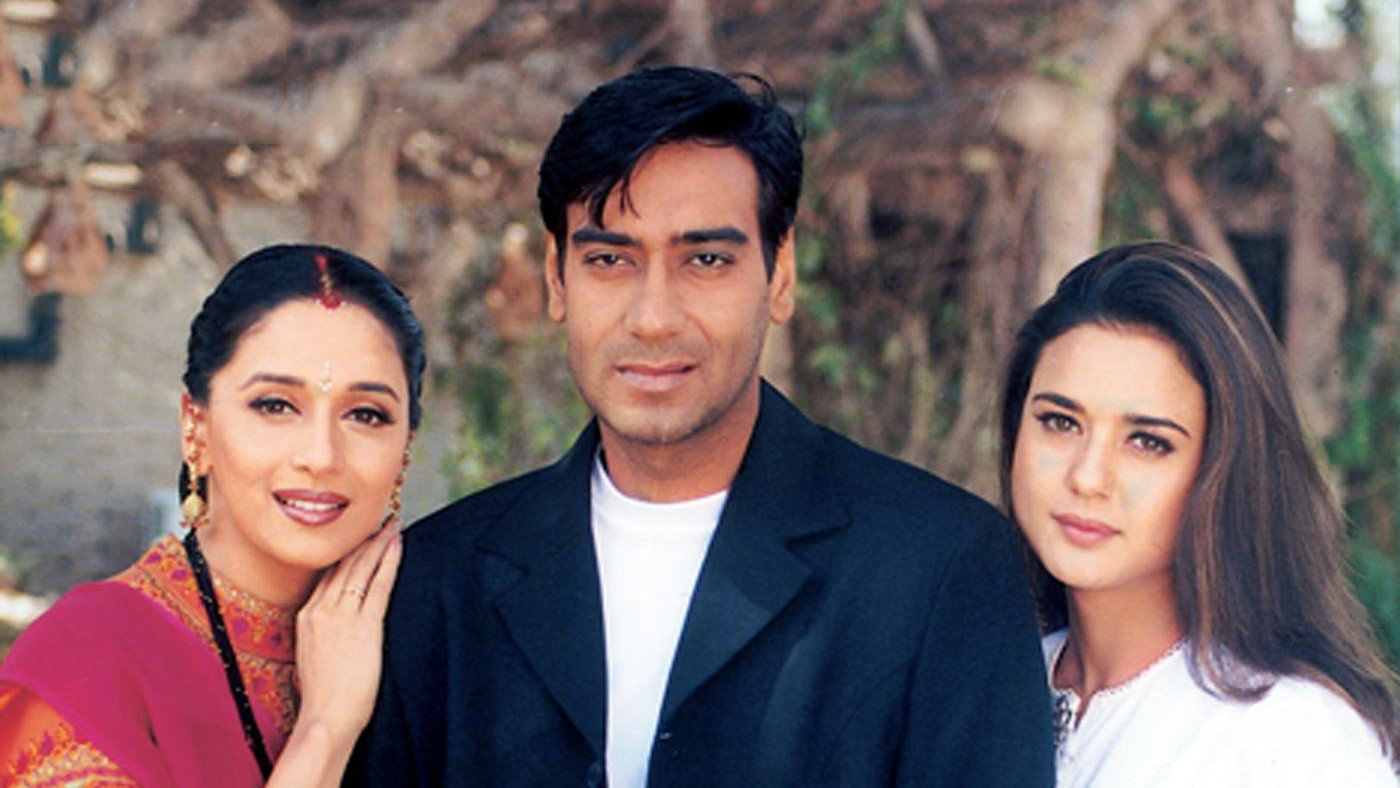
YEH RAASTE HAIN PYAR KE
Yashish Enterprises’ Yeh Raaste Hain Pyar Ke is about a big-time car thief, his girlfriend, his look-alike and the look-alike’s wife. The thief and his girlfriend make fast money by stealing cars, gambling and doing all things illegal. In the course of their activities, they get into a brawl with the local goonda‘s brother and the latter gets killed accidentally. In a fit of rage, the goonda swears vengeance and sets out to kill the thief but, due to a case of mistaken identity, kills the look-alike instead. The deceased’s newly-wed wife sees her husband being killed but refuses to believe it because the mental shock takes her into partial amnesia. Her doting father-in-law sees a ray of hope in the car thief who accidentally reaches their palatial house, because of his striking resemblance to his deceased son. He pleads with the thief to stay with them and pose as his son so that his daughter-in-law can, at a convenient time, be made to realise that she is a widow. The guy agrees for a fat sum of money in return. His girlfriend is happy at first, then suffers due to his absence and ultimately even revolts. Circumstances, in the meantime, bring the widow back to her senses.
The story (Deepak Shivdasani) offers no novelty whatsoever and looks heavily inspired by old films like Khilona. Screenplay (Robin Bhatt and Akash Khurana) is poor and haphazard. How a father-in-law would trust an unknown person living and sleeping in the same room as his daughter-in-law is not explained. Why the father-in-law does not inform his daughter-in-law’s family about the death of his son is not known. How the widow suffers from partial amnesia even when she sees her husband’s dead body in the morgue is not known. Servants of the dead guy also seem to be oblivious to their boss’ death and so also the people of the town in which he lives although they (people) adored him when he was alive. Is death so trivial that nobody is informed about it? Slips and blunders like the above are aplenty. The family doctor’s characterisation is weird. He keeps giving suggestions which can never befit a doctor. And in the climax, it is this same silly doctor who announces that the lady has regained her lost memory. Dialogues (Kaden Khan, Robin Bhatt and Shankar Iyer) are ordinary.
The action climax is half-heartedly done. In the climax, the villain, who has been pursuing the thief’s girlfriend to get her married to his younger brother, even if by force, himself comes and hands her over to her beloved. Why didn’t he get his brother married to her when he had a golden chance?
Ajay Devgan is average as the thief. He looks disinterested or just too casual in some scenes. As the look-alike rich guy, he has a brief role. Ajay looks too thin in some scenes. He dances rather awkwardly. Madhuri Dixit acts naturally and leaves a mark in the morgue scene. She lacks freshness in her looks, though. Her dances are pretty graceful. Preity Zinta gets limited scope and acts quite well. Vikram Gokhale gives a sincere performance. Deep Dhillon has an effective voice but gets no scope to show his talent. Kiran Kumar fills the bill. Smita Jayakar is natural. Shammi, Mayur, Brij Gopal and Jayshree T. pass muster. Sunny Deol has been hopelessly wasted in a special appearance. Although he acts ably, the audience will be sorely disappointed with his inconsequential role.
Deepak Shivdasani’s direction is rather dull. He has cared little for logic or continuity, and the entire drama suggests that he has taken the viewer too much for granted. Sanjeev Darshan’s music is fair. The title song, ‘Jo pyar karta hai’, ‘Balle balle’ and ‘Aaja aaja’ are quite good. Picturisation of the last named song is enchanting for Madhuri’s dance.
Rajan Kinagi’s camerawork is eye-filling. Foreign locations are pretty. Background score leaves something to be desired. Action scenes are functional. Production and other technical values are fair.
On the whole, Yeh Raaste Hain Pyar Ke is a weak film with bleak chances in most circuits. It should, however, do well in Bihar.
Released on 10-8-2001 at Minerva and 22 other cinemas of Bombay thru Devgan Entertainment & Software Ltd. Publicity: good. Opening: fair. …….Also released all over. Opening was good in Bihar but below the mark in most of the other circuits.
LATEST POSITION
The debacles of YAADEIN… and both of last week’s releases, PYAAR ISHQ AUR MOHABBAT and HUM HO GAYE AAP KE, have given a further boost to GADAR which, in any case, was going great guns.
Pyaar Ishq Aur Mohabbat is a washout. 1st week Bombay 19,71,023 (64.96%) from 9 cinemas (10 on F.H.); Ahmedabad 12,42,450 from 5 cinemas (1 unrecd.), Jamnagar 56,025 from 2 cinemas (1 in matinee); Pune 7,10,010 from 5 cinemas, Solapur 1,44,957 from 2 cinemas (1 in matinee); Bijapur 1,00,651 from 2 cinemas (1 in noon); Delhi 19,46,556 (39.49%) from 9 cinemas (1 on F.H.); Kanpur 3,15,687 from 2 cinemas, Lucknow 2,35,879, Agra 3,05,000, Varanasi 1,16,735, Bareilly (6 days) 79,631, Jaunpur 60,000; Calcutta 2,97,096 (other cinemas poor); Nagpur 2,66,354 from 3 cinemas, Amravati 1,43,248, Akola 70,309, Raipur (6 days) 55,199, Bhilai (6 days) 65,790, Jalgaon 87,842, Yavatmal (6 days) 53,159; Jaipur 2,60,308 (20.57%) from 2 cinemas; Hyderabad (gross) 19,86,261 from 13 cinemas; Vijayawada (gross) 2,07,233, Visakhapatnam (gross) 1,52,197.
Hum Ho Gaye Aap Ke is a total loss. 1st week Bombay 25,35,894 (49%) from 13 cinemas (7 on F.H.); Ahmedabad 3,75,070 from 4 cinemas, Jamnagar 42,430; Pune 3,92,384 from 4 cinemas (1 in matinee), Solapur 84,328 from 2 cinemas (1 in matinee); Delhi 21,41,969 (33.46%) from 11 cinemas; Kanpur 2,74,167 from 2 cinemas, Lucknow 3,16,746, Agra 1,76,000, Varanasi 1,31,490, Bareilly (6 days) 33,860; Calcutta 2,23,865 (other cinemas poor); Nagpur 1,71,697 from 2 cinemas, Jabalpur (6 days) 48,846, Amravati 74,912, Akola 91,860, Bhilai (6 days) 49,400, Jalgaon 48,188; Bhopal 61,016 (1 unrecd.); Jaipur 2,24,143 (22.29%) from 2 cinemas, Ajmer (29 shows) 70,739; Hyderabad (gross) 14,65,892 from 5 cinemas (1 on F.H.).
…………..
Yaadein… drops dramatically. 2nd week Bombay 29,14,409 (64%) from 9 cinemas (14 on F.H.), total for 2 weeks 1,02,09,470; Ahmedabad 1,85,284 from 2 cinemas, Jamnagar (9 shows) 28,707; Pune 11,15,673 from 5 cinemas, Solapur 90,120; Bijapur 41,997 (25%); Delhi 46,02,325 from 12 cinemas (1 on F.H.); Kanpur 3,91,682 from 2 cinemas, Lucknow 6,39,728 from 2 cinemas, Agra 2,44,000, Varanasi 1,68,065, Bareilly (6 days) 67,159, Jaunpur 30,000; Calcutta 7,92,726 from 4 cinemas; Nagpur 1,58,217 from 2 cinemas, Jabalpur (6 days) 1,68,974, Amravati 1,05,022, Akola 80,400, Raipur (6 days) 1,76,973, Bhilai (6 days) 65,904, Durg 60,231 (1st week 1,11,003), Jalgaon 89,006 (1st week 2,68,324), Wardha 37,716, Chandrapur 64,223, total 2,50,755, Yavatmal 51,650, total 1,73,002, Sagar 43,572 (1st week 52,568); Indore 1,90,000, Bhopal 90,000; Jaipur 6,32,839 (74.73%), Ajmer (gross) 1,19,508; Hyderabad (gross) 4,35,286 from 2 cinemas (1 in noon, 1 unrecd.); 1st week Davangere 1,87,814; 2nd week Vijayawada (gross) 2,45,435, total 6,63,693, Viskhapatnam (gross) 1,71,738, total 4,86,045.
Lagaan (21 shows all over) 8th week Bombay 32,12,572 (67.55%) from 10 cinemas (5 on F.H.), total for 8 weeks 4,52,42,609; Ahmedabad 86,814 from 2 cinemas (1 unrecd.); Pune 6,40,572 from 2 cinemas; Delhi 15,78,108 from 4 cinemas (2 on F.H.); Kanpur 76,558, Lucknow 2,31,206, Agra 1,50,000; Calcutta 3,50,852 from 3 cinemas; Nagpur 1,36,425, 7th week Jabalpur (6 days) 46,721, 8th week Amravati 67,357, Raipur (6 days) 56,390, Bhilai (6 days) 19,229; Indore 60,000; Jaipur 3,32,162 (34.90%) from 2 cinemas; Hyderabad (gross) 12,05,953 from 5 cinemas (2 in noon); Vijayawada 3 weeks’ total 12,40,886 (gross), Visakhapatnam 3 weeks’ total 12,60,320 (gross).
Gadar Ek Prem Katha continues to roar and score. 8th week Bombay 28,21,590 (54.23%) from 13 cinemas (10 on F.H.), total for 8 weeks 4,93,89,838; Ahmedabad 4,46,774 from 4 cinemas (2 unrecd.), 1st week Idar 1,01,083, 2nd week Balasinor 2,91,482 from 2 cinemas, Himmatnagar 1,80,693, 8th week Jamnagar 52,666 from 2 cinemas (1 in matinee); Pune 9,18,213 from 5 cinemas (1 in matinee), Solapur 1,55,110 from 2 cinemas (1 in matinee); 2nd week Shimoga 95,865; 8th week Delhi 36,85,323 from 13 cinemas (2 on F.H.); Kanpur 4,41,356 from 2 cinemas, Lucknow 5,34,665 from 2 cinemas, Agra 3,75,000, Varanasi 2,56,271, Bareilly (6 days) 95,183, Jaunpur 20,000; 7th week Calcutta 3,02,470 from 2 cinemas; 8th week Nagpur 3,60,231 from 3 cinemas, Jabalpur (6 days) 2,09,238, Amravati 1,33,193, Akola 1,44,235, total 15,45,976, share 12,59,545, Raipur (6 days) 1,18,066, Bhilai (6 days) 76,751, Jalgaon 1,52,228, 4th week Gondia (6 days, gross) 1,26,334, Wardha 43,779, total 9,04,546, Yavatmal 56,826, total 9,73,417, share 7,73,417, Sagar 61,045; Indore 1,77,049 (1 on F.H.), Bhopal 2,40,403; Jaipur 3,39,267 (57.98%), Ajmer (gross) 2,64,773; Hyderabad (gross) 3,76,344 (1 unrecd.).
WIFPA DEMANDS REDUCTION IN WELFARE CESS
The Western India Film Producers’ Association has urged the parliamentary standing committee for labour welfare to reduce the cine workers welfare cess, currently Rs. 20,000 per film, to the minimum possible. The WIFPA has, in a letter dated 19th July, 2001, sought clarifications from the committee with regard to (i) the accumulated amount collected as cess till date; (ii) the constituted criteria for availing of the fund; (iii) the average amount of cess collected from film producers every year; (iv) the average annual amount of cess being spent under various schemes for the benefit of the workers; (v) the total number of cine workers registered under the scheme and the number of beneficiary cards issued till date; (vi) average number of beneficiary cards issued annually; and (vii) the average annual number of feature films on which cess is applicable.
Surprisingly, beneficiary cards are issued to cine workers who earn below Rs. 1,600 per month. In today’s times, such low remuneration (which, incidentally, was last revised in 1987) is hardly earned by anybody. Therefore, most of the workers are not able to avail of the benefit of the cess.
The letter suggests that the cess be also made applicable to producers of TV serials and ad films so as to substantially reduce the burden of cess on film producers. The WIFPA has also asked for a representation of the producers on the Welfare Cess Committee. A suggestion is also made about shifting of the office of the Welfare and Cess Commissioner to Bombay as it is the hub of all Hindi film activities.
The issues were discussed by a WIFPA representation, led by O.L. Sharma, convenor of the WIFPA’s government committee, with the under secretary, labour and welfare department, on 20th July in New Delhi.
SURINDER KAPOOR HOSPITALISED
Producer Surinder Kapoor suddenly took ill on 10th August and had to be hospitalised. He is under observation at Nanavati Hospital in Bombay. His condition is stable.
Boney Kapoor, who was shooting in Jodhpur for his Nana Patekar starrer, rushed to Bombay on getting the news of his father’s ill-health.
ANNUAL PRIZE MONEY FOR MARATHI FILMS HIKED
The Maharashtra government has hiked the annual prize money allotted for Marathi films. Ramkrishna More, the state cultural affairs minister, announced a raise of Rs. 1.61 lakh, taking the total amount of award money to Rs. 5.76 lakh. The prize money for the best film will now be Rs. 85,000. The hike will be effective from the 39th Marathi film festival next year.
DALCHAND JAIN NO MORE
Producer-exhibitor Dalchand Jain (Gayatri Cinema, Ratlam) passed away in Indore on 9th August due to renal failure. He had been admitted to a hospital in Indore on 6th. A member of the Ratlam Cinema Association, he had also produced Veer Chatrasal. He is survived by daughter Shashi and son Mohit. All Ratlam cinemas suspended one show on 9th.
‘VEER SAVARKAR’ CENSORED
Savarkar Darshan Pratishthan’s Veer Savarkar has been cleared by the CBFC for universal viewing. Written and directed by Ved Rahi, the film stars newfind Shailendra Gaur in the lead role alongwith Navni Parihar, Mrinal Kulkarni, Pankaj Berry, Tom Alter, Bob Christo and Rohitashva Gaur. Music: Sudhir Phadke. Cinematographer: Sameer Athalye. Editor: Vijay Kochikar. Art: Sharad Pole. The film is being readied for an early release. It has been shot extensively on locales of UK, France and in India on the Andaman and Nicobar islands.
YOU ASKED IT
How much business did Mother India do in its first run in Bombay?
– In the first 18 months alone, the business crossed 35 lakh. The cost of 8 technicolor prints to the distributor at that time was an astronomical 15 lakh.
When is it advisable to take a top star in a special appearance in a film?
– Only when you have a role to suit his/her status.
What is important in this industry — to make a good film or to make a successful film?
– It is more important to make a successful film because one is judged by the yardstick of success here.
MULTIPLEXES IN MAHARASHTRA
Tax Exemption Policy Announced
Existing Cinemas Protest
While those planning multiplexes in Maharashtra rejoiced at chief minister Vilasrao Deshmukh’s announcement of tax holidays to new multiplexes in the state, on 7th August, existing cinemas across the state pressed panic buttons. At a hurriedly-called meeting of the Theatre Owners’ Association and the Cinematograph Exhibitors’ Association of India on 8th, it was decided to shut single-screen cinemas in Bombay on 9th to protest against the state government’s decision to waive entertainment tax on multiplexes under what was described as a discriminatory scheme.
The call for closure of cinemas was so sudden that the bandh on 9th remained partial. Another reason for the closure not being completely successful is that several single-screen cinemas do not either think, there is anything wrong with the multiplex policy or that anything will come out of the bandh.
The chief minister of Maharashtra announced 100% entertainment tax exemption on multiplexes for the next three years, and a 25% exemption for the subsequent two years. The exemption scheme, it is believed, will be applicable to multiplexes with at least four screens and a seating capacity of over 1,200. The announcement was made by the chief minister at the Enter Media 2001 conference organised by the Confederation of Indian Industries (CII) on the entertainment industry.
While Bombay cinemas registered their protest, albeit half-hearted, cinemas in other parts of Maharashtra are gearing up for action. Exhibitors of Nagpur, Akola, Amravati, Jalgaon, Dhule, Wardha, Khamgaon, Chandrapur (all centres of C.P. Berar) have lodged individual protests with the chief minister and home minister of Maharashtra by sending them telegrams reading: ‘We strongly protest and condemn discriminative and unjust announcement of tax holiday for multiplex theatres by the chief minister’.
A meeting of exhibitors of the Maharashtra belt of C.P. Berar will be held on Sunday, 12th August in Nagpur at Hotel Tuli International to chalk out the future course of action to be taken by the existing cinemas against the tax exemption policy for multiplexes. A memorandum is expected to be prepared at the meeting for handing over to the chief minister.
Meanwhile, distributors of Bombay circuit have condemned the abrupt closure of cinemas in the city on 9th August. The IMPDA is asking its members to claim their shares for the day from the closed cinemas as the closure was decided without taking them (IMPDA members) into confidence. Leading Bombay distributor Balkrishna Shroff said, “It is ridiculous to be protesting against something which the government is giving to the industry. Nobody is stopping the existing single-screen cinemas from converting themselves into multiplexes and availing of the tax exemption. How can anybody prevent progress?”
The IMPDA also lodged a strong protest against the CEAI and TOA’s unilateral decision to close down cinemas. Welcoming the government’s move, the IMPDA called the grant of tax-holiday to multiplexes an encouraging move which “would bail out the theatres, most of which are in the red on account of slackness of business and the difficulties in maintaining high overheads”. The IMPDA has also urged the government to favourably consider the cinema owners’ demand for an increase in the tax-free service charge from the present Re. 1 to Rs. 2. FICCI, like IMPDA, has also praised the Maharashtra government for what it termed a “pragmatic step”.
‘DDLJ’: 300 And Still Going Strong!
8th September, 1994. Bombay’s Filmistan Studios. A young director is calling the first shot of his career. His father and the film’s producer, himself a living legend of Indian cinema, beams with pride. Little do they know, the film that they are about to make will turn out to be much bigger than they could ever imagine.
Diwali, a year later. The film releases to bumper response all over India and the Overseas and is instantly declared a blockbuster. The shy, first-time director finds himself catapulted into the big league overnight.
10th August, 2001. The film enters the 300th week of its run at Bombay’s Maratha Mandir cinema in matinee. The show on 10th is house-full!
During the course of its run, umpteen box-office records have been shattered all over India and the world. Even now, in the sixth year of its run at Maratha Mandir, it draws full houses on weekends. It became the longest-running film in history thirty weeks ago when it surpassed the record of Sholay (it had a 269-week continued run at Bombay’s Minerva cinema).
No mean feat, this. One’s film — that too, one’s debut effort — going so strong in its 300th week! But director Aditya Chopra is too shy, as usual, to comment. Producer Yash Chopra is more forthcoming when asked for his reactions to the 300-week run of Dilwale Dulhania Le Jayenge. “It is one of the most important occasions in the lives of all of us who are connected with the film,” he says. He is obviously proud of the fact that the film, released during the silver jubilee year of Yash Raj Films, has brought unprecedented laurels to the company.
But did Yash-ji have any inkling, prior to the release of DDLJ, of the kind of success the film was going to achieve? “No way!”, he says, adding, “At the time of its release, we had thought, yeh picture 50 weeks kar le to achchha hai! We didn’t even think in our wildest of dreams that the film will go on to run for so long. It is a rare event.”
Dilwale Dulhania Le Jayenge premiered on 20th October, 1995 at New Excelsior and other cinemas of Bombay. After running for 50 weeks at New Excelsior, it was shifted to Sachinam for three weeks, after which it moved on to Maratha Mandir in matinee shows where it is running till date. It won the National Award for the best film providing wholesome entertainment for the year 1995 and has been exempted from payment of entertainment tax in Maharashtra. Even at the low admission rates of Rs. 9, 11 and 13, the film has collected a total of Rs. 1,19,80,274 in 246 weeks’ run at Maratha Mandir against a capacity of Rs. 1,84,04,736 (65.09%)! Its 299 weeks’ run in Bombay city & suburbs (excluding Thane district and F.H. cinemas) has yielded a total collection of Rs. 10,41,27,753!
One of the major contributing factors to the film’s sustained run, apart from its tremendous repeat-value, is the fact that the admission rates are very low. Yash Chopra agrees, “No doubt, the low ticket prices have helped the film. The condition that one cannot increase admission rates in the case of tax-exempted films has actually proved a boon to us!” Like the admission rates, the theatre rental at Maratha Mandir for this film has also remained unchanged over the five years of the film’s run there. That could be a sore point for any exhibitor. But not for Manoj Desai who manages Maratha Mandir, besides the G-7 multiplex at Bandra, Bombay. He says, ever-so-smilingly, “I do not regret not being able to increase the theatre rent for five years, simply because we are becoming a part of history due to the unprecedented long run of the film. Also, it is not possible to increase the admission rates in the first place. Moreover, I don’t think, the film would have been able to sustain for long if the rates were increased. The film has been released elsewhere with higher rates and has not enjoyed a long run there. As far as we are concerned, it is a matter of pride that a record — probably, a world record, I am not aware — has been created at our cinema!”
At Maratha Mandir, the long run has entailed changing three prints in 300 weeks. A fourth print — a digital one at that — has been employed from this week.
The collections of DDLJ are rock-steady even today. Manoj Desai reveals that the film has not suffered deficit in a single week at his cinema so far. He says, “Even now, the house is 70-80% on weekdays, and full on holidays. So, the film is going to keep running.” The sentiment is shared by Yash-ji who says, “The film is very well set. Every now and then, there’s a holiday and the collections go up. It has run for so many years. I feel, yeh picture to saalon-saal chalti rahegi.”
The entire patronage of DDLJ at Maratha Mandir cinema is repeat-audience. Different people repeat the movie to see their favourite portions in the film. Most people know by now at which point their favourite song or scene comes and they come to the cinema just about that time and many leave the cinema soon thereafter. The current booking window is kept open for a longer time in order to accommodate all these people. Situated very close to the state transport (ST) bus terminus as well as Western Railway’s Bombay Central mail train terminus, a large part of Maratha Mandir’s patronage comprises people from outside Bombay. According to Manoj Desai, nearly 30-40% of DDLJ‘s audience is tourists.
Blockbusters have come and gone at Maratha Mandir, but none has come anywhere close to DDLJ. Mughal-E-Azam is the only film that comes close, if only by a long shot. Manoj Desai informs, “Mughal-E-Azam ran for three years at Maratha Mandir in regular shows. I was just about born around that time, but I have learnt this from old staffers at the cinema. That was the golden era of Hindi films. At a time when cinema tickets used to be sold for eight annas and twelve annas, Mughal-E-Azam‘s tickets sold for an incredible Rs. 150 (black rate)! It was something out of this world.”
Yash Chopra is planning to celebrate the 300 weeks of DDLJ with the airing of a special capsule, highlighting the film’s success story on Sony TV tomorrow (12th August). The capsule will feature the film’s lead pair, Shah Rukh Khan and Kajol, among others. HMV has released a double-cassette album to commemorate the occasion. The album tells the story of the film through dialogues and songs. Yash Raj Films is also planning to give the album as a souvenir to all the patrons of DDLJ in its 300th week. Later, Yash Raj Films will release a 2-set DVD of the film which will also contain footage not included in the theatrical version.
Manoj Desai, meanwhile, is awaiting DDLJ‘s trophy with bated breath. There is a trace of emotion in his voice when he says, “Hum ne DDLJ ko teen-sau weeks nau, gyarah aur terah ke rates mein itne pyar se chalakar diya hai…. Yash-ji se ummeed aur kuchh nahin hai, bas ek achchhi-si trophy woh humein dein. I respect Yash-ji a lot and sincerely believe that we will not find a maker like him. I only want to say this — and I hope, you will pass on this message — ki trophy to hamara haq hai aur woh toh unko humein dena chahiye.” Obviously, the trophy means a lot to him — it is something that he will cherish for years to come. Just like the film itself, which people will cherish for years to come.
– GAUTAM MUTHA &
RAJ VAIDYA