

























EK RISHTAA THE BOND OF LOVE
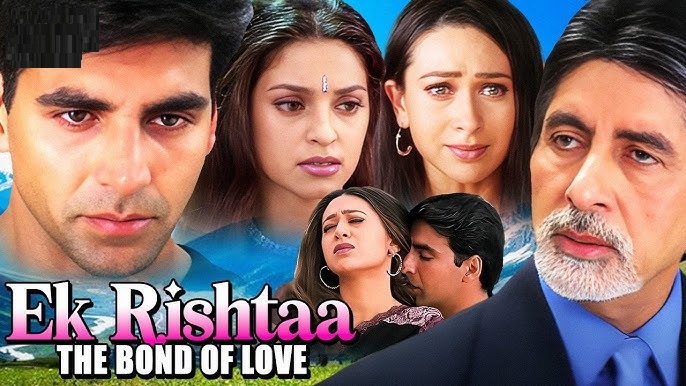
Shree Krishna International’s Ek Rishtaa The Bond Of Love is a family drama of the kind made in the seventies. The peace of a rich industrialist’s (Amitabh Bachchan’s) happy family is destroyed when a scheming young man (Mohnish Bahl) gets married to his eldest daughter (Juhi Chawla) and dupes the family of crores of rupees. Not just that, he also creates misunderstandings between the father and his son (Akshay Kumar). Ultimately, all misunderstandings are cleared and the evil son-in-law is made to repent for his horrendous acts.
The story has some appeal for the ladies and family audience, especially in small centres. But Suneel Darshan’s story has been mauled by a screenplay (Robin Bhatt and S.M. Ahale) which abounds in flaws. In fact, so poor is the screenplay that the dialogues (K.K. Singh), which are very good at places, often lose their impact.
Some glaring mistakes in the screenplay: Amitabh Bachchan’s characterisation lacks consistency. He is shown praising his mill workers in the beginning, then criticising some of them when chiding his son for picking up a fight with them, then again going with folded hands to the workers in the pre-climax. Karisma Kapoor (who plays Akshay Kumar’s wife) has negative shades for no reason at all. What’s her problem with her in-laws? Absolutely nothing! Still, she leaves her husband’s home only because he visits his parents! And Karisma is the film’s heroine! Amitabh Bachchan does not forgive Akshay Kumar even after it is proved beyond doubt that it was Mohnish Bahl who was wrong, not Akshay. He refuses to talk to Akshay. And in no time, he seems to overlook everything and forgives Akshay even though the latter has beaten up Mohnish — something which Amitabh doesn’t approve of at all. Karisma’s father objects (in vain) to his daughter’s marriage with Akshay because the latter has been disowned by his father, but when Akshay returns to his father’s home, the father-in-law, instead of rejoicing, forces Akshay to give his daughter a divorce. And Karisma doesn’t even ask her husband why he wanted a divorce! The entire divorce angle looks out of place and too heavily inspired by Raja Hindustani. After Akshay returns to his father’s house, he doesn’t do anything constructive to save the family honour although he is educated. A one-upmanship game between Amitabh and Akshay on the one hand and Mohnish on the other was the need of the story.
The film has no relief or entertaining comedy. Romance is conspicuous by its absence. Hit music is also missing. The only thing it boasts of are some good emotional scenes. There’s too much repetition and sermonising and it gets boring at many places. The first half is fair but the post-interval portion is a big letdown. Robin Bhatt and S.M. Ahale conveniently forget the information technology (IT) angle in the second half.
The action climax belongs to the mill workers. Although this could have been accepted in another film, it looks ridiculous when you have Amitabh Bachchan and Akshay Kumar as your heroes. Actually, showing Amitabh ill and inactive for a major part of the second half was not at all a good idea. Another unfortunate part is that the mother (Raakhee) gets very little scope in the family drama, something which the audience will not appreciate.
It is because of the innumerable errors in scripting such as the above that the drama looks hollow and unreal. Mohnish Bahl’s sugarsweet characterisation in the first half pre-empts the audience to think that he is a wicked guy. Consequently, the revelation that he is the villain doesn’t come as a shock.
On the plus side are some excellent emotions which draw tears from the viewers’ eyes. The father-son sentiments strike a chord in the hearts.
Amitabh Bachchan does well but is unable to excel because of a weak characterisation and a poor role in the second half. Raakhee does fairly well in the limited role she has. Akshay Kumar looks handsome and acts very well. He is especially impressive in emotional scenes. Karisma Kapoor gets limited scope and has the worst characterisation. Juhi Chawla has no worthwhile role to suit her image. Her bloated appearance (due to her real-life pregnancy) throughout the film looks bad. Mohnish Bahl is good. Simone Singh and Ashish Vidyarthi lend able support. Shakti Kapoor looks too tired to be true. He has nothing much to do. Sharat Saxena is quite good. Aloknath, Kanika Kohli, Anang Desai, Kunika, Avtar Gill, Tej Sapru, Anil Nagrath, Vishwajeet Pradhan, Malay Chakraborty and Naghma, in a special appearance, lend good support. Vrajesh Hirjee leaves a mark in the single scene in which he comes. Sunil Shetty is alright in an inconsequential friendly appearance.
Suneel Darshan’s shot-takings are mediocre but he has been able to emotionally move the viewers in several scenes. Nadeem Shravan’s music lacks a hit number. However, ‘Mohabbat ne mohabbat ko’, ‘Ek dil hi toh hai’, ‘Dil lagaane ki sazaa’ and ‘Hum khush huye’ are melodious. Song picturisations are very routine but the one shot on foreign locales is eye-filling. Akshay Kumar is getting too repetitive in his dance movements. Sameer Reddy’s cinematography is not up to the mark. Action (Abbas Ali) is exciting. Production values should have been richer. Editing is the weakest point after the faulty screenplay. In fact, judicious re-editing can take care of several drawbacks of the screenplay. The film needs to be shortened by at least 20 minutes. Re-editing can work wonders for the film.
On the whole, Ek Rishtaa The Bond Of Love has family emotions as its only trump card and will, therefore, appeal to audiences in smaller centres and in U.P. and Bihar. Considering its very high price, it would entail losses to most of its distributors.
Released on 18-5-2001 at Novelty, New Empire and 21 other cinemas of Bombay thru Devgan Entertainment & Software Ltd. Publicity: excellent (quantitatively but not qualitatively). Opening: very good. …….Also released all over. Opening was very good in U.P. but below the mark in Delhi, C.P. Berar, C.I. and Rajasthan especially.
MULTIPLEX OPENS AT BOISAR
A new 2-screen cinema complex, K.T. Multivision, opened yesterday (18th May) at Boisar (Thane district) with the screening of Ek Rishtaa The Bond Of Love. The inauguration ceremony of the multiplex was held on 17th. While local MLA Hitendra Thakur formally inaugurated the cinema, MLA Krishna Ghoda switched on the projector, and Hasmukh Parekh turned on the lights. The 2 screens have seating capacities of 540 and 450 respectively. At present, only the first screen is functioning. Naaz distributors have been invited to celebrate the opening at a party today (19th May) at K.T. Hill Resorts, Virar.
K.T. Multivision is controlled by Pradeep Bhaiyya of S.P. Enterprises, Bombay. It is owned by Hasmukh Shah who also owns K.T. Vision cinema at Vasai (Thane).
ASHUTOSH RANA, RENUKA SHAHANE TO WED
Actor Ashutosh Rana will tie the knot with actress Renuka Shahane on 25th May at the former’s native place, Bandakapur in Madhya Pradesh.
CINEMA DEADLOCK CONTINUES IN CALCUTTA
The cinema employees’ strike in West Bengal entered its 58th day today (19th May). A fresh round of talks is likely to begin and an early settlement is in sight.
CCCA AGM, ELECTIONS IN SEPTEMBER IN JAIPUR
The annual general meeting and elections of the Central Circuit Cine Association (CCCA) will be held on September 25 and 26 in Jaipur. This was decided at the meeting of its executive committee, held on 15th May in Bombay.
The meeting also decided on the printing of a new book of rules of the Association. Several rules have been amended over the years and the new book will be the updated version.
FCAT CLEARS ‘BAWANDAR’
The Film Certification Appellate Tribunal on 13th May cleared Jagmohan Mundhra’s Bawandar (Sandstorm) with just one cut in the dialogue. The film has been awarded ‘A’ certificate.
Jag Mundhra had appealed to the FCAT nearly six months ago after disagreeing with five cuts ordered by the CBFC. All but one cuts ordered by the CBFC have been waived by the Tribunal.
WORKERS’ CESS HIKED
The Union labour ministry of the Cenral government has announced a hike in cine workers’ welfare cess on feature films with effect from 20th April. The cess for Hindi films has been increased from Rs. 10,000 to Rs. 20,000. For English films made in India, it is a big leap, from Rs. 2,000 to Rs. 20,000. While Marathi, Gujarati and Bengali film producers will now have to cough up Rs. 7,000 more than the previous amount of Rs. 3,000, producers of Tamil, Telugu, Malayalam and Kannada films will have to pay double the cess paid earlier — that is, Rs. 10,000 in place of Rs. 5,000. Thus, producers of Hindi and English (Indian) films have to pay Rs. 20,000 and those of all other language feature films will have to pay Rs. 10,000.
It must be mentioned here that imported films are exempted from the cess as they don’t come under the jurisdiction of the Cine Workers Welfare Cess Act.
FFI’S S.O.S. TO I & B MINISTER
Film Federation of India president Shakti Samanta this week rushed a fax to Union information & broadcasting minister Sushma Swaraj to lodge a strong protest against the notification issued by the union labour ministry to enhance the rates of cine workers’ welfare cess. The fax brings to the minister’s notice that in spite of government’s assurance to not increase the rates beyond Rs. 2,000 per film, the government had earlier increased the rates of cess to Rs. 10,000 per Hindi film and had also substantially increased it in respect of regional films.
As per the notification of 20th April, 2001, Hindi and English film producers will now be required to pay Rs. 20,000 per film and regional film producers will have to pay Rs. 10,000 per film. The FFI president has said that the FFI was also equally concerned about the welfare of cine workers, but there were various trusts which looked after their welfare. This additional financial burden, he added, would snowball producers’ hardships which they had been facing from all fronts.
RBI FINALISES NORMS FOR FILM FINANCING
Banks To Lend Upto 50% ✪ Maximum Loan Amount Rs. 5 Crore
The final bureaucratic hurdle in making available institutional finance for films has been removed now that the Reserve Bank of India has officially issued a directive specifying eligibility and other criteria for funding film production. The RBI has declared that banks can finance those films which have a total production cost not exceeding Rs. 10 crore. The apex bank stipulates that the loans shall not exceed 50% of the total production cost. In other words, the maximum institutional funding available to films will be Rs. 5 crore. However, the upper limit would be available only to “deserving cases” — where the lending institution is comfortable with the venture as well as the background of the producer — and under normal circumstances, a loan to the tune of 35-40% may be extended.
Loans would be available to both, corporate and non-corporate entities, provided the eligibility criteria are met. The borrower will need to bring in 25% of the production cost as promoter’s contribution, besides drawing up contracts for advances from distributors amounting to another 35-40%. The balance amount of 35-40% can be met through a bank loan. The RBI, however, stipulates that the loans may be disbursed only after the promoter has brought in his contribution. According to the RBI norms, once sanctioned, the loan will be disbursed only after the producer’s contribution and distributors’ advance payments are utilised. There is no objection, however, to banks disbursing the loan side by side with payments by the distributors on a proportionate basis, provided such an arrangement is worked out at the start of the project.
As security, the RBI insists that the lending institution obtain the lab letter stating it to be the negative rights-holder of the film. As additional security, the RBI has said, the bank must take other items such as music, audio or video rights, internet rights, overseas rights etc. The producer will have to assign all agreements and IPR in favour of the lending institution which will have the right to determine the valuation of the IPR. A Trust and Retention Account for all capital and revenue inflows and outflows will be maintained between the producer and the bank. The receivables on IPR will be credited to the TRA on which the bank will have the first charge. Over and above these, the lender bank will have the first hypothecation charge on all the tangible assets under the project.
The RBI restriction of the maximum loan amount of Rs. 5 crore will not apply to IDBI-funded films. The Industrial Development Bank of India will lend even more than Rs. 5 crore per film, a top source at the IDBI told Film Information.
YOU ASKED IT
Why did yesterday’s Ek Rishtaa not take even a reasonably good opening in several circuits? Is it because Amitabh’s KBC is not as popular as it used to be some months back? Is the unexciting opening bad news for the industry?
– EK RISHTAA took a dull opening because of several reasons — it’s a family film, and family films generally do not take bumper opening; its music is not hit; its publicity did not create excitement among viewers. The decline in popularity of KBC has very little to do with the opening of EK RISHTAA. The dull opening is bad news for the industry because the film was sold at high prices and one didn’t expect an Amitabh-starrer to open to dull houses. By the way, the film opened to excellent houses in U.P.
Have you heard the music of Subhash Ghai’s Yaadein? How is it?
– It is the music of the year! Hold your horses till 30th May when the music will be released (in Delhi).
What do you think of Jeetendra’s son, Tusshar?
– Kareena Kapoor was so overpowering in the promotional trailers of MUJHE KUCCH KEHNA HAI that the audience didn’t quite care for Tusshar in the beginning. But the audience opinion is now definitely changing. People are liking Tusshar; he is growing on them. The boy’s honesty and sincerity are reflected on his face and even that can be enough sometimes for a debut-making hero.
3-E
Education-Entertainment-Enlightenment
Boom Time?
Anyone who will read this will think, exhibition trade is booming in Bombay. More than 20 new screens are very likely to come up in the city in the next one year or so. While K.T. Multivision at Boisar (Thane) opened the first of its two halls yesterday (18th May), the rest of the screens are all going to come up within Bombay city limits. It may be recalled that Movie Star at Goregaon already opened last month. 4-screen Moviemax will begin functioning with the opening of its first two screens on 22nd June. A multiplex will come up in Tardeo where Ganga-Jamuna cinemas stand today. Moviemax is owned by Gul Achra. Kasturba, Malad is revamped and is expected to open soon. Two screens are coming up behind the IMAX hall at Wadala. Construction of Roxy cinema at Opera House is also complete and so of Apsara at Lamington Road. A 2-screen cineplex is being constructed at Jogeshwari where Ram Shyam cinemas once stood. Then, there is another multiplex which is also under construction at Jogeshwari. There are a couple of multiplexes under construction at Andheri. Several other cinema screens are currently in the pipeline and will come up in due course.
Straight From The Dil
“Hello! May I please speak with Farhan Akhtar?”
“Who is that?”, asked the debut-making director’s mother, writer Honey Irani.
“I am Sunil,” came the voice from the other end. The telephone conversation continued with the caller saying, “I’ve seen his design of Dil Chahta Hai in the trade papers (carried by Film Information last Saturday) and I think, it is wonderful. So, I’d like to congratulate Farhan and the film’s producer, Ritesh Sidhwani. I also want a role in Farhan’s next film.”
By now, Honey Irani thought, she knew the voice on the other end. “Is it Sunil Dutt Sahab?”, she asked.
“Yes, I’m Sunil Dutt,” replied the actor, continuing with his praise for the colourful publicity design.
And Sunil Dutt and Honey Irani had a hearty laugh thereafter.
But for the young Ritesh and Farhan, the debut-making producer and director respectively of Dil Chahta Hai, the words of encouragement from a man of the stature of Sunil Dutt was no light matter. “It’s a compliment, we’ll always cherish,” remarked Farhan and Ritesh.
Will They Or Won’t They?
Romours are rife in the industry that Gadar Ek Prem Katha and Lagaan will never make it on the same day, June 15. While producers of both the films insist that they will come on the scheduled date, the rest of the trade is not sure. Though it doesn’t seem a cent per cent possibility that both the films will come on 15th June, if they do, it would be a case of history repeating itself after 11 years. For, Dil, starring Aamir Khan, and Ghayal, starring Sunny Deol, had also released on the same day — 22nd June — in 1990. The two forthcoming releases also star Aamir and Sunny. While in 1990, Ghayal was Sunny’s home production, this year Lagaan is Aamir’s home production. And note the small difference of just one week: it was June 22 then and would be June 15 now!
Cordially Invited
Aamir Khan has once again sent out invitations to his all-India distributors to come to Bombay. Occasion: the first trial show of the final copy of Lagaan. Needless to add, his distributors will arrive in Bombay next week to see the film on 27th May.
Insured, Therefore Secured
Like Lagaan, another film which has been shot with sync sound is Farhan Akhtar’s Dil Chahta Hai. And like Lagaan, this one, too, was completed in one single schedule — from 1st August, 2000 to December 2000. Only thing, unlike Lagaan, the schedule took place at more than one place — Bombay, Goa and Australia. Farhan’s film was insured, and producer Ritesh Sidhwani is shortly due to get his claim of Rs. 11 lakh which was the loss he suffered because of bad weather in Sydney (Australia). The days’ shooting had to be cancelled due to inclement weather.
By the way, if Farhan Akhtar is the son of Javed Akhtar and Honey Irani, Ritesh Sidhwani, too, has film connections. He is the grandson of Shanker B.C. But the guy’s family business is manufacturing pressure cookers — the Marlex brand.
Of Expecting & Expectations
All through the making of Ek Rishtaa The Bond Of Love, Juhi Chawla was expecting her first baby in real life. The film’s other heroine, Karisma Kapoor, is shown in it as an expectant mother. With both the heroines expecting — one in real life and the other for the camera — it is not surprising that there were great expectations from the film.